
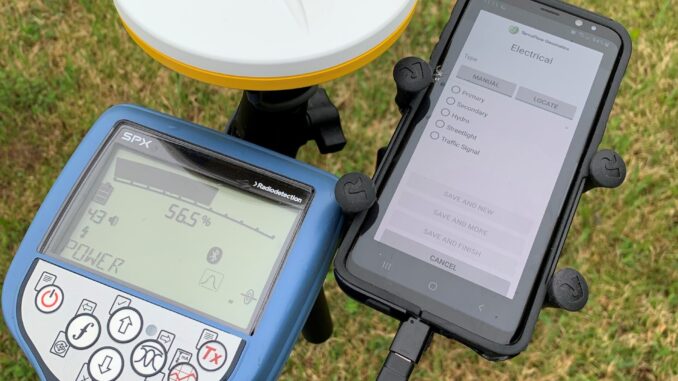
The industry standard for locating underground utilities is a manual process involving the use of an electromagnetic (EM) wand to detect underground cables and pipes. The detected location is typically recorded by painting or otherwise marking the ground. I recently had the opportunity to chat with Kieren Tinning of Terraflow Geomatics, whose Utility Mapper product adds significant value to an industry standard underground locating tool by enabling the digital capture of the location of underground pipes and cables detected with an EM wand and the generation of 3D data for integration with CAD and GIS applications. On a recent depth of cover survey of a thousand kilometre gas transmission line it was found that because Utility Mapper automated most of the data capture and geoprocessing staff time was reduced by 42 %.
Background
In the U.S., underground utilities are a major cause of highway construction delays. Knowing where things are underground has become important enough that in several countries around the world – France, the Netherlands, Singapore, and the U,K., initiatives are already underway to create national digital twins of above and below-ground infrastructure. Recently there have been important technical advances in several areas that are have brought the feasibility of cost-effective mapping of underground infrastructure at the municipal, regional, and national level within reach. One of these is to digitally capture the location of underground utilities detected using remote sensing technologies such as electromagnetic (EM) and ground penetrating radar (GPR).
Remote-sensing tools for underground utility detection have been available for decades. Electromagnetic (EM) detection wands can be used in several different ways. Passively detecting utilities with EM is used for services that emit naturally emit a frequency such as electrical cables (50 or 60 Hz). Another approach is to physically connect a signal generator to a service. This method requires physical access to the service, usually by way of a surface feature that is connected to the service such as a valve. Another technique is to introduce an active signal into a line through electromagnetic induction (EMI). The advantages of EM detection are that it is simple to use and effective for detecting conductive underground infrastructure. Ground penetrating radar is an alternative technique for underground detection, but in some soil types such as aggregate and clay GPR does not perform well. Without supplementary information GPR does not identify the type of utility (gas, water, electric, fiber optic). In addition GPR requires an expert, typically a trained geophysicist, to interpret the scans. As a result EM detection has become the industry standard.
One of the serious deficiencies of EM is that most wands do not permit the digital capture of the location of detected underground objects. Typically EM detection is a manual process in which the location of underground infrastructure is recorded by painting or otherwise marking the ground. Terraflow Geomatics’ Utility Mapper changes this by enabling the digital capture of the location of underground pipes and cables detected with an EM wand. Using together RTK devices such as Trimble’s Catalyst enables highly accurate location information to be simultaneously captured. Terraflow’s Data Engine automates the synchronization of this data back to the desktop for integration with AutoCAD, Microstation, ArcGIS and other applications.
Customer experience
PVS Contractors performs large scale depth of cover and other locate services for pipeline operators. Prior to acquiring Utility Mapper, calculating the depth of cover was a manual process in which the depth was recorded manually and correlated with the GPS location. For a survey of a thousand kilometre pipeline, this typically would require eight full time staff for eight months, plus an admin staff member and supervisor for several days per week to check and confirm the data. For a recent large scale depth of cover survey for a gas transmission pipeline running from Windsor to Montreal, about a thousand kilometres, PVS deployed Utility Mapper together with Vivax-Metrotech electromagnetic locators and Trimble Catalyst, which enabled survey-grade positioning with an Android smartphone. Utility Mapper automated most of the capture and processing – integrating the GPS and electromagnetic locate information and wirelessly synchronizing the location and depth of cover information directly to ESRI’s ArcGIS Online for quality assurance and quality control. This reduced staffing requirements from 64 to 47 person-months. Furthermore, the Utility Mapper solution reduced the data review time for a supervisor (prior to sending the data to the client) to one hour per week .
Summary
Terraflow’s Utility Mapper is an important advancement. It adds significant value to the industry standard EM underground utility locating tool by enabling the cost-effective digital capture of 3D location data captured by EM devices and RTK GNSS and streaming this data to users’ CAD and GIS applications.

Be the first to comment