
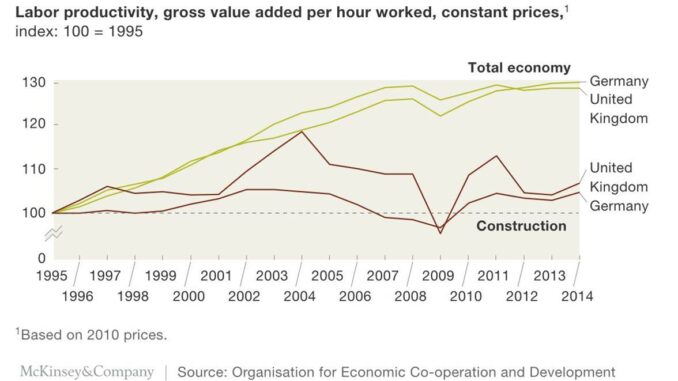
The CG/LA Infrastructure Leadership Forum in Montreal has provided a fascinating glimpse into what is happening around the world in infrastructure from a technology, financing, and business model perspective. From 50,000 feet the big item is that the construction industry may be at the tipping point with respect to digitization. Just about every speaker referred to the lack of progress on productivity in the construction industry.
But Wipro, Booz Allen Hamilton, Aconex, Jacobs, and other vendors believe that the construction industry is poised for the digitization revolution. Vendors are investing heavily in technology including artificial intelligence, digital modeling such as BIM and full lifecycle BIM or BIM++ as one speaker referred to it, machine learning, drones, neural networks, virtual reality, big data, analytics, automation and hyperautomation.
$10 trillion is spent on construction goods and services every year. But whereas the average worker adds $37 of value for every hour worked, a construction worker adds only $25 per hour worked. Construction productivity has stagnated over the past decades in many of the world’s advanced economies.
McKinsey Global Institute’s Industry Digitization Index combines 27 indicators to measure the digital assets, digital usage, and digital workers in each sector. Construction is among the least digitized sectors in the world. According to this index construction comes second to last in the United States and last in Europe. Globally, labour-productivity growth in construction has averaged only 1 percent a year over the past two decades, compared with growth of 2.8 percent for the total world economy. In the Unites States labour productivity in construction has actually declined. 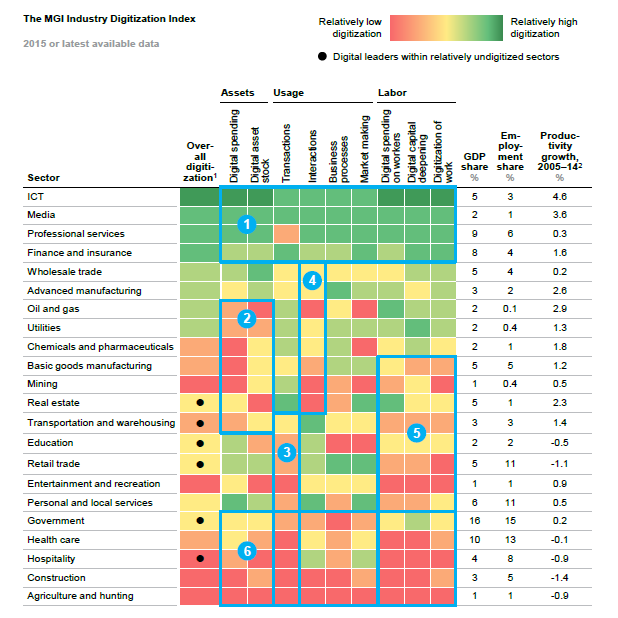
Construction productivity needs to be improved if we are going to attract the private sources of funding that are required to address the world’s infrastructure gap. McKinsey estimates that if construction-sector productivity were to catch up with that of the total economy this would increase the sector’s value add by about $1.6 trillion which would add 2 percent to the global economy.
Globally the sector is extensively regulated, highly dependent on public-sector demand and highly fragmented. It ranks among the lowest industries with respect to investment in R&D. The sector splits broadly in two:
- large-scale players engaged in heavy construction such as civil and industrial work and large-scale housing, and
- mom and pop firms engaged in fragmented specialized trades such as mechanical, electrical, and plumbing work that act as subcontractors or work on smaller projects like refurbishing single-family housing.
According to McKinsey the first group tends to have 20 to 40 percent higher productivity than the second.
Digitization by itself is not going to solve the productivity gap in construction but it could at least play an important role or it could even be disruptive as it has been in other industries. Innovative firms have increased productivity by 50 to 60 percent by infusing digital technology, new materials, and advanced automation, reskilling the workforce, changing business practices and pushing government to change regulations.
Digital America: A tale of the haves and have-mores, McKinsey Global Institute, December 2015
Reinventing construction through a productivity revolution, McKinsey Global Institute February 2017

Be the first to comment