

Stephen Berberich, President and Chief Executive Officer of the California Independent System Operator (CaISO), gave one of the keynotes at Distributech 2013 in which he provided insight into what 33% renewables will likely mean for ISOs, the folks that are responsible for managing electricity flows and “keeping the lights on”.
By way of background CaISO manages the flow of electricity across the high-voltage, long-distance transmission power lines that make up 80 percent of California’s power grid. California ISO is a nonprofit corporation that manages the competitive wholesale electricity market , balancing supply and demand, in California. It also manages access to 25,865 circuit-miles of transmission power lines. Every five minutes CaISO forecasts electrical demand (which you can see on the CaISO web site) and dispatches the lowest cost power plant unit to meet demand while ensuring enough transmission capacity is available to deliver the power.
CaISO’ grid has a peak capacity of 50’000 MW, manages 25,865 miles of transmission lines, and manages an electric power markert comprised of 2’000 utility scale generators. California produces about 70% of the power it uses. It imports the rest from the Pacific Northwest (10%) and the Southwest (20%).
Impact of renewables on the balance between load and generation
Historically CaISO has been able to predict load and generation and balance the two with the fleet of power generators it manages the wholesale market for. Intermittent renewable energy sourse, whoch will provide 33% of California’s power by 2020 is changing this. 33% renewables by 2020 means that at times intermittent sources may provide up to 50-60% of load. Also renewables have special effects. For example, wind turbines are
designed to cut out when the velocity exceeds a maximum threshold. When this happens the impact on the grid can be dramatic. Intermiitent energy sources such as soalr and wind have made reliable meteorological forecasting critical to CaISO, becaue they need accurate forecasting to be able to predict in advance changes in solar and wind generation.
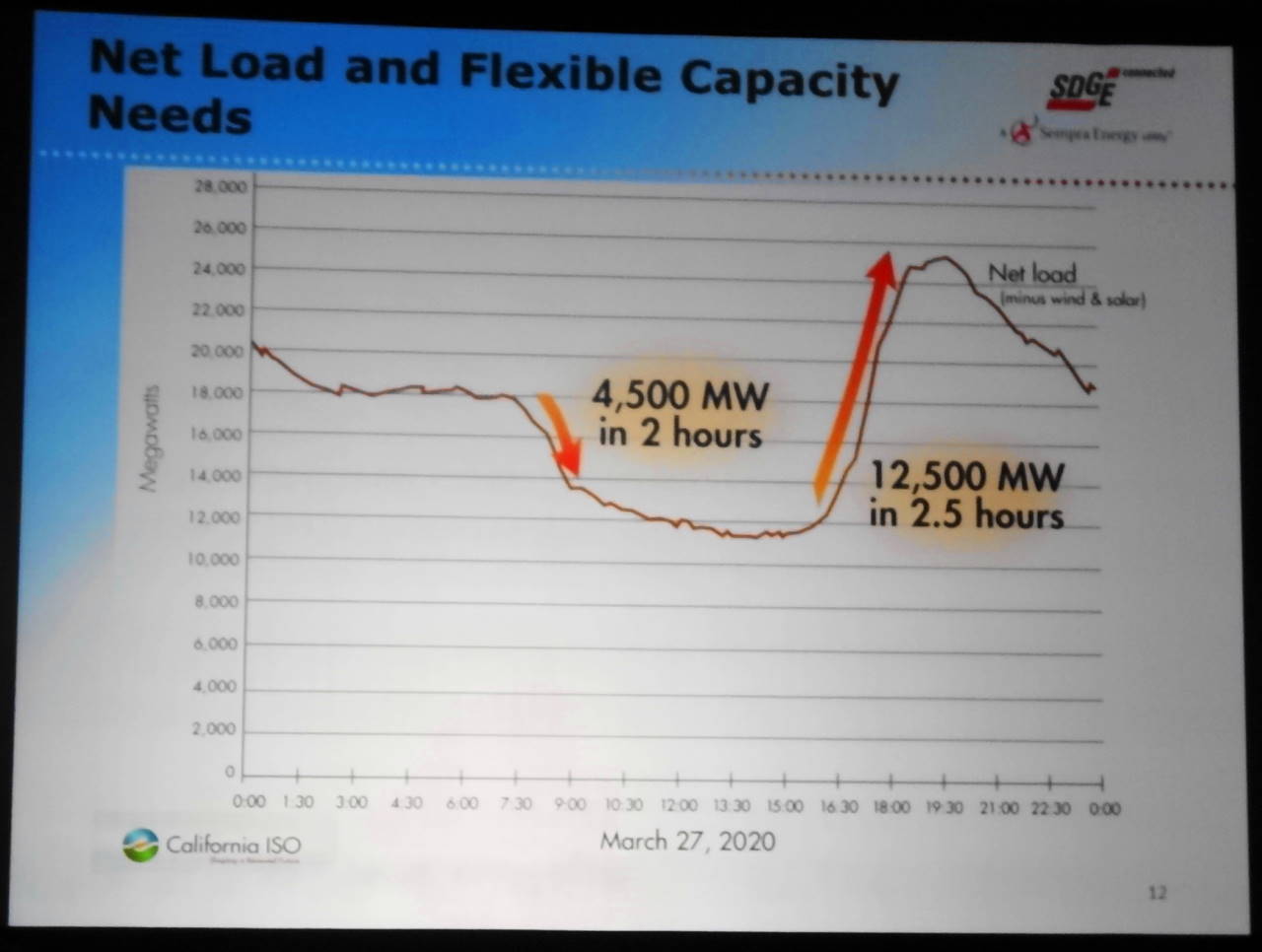 CaISO has experienced in some local networks with a high proportion of wind and solar PV ramps of up to 12’500 MW in 2.5 hrs. The only power generation that is capable of ramping up dispatchable power this rapidly is large-scale hydroelectric (16% of California’s instate generation capacity) and natural gas turbines (62% of total capacity). The California natural gas distribution system was not designed for ramps of this magnitude and will require major investment to be able support this level of renewables. California is developing capacity like some Eastern ISO’s to rapidly ramp. This in turn will raise electric power rates.
In addition small scale renewables such as rooftop PV is changing how electricity is marketed and sold, because the consumer is often buying less power from the utility.
Plug-in electric vehicles
There are 35 million cars in California and it is estimated that nearly 30’000 of these are electric lug-in vehicles. CaISO estimates that by 2020 there could be as many as a million PEVs in California. A major driver is the new Federal CAFE standard of 54.5 miles per gallon in all new vehicles by 2025, because it may be that PEVs are the only practical way to achieve this.
To manage the increased demand arising frm PEVs, there will need to be incentive rates to encourage off-peak charging as SDG&E has implemented, for example. The way electric vehicles are taxed will have to change from the current volumetric gasoline tax. One idea for addressing the challenges of consumer power generation and plug-in electric vehicles that Mr. Berberich mentioned is if the solar PV arrays and the charging stations were owned by the utility. To me this is reminiscent of the early days of telephone deregulation when the telephone companies unsuccessfuly attempted to maintain a monopoly on telephone handsets.
These challenges are going to impact all utilities
Along with other speakers, Mr Berberich reiterated that what is happening in California is going to happen to other utilities as coal-fired plants are shut down under the EPA’s latest regulations. California is a microcosm of what is going to happen across the country, according to Mr. Berberich, and the time is not far off. The speed with which it happens will be dictated by national policy. In his inauguration speech President Obama made it clear that climate change remediation will be a natlonal priority so it could happen faster than many expected.
Be the first to comment