
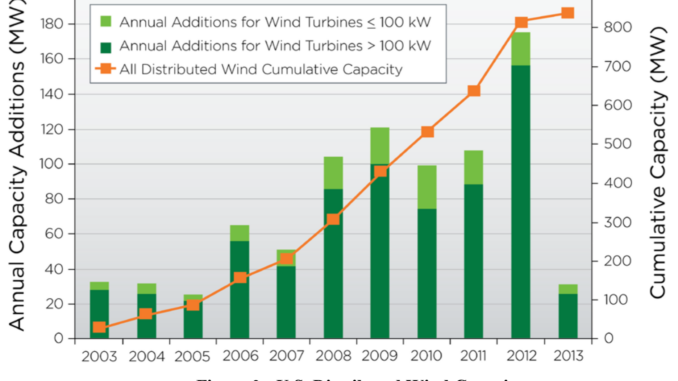
The total wind capacity in the U.S. at the end of 2013 was 61 GW which provided about 4.5 % of total U.S. demand. A large portion of all wind turbines installed in the United States generate power for on-site or local use. In 2013 distributed wind installations accounted for more than 80 percent of all wind turbines installed in the United States. However, distributed wind capacity is a small proportion of the total U.S. wind capacity. Reducing utility bills and hedging against rising electricity rates are common reasons for installing distributed wind. Some utilities implement net metering which pays the distributed wind owner for excess generated energy that is returned to the grid.
The U.S. Department of Energy (DoE) has just released an interesting report on distributed wind energy in the U.S. Distributed wind is defined by the wind project’s location relative to end-use, rather than on turbine or project size. Distributed wind power is used at or near where it is generated, as opposed to wind power from wholesale generation, where power is sent to consumers via transmission lines and substations. The distributed wind market includes wind turbines from very large to small domestic turbines. DoE breaks the market into two segments: “small wind” with turbines 100 kW or less and wind turbines greater than 100 kW.
In 2013, 2700 new turbines were added totalling 30.4 megawatts (MW). At the end of 2013 the total installed distributed wind capacity in the U.S. included 72,000 wind turbines totaling 842 MW. In 2013 40% of the new installations were residential, followed by 26% agricultural, 20% industrial and commercial, and 14% government and institutional. Off-grid small wind turbines account for the bulk of wind turbine units deployed in U.S. distributed wind applications.
DoE has estimated the levelized cost of distributed wind energy. The levelized cost of energy (LCOE) is used to compare the cost of energy across different technologies. For wind turbins the cost of the turbins and their capacity factor, which is dependent on the available wind resources, siting, and tower height, are the major factors determining a wind project’s LCOE. Typically the higher the capacity factor, the lower the LCOE. The capacity-weighted average capacity factor for a selected group of distributed wind projects installed between 2006-2013 analyzed by DoE is 15%, and their capacity-weighted average LCOE is 14¢/kWh. This can be compared to utility-scale natural gas 6-7¢/kWh, utility-scale wind at 8¢/kWh, or solar PV at 13¢/kWh.

Be the first to comment