
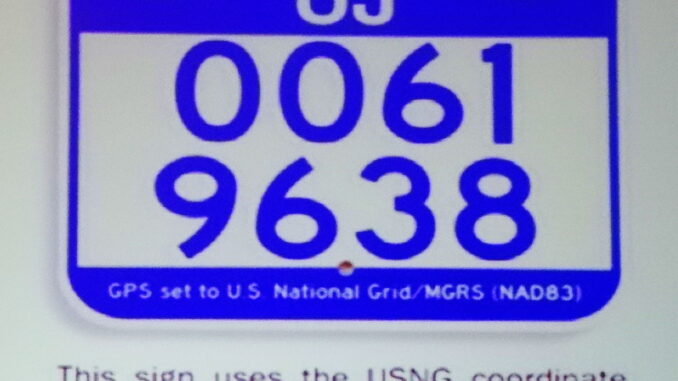
The Federal Geographic Data Committee in the United States developed the U.S. National Grid (USNG) to provide an unambiguous way to describe locations for people operating either in an area away from the established road network or in an area impacted by a natural disaster where road signs have been destroyed. It is an alphanumeric system that is widely used by first responders in the United States. It is not intended to replace the street number and street name system but to complement it.
A similar system is being adopted by the Municipality of Dubai. The system was described by Abdul Hakim Abdul Karim Malik, Director of GIS in the Dubai Municipal Government, at the Middle East Geospatial Forum in Dubai. The Dubai system uses numeric characters only, but otherwise is similar to the USNG. It is intended to be used by ordinary citizens as well as emergency services personnel.
One of the motivation for using this system is that there are two hundred nationalities speaking 100 languages living in Dubai and the pronunciation of Arabic street names by people with a Russian, Pakistani, Indian, English, American or other background is often confusing.
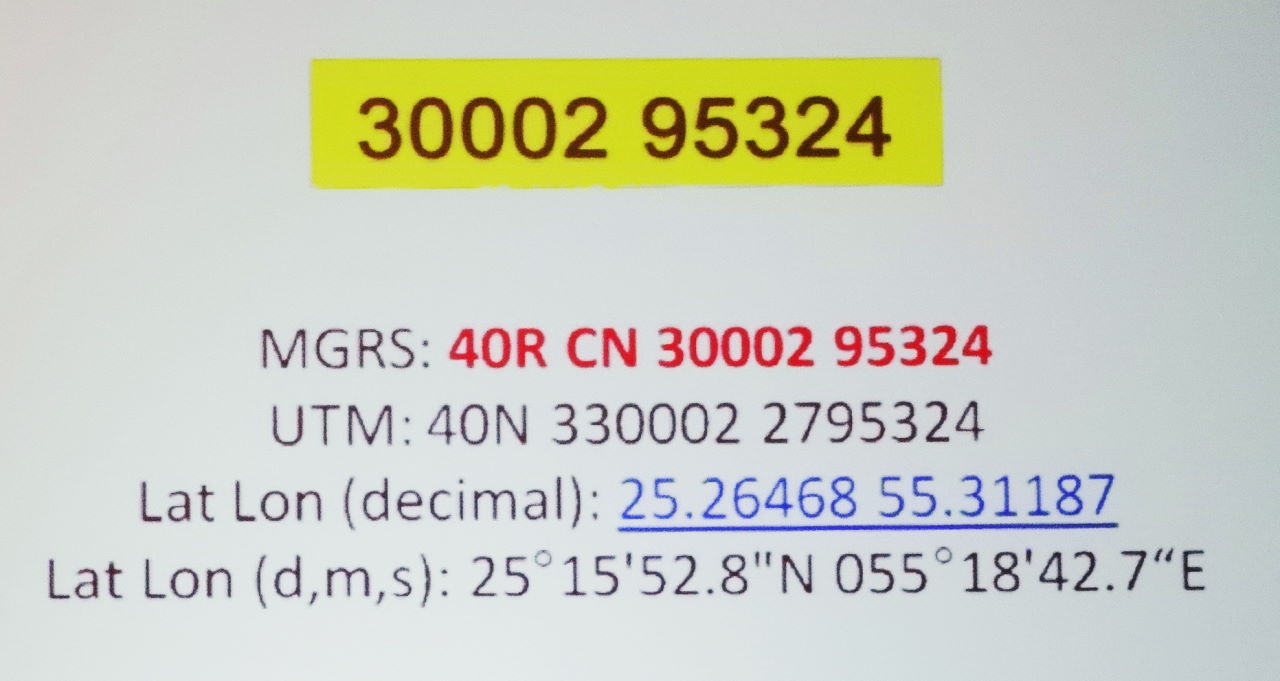 Like the USNG the Dubai grid reference system is basically a truncated UTM (universal tranverse mercator) system. The Dubai scheme uses a 10 digit number to geolocate buildings (actually entrances to buildings) to within a meter. For example the Dubai Municipal Government’s main building entrance is at 30002 95324.
An application called Makani supporting the Dubai grid addressing scheme has been developed for iOS and Android and will be available on iTunes and Google Play in February. It is also likely that Dubai grid 10 digit references will be supported by Google Map.

Be the first to comment