

U.S. NIST study
In 2004 in a remarkable study the U.S. National Institute of Standards and Technology (NIST) attempted to identify and estimate the efficiency losses in the U.S. capital facilities industry resulting from inadequate interoperability. The NIST study focussed on interoperability problems attributed to the highly fragmented nature of the industry, the industry’s continued paperbased business practices, a lack of standardization, and inconsistent technology adoption among stakeholders.
It concluded that inadequate interoperability cost the U.S. capital facilities industry $15.8 billion in annually in 2002, but qualified the conclusion by saying that this is likely a conservative figure because there were additional significant inefficiency and lost opportunity costs associated with interoperability problems that were beyond the scope of NIST analysis.
Standards in Australia
In 2006 Centre for International Economics in Australia conducted a study for Standards Australia that attempted to quantify the economic impact of standardization on the Australian economy.
In Australia in 2007 there were about 6 800 standards that are the responsibility of Standards Australia. They include electrical and water industry technical standards, IT standards, management standards, and health and safety standards. The economic benefits of standards that were considered include increasing trade, providing a basis for innovation and knowledge dissemination, reducing costs of production, increasing productivity, and assisting with risk management.
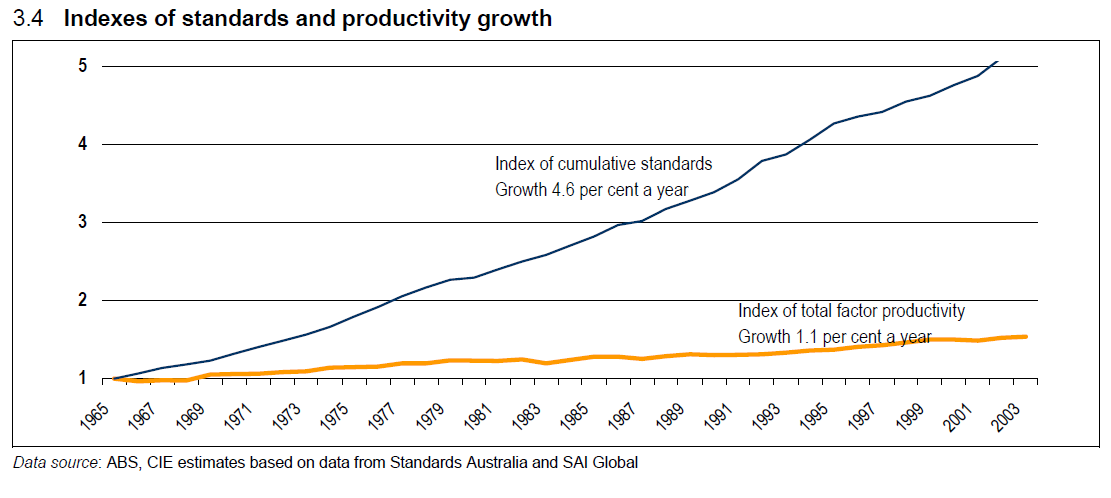 Economic benefit of standards on the national economy
Taking a statistical, macroeconomic approach the study quantified the correlation between the stock of standards and national productivity and found that a 1 % increase in the stock of standards is associated with a 0.17 % increase in productivity.
The study also looked at the impact of standards on particular industries. To do this the authors had to imagine what might have been done if there were no standards in the particular industry.
Economic benefits of standards in the mining industry
In the Australian mining industry it found that sampling standards increase accuracy and precision of mineral content of ores and concentrates and concluded that sampling standards increase the value of trade by $24 million to $100 million per year.
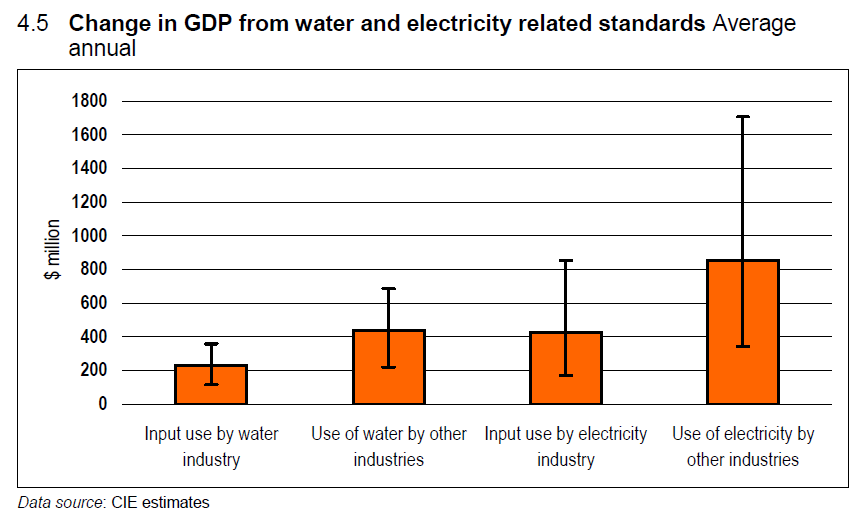 Economic benefits of standards in water and electric power industry
In the water and electrical industries standards increase the effectiveness of the water and electricity grids in using inputs and in delivering water and electricity to consumers. The economic benefit was estimated to be $1.9 billion per year.

Be the first to comment