
The primary objective of interventions relating to underground infrastructure is reducing damage to underground infrastructure during excavation. Different jurisdictions have implemented different schemes for reducing damage to underground infrastructure during construction. It is a well-known adage that if you can’t measure it you can’t improve it. Collecting information about incidents of underground damage and compiling the information to produce statistics is essential in assessing the effectiveness of systems in reducing underground damage.
Background
In North America the Common Ground Alliance (CGA) has collected voluntarily submitted incident reports since 2003. In Ontario the Ontario Regional Common Ground Alliance (ORCGA) has been collecting voluntarily submitted data on underground damage incidents since 2005. In the Netherlands network operators are required to report all incidents of damage to their infrastructure to the KLIC one call system. In France DT-DICT regulations make reporting incidents of underground damage during construction mandatory for network operators.
In contrast in the UK there is relatively little information available about incidents of damage to underground infrastructure during excavation in spite of the efforts of the Utility Strike Avoidance Group (USAG), LineSearchBeforeYouDig (LSBUD), and Anglian Water Services (DIGDAT). This makes it difficult to assess the effectiveness of measures for reducing underground utility damage.
In North America, one call systems have been mandated at the state and province level that require network operators to visit the proposed construction site to physically locate their underground infrastructure and mark the ground. Unfortunately this information is rarely captured and shared. In the Netherlands an on-line one call system has been implemented that provides digital maps of underground utilities to excavators within 24 hours. A disadvantage of this system is that it relies on network operators’ records which in many jurisdictions are notoriously unreliable. In France the DT DICT system mandates a process that requires project manager’s knowing the location of critical underground utilities to 40 cm at the beginning of a construction project. An important feature of the DT DICT process is that it results in improved location quality of network operators’ records.
United States
In most jurisdiction in North America a request for information about underground utilities requires that each utility (or their contractor) visit the site to physically determine the location of their underground equipment in the proposed excavation area and to mark the ground, typically with paint or flags. In most jurisdictions it is not required that this information be captured digitally.
The advantage of the North American one call system is that it does not rely directly on network operators’ records which are often inaccurate, out of date or simply missing. A disadvantage is that it typically does not result in improved quality of network operators’ records. Furthermore, it is expensive for network operators who must support the one call centres and maintain fleets (or hire contractors) for locate operations.
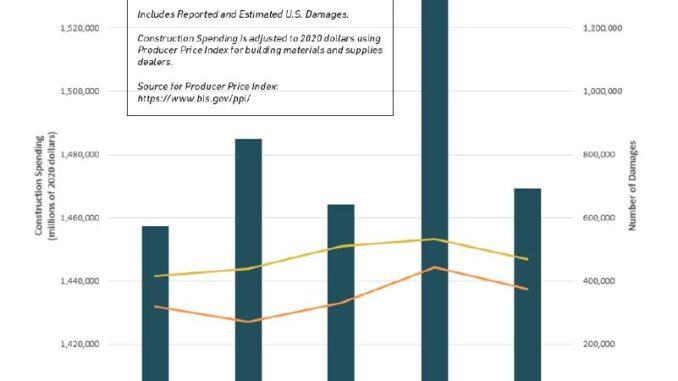
The CGA collects voluntarily submitted reports of underground utility damage, compiles them and releases an annual DIRT report. A key metric relied on by the CGA to track temporal trends is the ratio of damages to construction spending for consistently reporting sites. The overall trend in this metric when prorated to construction activity has been upward since 2015.
Ontario
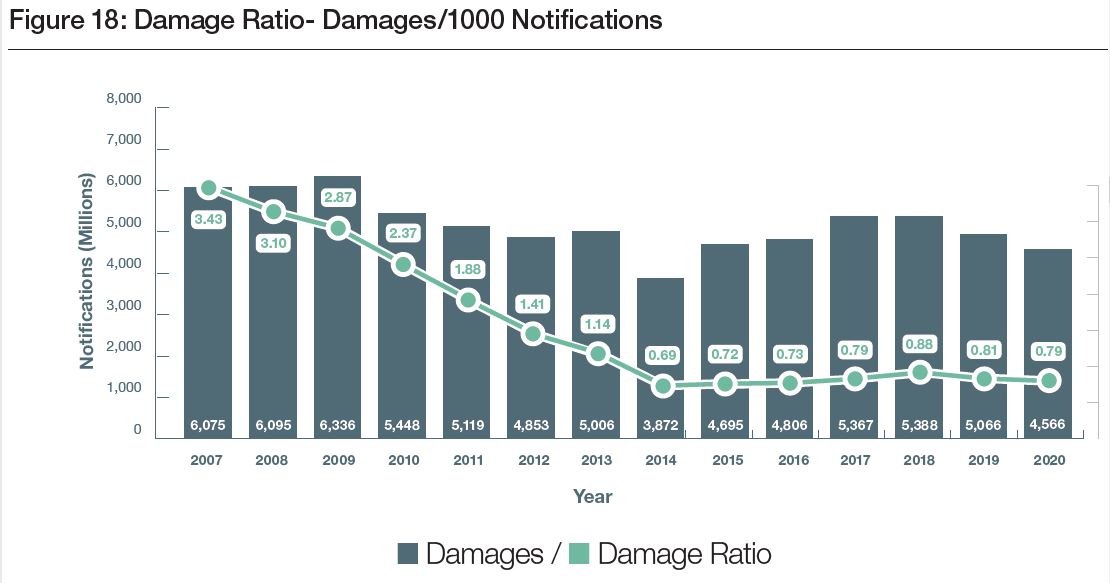
The ORCGA releases an annual DIRT report for Ontario. In Ontario industry practice is to measure damage prevention performance by the damage ratio metric which represents the number of damage incidents per thousand notifications. (Notifications are tickets transmitted from Ontario One Call to underground utility network owners in response to a request from an excavator.) Since 2014 the damage ratio has been very nearly constant.
Netherlands
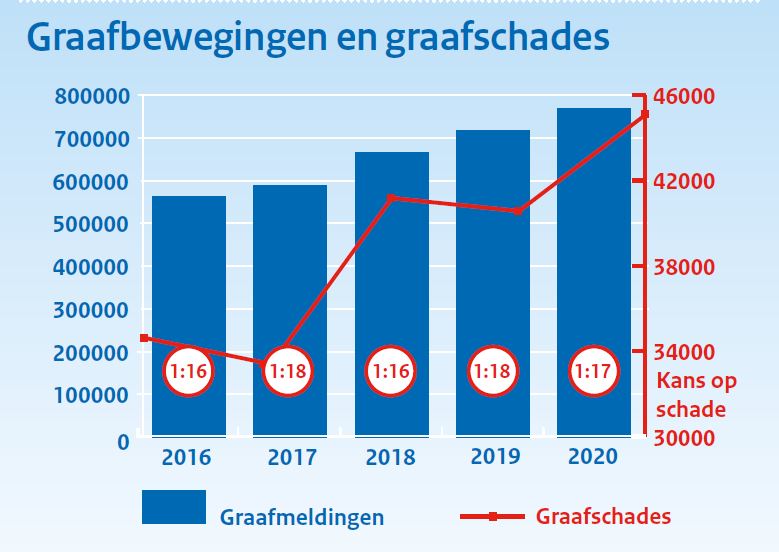
In the Netherlands, reporting incidents of underground damage is mandatory and the Dutch Telecom Agency (Agentschap Telecom) issues an annual report with statistics on underground utility damage in the Netherlands. The key metric used in the report is the ratio of the number of incidents of underground utility damage to the number of request received from excavators. The statistics show that this ratio has remained nearly constant since 2015.
France
At the beginning of a construction project, the project manager must submit a Déclaration de projet de Travaux (DT) or works project declaration. The DT is forwarded to each network operator with equipment in or near the proposed construction site. Network operators can respond in two ways. They can provide maps of their underground infrastructure accurate to 40 cm. If they are not able to provide 40 cm compliant maps, they can request that the project manager contract a locate service provider to conduct locate operations to ensure 40 cm compliance for all non-compliant underground utility facilities. The cost of the locate operations is borne by the network operator and the results of the locate operations are provided to the network operator to update their records. This process ensures that early in every construction project, the location of underground infrastructure at the project site is known to 40 cm or better.
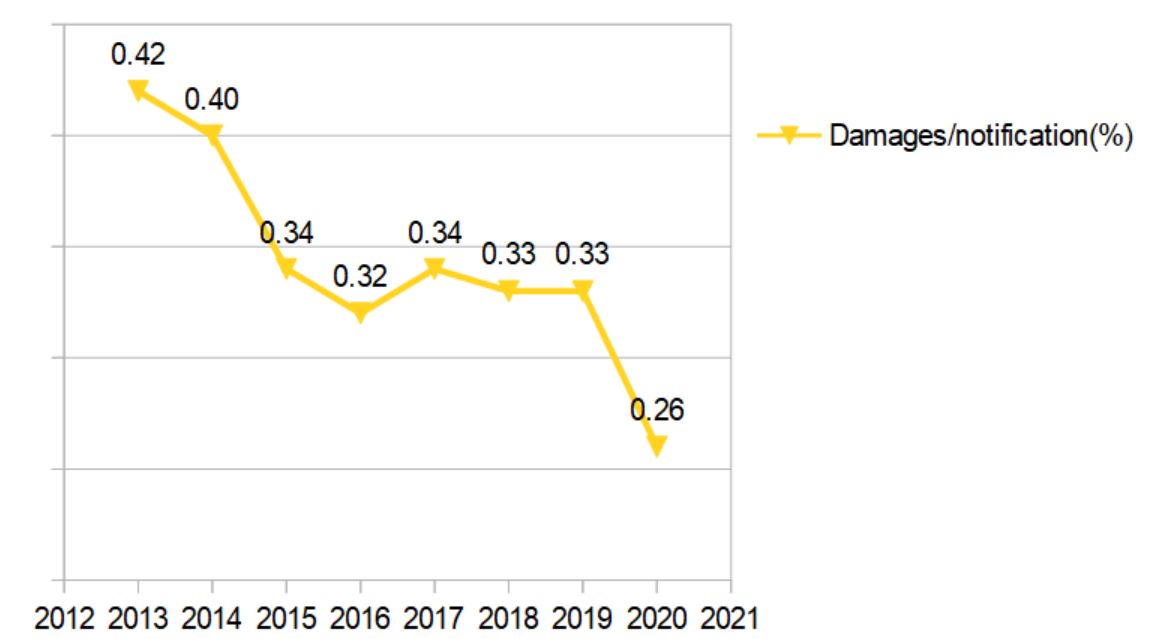 The DT DICT regulations make reporting incidents of underground damage during construction mandatory for network operators. The National Observatory DT DICT compiles these reports and issues a network operator dashboard summarizing the damage statistics for the year. The prorated statistic used by the National Observatory is the damages per DT notification expressed as a percentage. This statistic shows a significant reduction in underground damage since 2013 when statistics were first reported.
Conclusion
Around the world many different approaches that have been tried to reduce damage to underground utilities and other infrastructure during construction. In order to assess the effectiveness of a system for reducing damage to underground utilities, it is essential that incidents of damage be reported and the data compiled to produce statistics. Damage statistics reveal that underground damage in the United States, Canada and the Netherlands plateaued about five years ago and may actually be slowly increasing when prorated to construction activity. In France damage statistics show a downward trend in underground utility damage since the DT DICT system was implemented in 2013.

Be the first to comment