
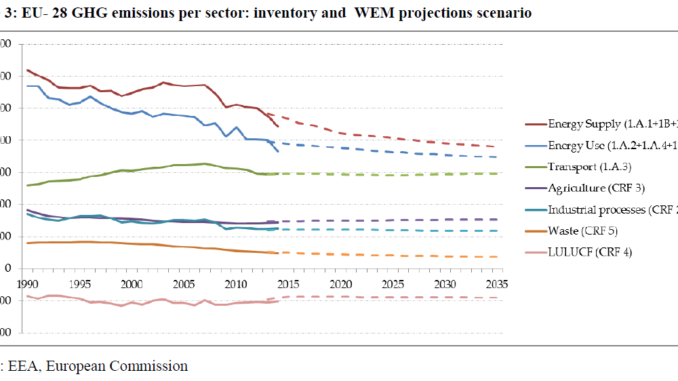
The EU has set three goals for reducing greenhouse gas emissions under the catch phrase 20-20-20 by 2020
- Reduce greenhouse gas emissions by at least 20% from 1990 levels by 2020
- Increase the share of renewable energy sources in energy consumption to 20%
- 20% increase in energy efficiency
The legislation driving the 2020 goals are the Effort Sharing Decision, Renewable Energy Directive. and the Energy Efficiency Directive. The EU is on track to meet the 20% target for 2020. In 2015, EU emissions were already 22% below 1990 levels. According to national projections, emissions will further decrease until 2020 and showing a significant overshoot of EU 2020 goals.
As an example the largest member state, Germany, has about 1.7 million non-residential buildings. Of these office and administration buildings comprise the largest share(22%), retail (14%), agricultural (14%) and hotels, cafés and restaurants (13%). Public buildings of the federal, state and local Government are about 20% of all non-residential buildings by floor area. Efforts to reduce energy consumption in buildings 2000 to 2012 resulted in a decline in space heating consumption from 205 kWh/square meter/year in 2000 to 147 kWh/square meter/year in 2000 in 2012. The central goal of the German Federal Government is to further reduce the heating requirements of new and existing buildings to achieve a nearly carbon neutral building stock by 2050.
Under the Paris agreement, the EU has agreed to reduce its greenhouse gas emissions by at least 40% by 2030. In addition, the EU also has targets for renewable energy and energy savings of at least 27% by 2030. The Paris Agreement obliges the EU to review its legislation to achieve the 2030 targets before 2018 when world leaders will gather to assess progress in its implementation. According to Member States’ projections based on existing measures, in 2030, the total EU emissions are estimated to be 26 % below 1990 levels. Therefore, new mitigation policies are being put in place so that the EU target of at least a 40 % domestic reduction in greenhouse gas emissions compared to 1990 in reached in 2030. A 2017 survey has found that nearly 90% of EU citizens believe it is important for their national government to provide support for improving energy efficiency by 2030.
Energy efficient buildings have been one of three priorities in the EU to meet 2020 emissions goals and this will be intensified to meet the 2030 goals. The Energy Performance of Buildings Directive (EPBD) and the Energy Efficiency Directive (EED), have been the legislative drivers for improving the energy efficiency of buildings. In Western Europe intelligent building technologies and net zero energy buildings are key to meeting energy efficiency goals. A new Navigant Research report analyzes the market for energy efficient building technologies in Western and Eastern Europe with a focus on HVAC, lighting, building controls, water efficiency, water heating, and building envelope. According to Navigant Research, energy efficient building technology spending in Western and Eastern Europe reached $83.5 billion in 2017. It is projected to grow steadily to $111.9 billion by 2026.

Be the first to comment