
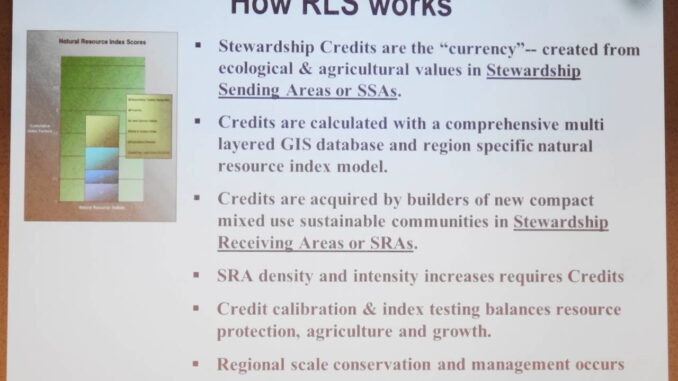
Al Reynolds presented a new and innovative schme for Rural Land Stewardship (RLS) that challenges the traditional paradigms of regulation (e.g. zoning) or land acquisition (e.g. Nature Conservancy) by incentivizing the protection of the habitat without public funding or regulation. Rural land stewardship is a private/public process based on scientific data and market-driven incentivization.
The area where this has been applied is in southwest Florida on the edge of the western Everglades. It is 300 sq miles of primarily agricultural land and is home to some of the few remaining Florida panthers as well as other endangered species.
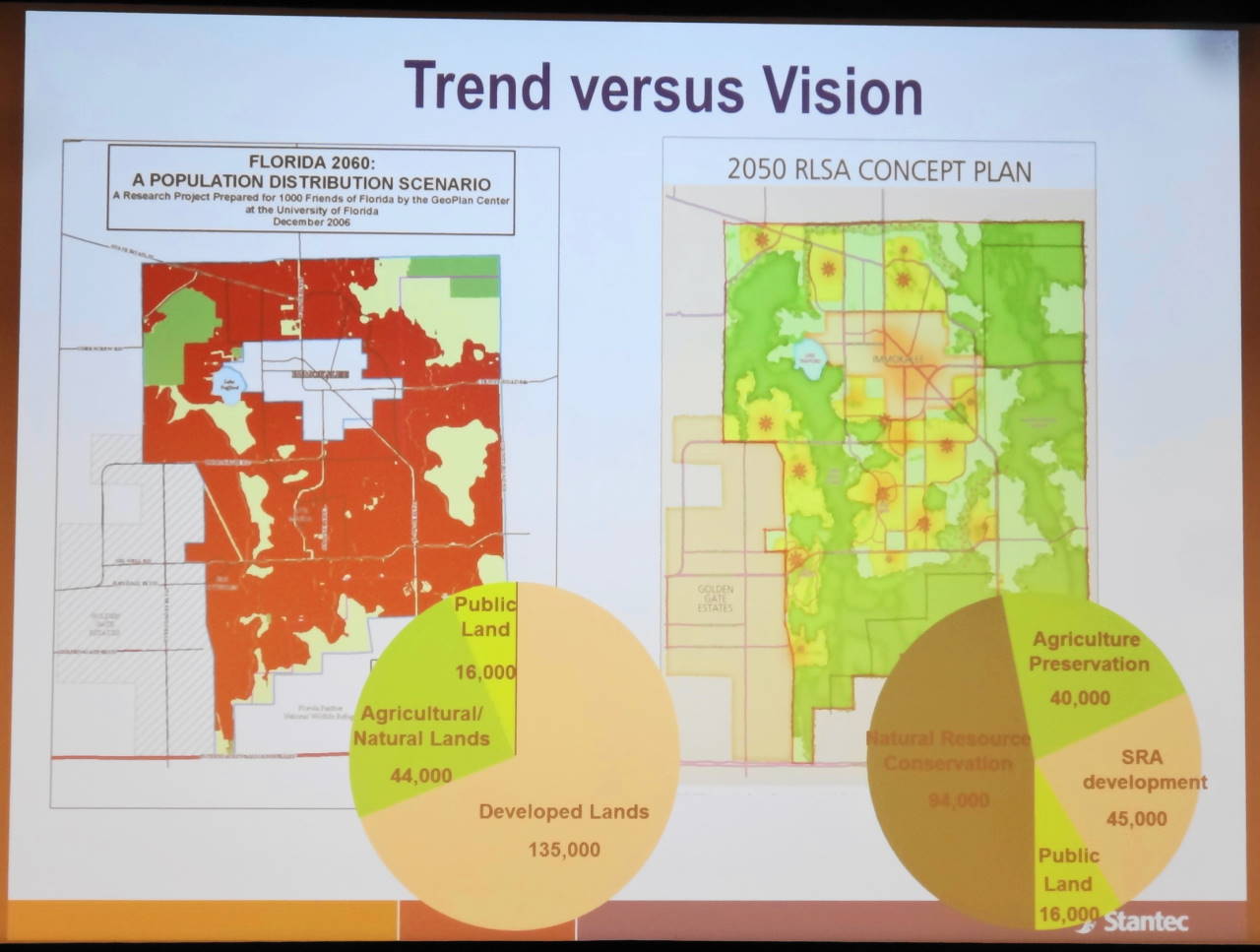
The Florida 2060 project aimed at painting a picture of what Florida is expected to look like in 2060 given current trends. This particular part of Florida was projected to be overrun by urban sprawl – almost 70% of the study area is projected to have been developed by 2060.
- 135 000 acres – Developed lands
- 16 000 acres – Public land
- 44 000 acres – Agricultural/natural lands
Rural Land Stewardship
The currency in this program is a stewardship credit. It’s calculated using a multi-layered suitability analysis. It is based on a Natural resource index system which gives a higher score for land that is ecologically good for endangered species.
In the past land that hosted endangered species was not considered to be finacially as valuable as much as land that did not host endangered species, because of the risk of regualtion. The Rural Land Stewardship program reverses this. Land is more valuable if it hosts or provides good habitat for endangered species. Endangered species become an asset instead of a liability.
 Al described an example, the new town of Ave Maria, home to 5 000 people. The town was deveeloped under the Rural Land Stewardship program and is 1/10 the size that a town with a similar population would have had if developed under a tradtional development paradigm.
- 45 000 acres – SRA development
- 16 000 acres – Public land
- 40 000 acres – Agriculture preservation
- 94 000 acres – Natural resource conservation
In additon to reducing urban sprawl the RLS program protected several panther corridors. And what absolutely distinguishes the development of Ave Maria is that the process managed to keep both developers and environmentalists happy.
One of the key enablers is the availability of geospatial data. In fact Al said that there was a proverbial firehose of data and the real problem was data management and the analytics required to make sense of the data and provide actionable information.
Transparency for all stakeholders into the process of analyzing the data and computing the indexes which determine the value of land (in stwewardship credits) is essential in developing trust among all stakeholders.
Based on his experience in this bit of Florida Al argued that traditional zoning doesn’t make sense in the modern world. We need to replace regulatory regimes like zoning with processes like the Rural Land Stewardship program that are based on scientific data.
Be the first to comment