
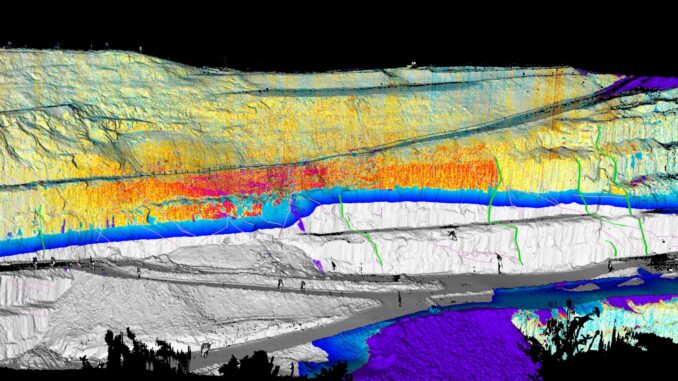
One of the most exciting presentations at the SA Geotech conference in Johannesburg was a presentation by Jason Richards of Maptek. He talked about using geospatial technology to map in space and time the instability and ultimate collapse of a wall of the Kanmantoo Copper Mine in South Australia. This is an open pit copper mine that was in operation 1970-1976 then closed but has reopened after significant additional deposits of copper and gold were confirmed. The copper and gold deposits are mined using well established open-pit excavation techniques including drilling, exploring, blasting, loading and hauling. Two operational pits were dug at the mine site to a depth of 270m for extracting the reserves. The larger pit (Giant Pit) spans up to 1.2km long and 600m wide. Hydraulic excavators and highway trucks are used to transport the ore to the processing plant. The roads used by the trucks wind along the walls of the mine. The surrounding rock is brittle and liable to fracture. Collapse of a wall has occurred in the past and is a serious hazard for the trucks carrying the ore out of the mine for processing.
Unexpected geological conditions occur in the east wall of the Kanmantoo Giant Pit resulting in threatening wall movements. A Maptek Sentry system was put in place to map wall movements to monitor the stability of the wall. The Sentry system combines laser scanning and photography and can monitor multiple areas within a scene in real time without the need for targets or reference points. Movement can be detected down to 1 millimeter per hour. Heatmaps colored by displacement or velocity provide an overview of movement in real time. Animations of time changes can be used to show morphology of terrain changes over time. Time lapse capability allows users to see changes and use this information to predict future movement.
In the Giant Pit a Sentry system was set up to monitor a 550 meter wide section of the brittle east wall of the Giant Pit at Kanmantoo. The wall was scanned initially every 23 minutes, but after significant continuing movement was detected scans of a more focussed area were made every 7 minutes. Movements were detected that were directly related to blasting with sharp jumps in displacement that usually stopped moving after an hour or so. But after one blasting sequence a 364 tonne block initially jumped 30mm with the blast. Two hours later it accelerated again, ultimately failing 4 hours after the initial blast. The Maptek system was able to capture the movement, raise an alarm and visualize the movement with heat maps and video. Jason showed a time lapse video of the movement and ultimate collapse of the wall which is one of most impressive videos of the progress of a geological event I have seen.
This is another example of how geospatial technology, in this case laser scanners combined with photography with real-time geoprocessing, is able to provide solutions in a wide range of industries.

Be the first to comment