
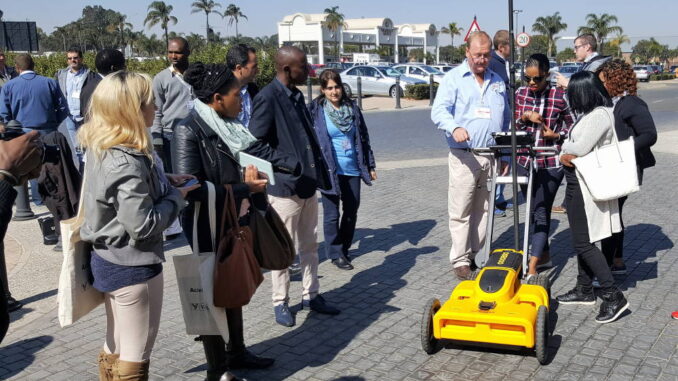
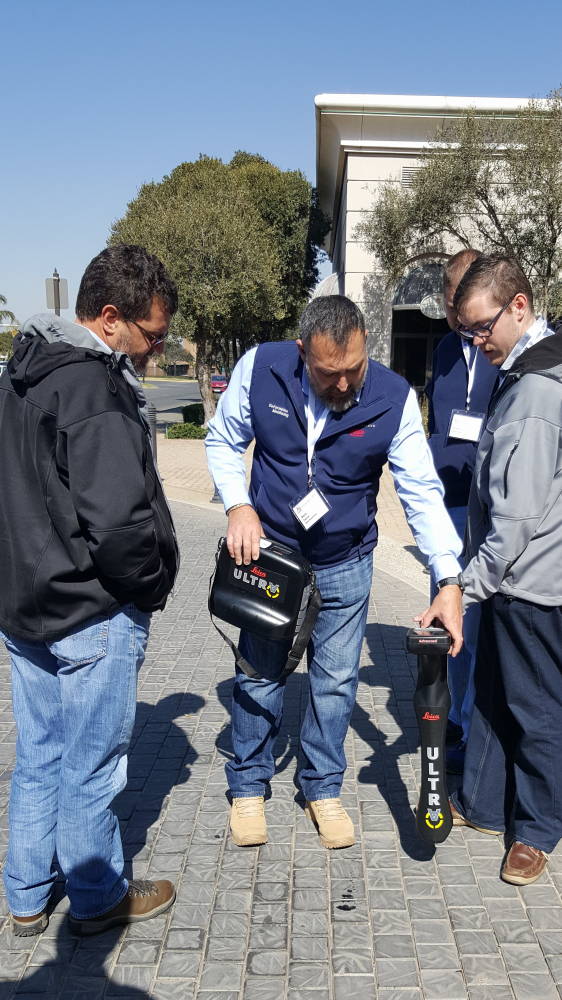
In South Africa there appears to be growing interest in underground utility detection. One of the highlights of the SA Geotech conference in Johannesburg where I had been invited to give a keynote was a demonstration of underground utility detection tools including electromagnetic detection and ground penetrating radar given by Aciel Geomatics. I suspect the organizers might have been surprised by the packed demonstration room. Even more surprising when the organizers asked for a show of hands of who wanted to go outside the convention centre for hands-on experience with the tools, virtually the entire room raised their hand.
This growing interest in underground utility location appears to be part of a worldwide phenomenon. Several years ago I published an article on LinkedIn “Accelerating world wide initiatives to map underground utilities“. I must admit that I was surprised by the amount of interest the article has attracted and continues to attract – so much so that I recently published a follow-on article “Major new initiatives to enable mapping underground utilities“. Several large jurisdictions have undertaken measures to improve location information about underground infrastructure. For example, France has initiated a project (>PCRS : Le PLAN CORPS de RUE SIMPLIFIE) which includes mapping all underground infrastructure in France to 40 cm.
 South Africa has a similar problem to that many of the world’s major economies have – the location of underground utility infrastructure (water, electric power, fiber optic, waste water) is poorly known. The result is safety and liability risks when any excavation is undertaken. In the U.K. the direct cost of a utility strike has been estimated to be on the order of a £1,000 and the indirect cost including traffic disruption and injuries at up to 30X the direct costs. The cost to the U.S. economy where a strike occurs every minute on average is estimated to be at least $1.5 trillion. Not knowing where underground infrastructure is adds risk to construction costs. In North America it is not uncommon for project bids to be increased by 10% to cover the risk associated with underground infrastructure.
There are a number of studies that indicate positive ROI associated with improving the reliability of underground infrastructure location.
- US$ 4.62 in avoided costs for every US$1.00 spent – Purdue University 1999 sponsored by US DoT
- C$ 3.41 average rate of return for each dollar spent – University of Toronto 2004 sponsored by Ontario Sewer and Watermain Contractors Association
- US$ 21.00 saved for every US$1.00 spent on elevating quality of underground information – Pennsylvania State University 2007 sponsored by Pennsylvania Department of Transportation
- C$ 2.05 to $6.59 for every dollar spent on improving underground utility location data – University of Toronto 2010 – all projects analyzed showed a positive ROI
- € 16 saved for every € invested in improving the reliability information of underground infrastructure – Lombardy, Italy – ROI estimated from economic analysis of a Milan pilot
Be the first to comment