
Geospatial information comes from many different sources and is managed by many different providers from mapping agencies to commercial data providers to volunteered geographic information. To optimize usage of this data there is a need to easily discover and share this information. Standards are essential to enable the sharing of authoritative geospatial data and services and provide significant value to society and government inlcuding enabling global competitiveness of both industry and nations.
Guide to the Role of Standards in Geospatial Information Management
At the request of the United Nations Global Information Management (UNGGIM) Secretariat and Expert Committee, three organizations, the International Organization for Standardization (ISO) Technical Committee 211 Geographic information/Geomatics, the Open Geospatial Consortium (OGC), and the International Hydrographic Organization (IHO) have collaborated to produce a guide that addresses the role of standards in geospatial information management. It is is intended to be useful for a wide variety of readers, especially in government. These include policy makers, program managers, technical experts and other individuals involved in geospatial information management. The Guide is comprised of two documents; an executive level guide that assists policy makers and program managers in understanding what capabilities are required to meet current and future needs and a companion document containing detailed technical information on the standards.
The guide is intended to:
- Articulate the critical role of standards in geospatial information management
- Inform policy makers and program managers of the value in using and investing in geospatial standardization
- Describe the benefits of using open geospatial standards to achieve standardization, data sharing, and interoperability goals.
Spatial Data Infrastructure (SDI) initiatives worldwide are implementing a common set of international standards for geospatial data. These standards encapsulate geospatial data development, production, management, discovery, access, sharing, visualization, and analysis. As organizations and jurisdictions develop and agree on a common set of open standards, the ability to share geospatial information is enhanced, reducing costs, improving service provision, and facilitating new economic opportunities.
SDI Standardization Maturity Model
 Community initiatives to share and make geospatial in formation available are typically oriented around Spatial Data Infrastructure (SDI) initiatives. Standards are a critical element of SDI implementation.
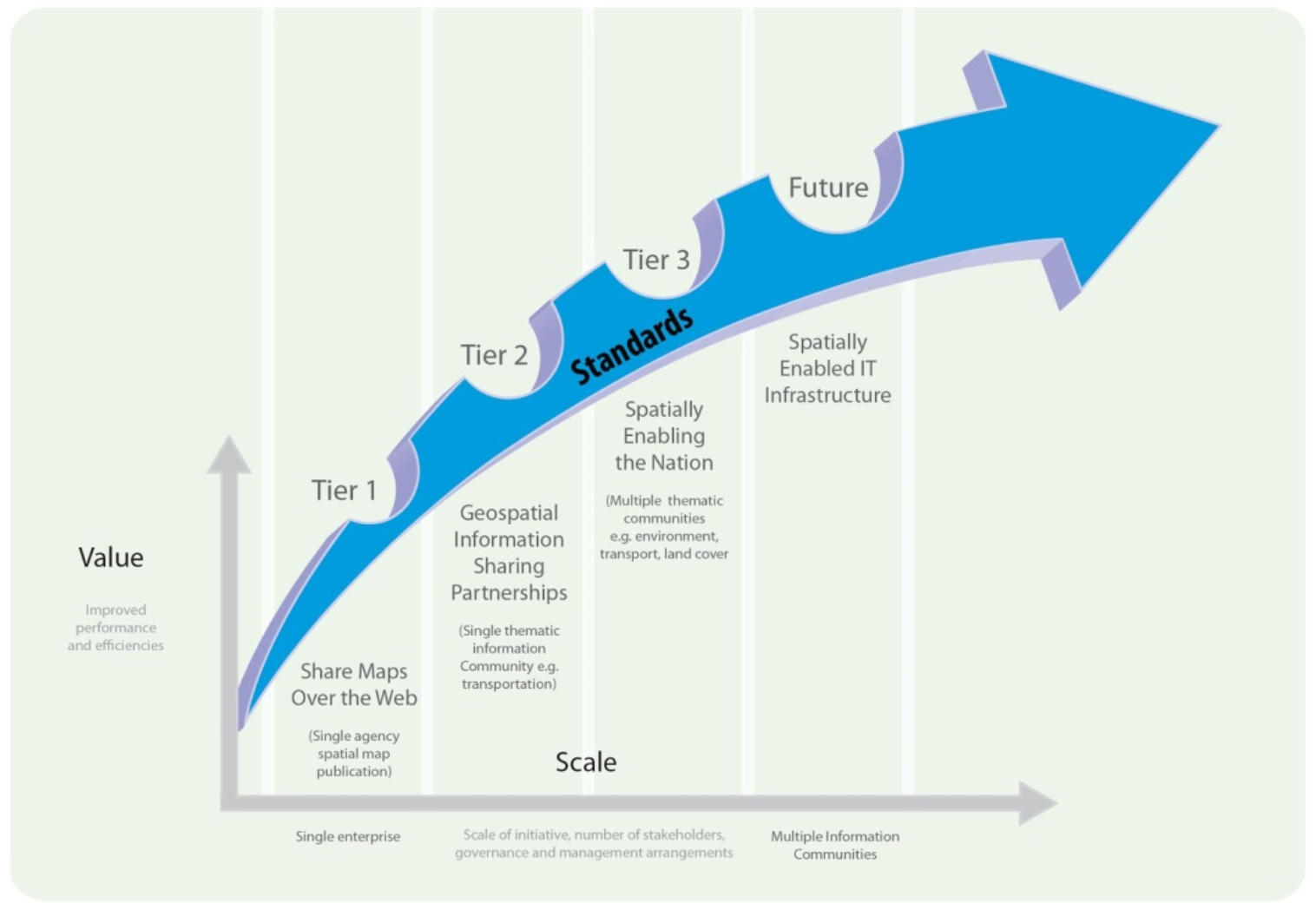
The Guide defines an SDI Standardization Maturity Model that includes different stages or tiers corresponding to increasing levels of capability.
- Tier 1 – Share maps over the Web
- Tier 2 – Geospatial Information sharing partnerships – share, integrate and use geospatial data from different providers
- Tier 3 – Spatially enabling the nation – large scale efforts to develop a comprehensive SDI that provides access to multiple themes of information, applications for using the shared information, and access via mobile, desktop, and other devices
- The future – Spatially enabling the Web of data – delivering geospatial information into the Web of data, and bridging between SDI and a broader ecosystem of information systems.
The Tiers represent a series of steps in an organization’s ability to offer increasing levels of geospatial information and associated services as part of an information community.
At the beginning of the process (Tier 1), an organization may want to provide access to geospatial information delivered as map images together with a description of them (metadata).
As the initiative matures, multiple organizations may wish to collaborate to provide a means to share, search for, access, integrate and cooperatively maintain a particular geospatial information layer (such as transportation) from multiple sources using web services (Tier 2).
Larger scale initiatives have a goal of establishing a nation-wide coverage of foundation or framework data as part of their National SDI. Foundation data is an accurate set of key geospatial data layers needed most by different users (imagery, elevation, administrative boundaries, transportation, land use, and water features for example). Providing access to this geospatial Foundation Data for a range of application areas is the next level of maturity (Tier 3).
Finally, to address emerging needs and leverage new technologies such as crowd-sourcing of geospatial information and big data analytics, a community would focus on delivering geospatial information from SDI environments into the Web of data (The Future).
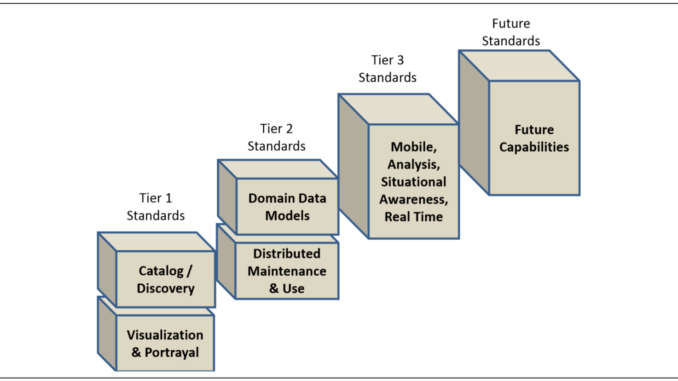
Tier 1 Standards
Each Tier is associated with a set of SDI standards. The separate Companion document details the specific standards associated with each Tier.
For example, recommended Tier 1 standards include standards for accessing and displaying geospatial information as images in any browser.
- OGC/ISO 19128 Web Map Service (WMS) – for access and display of geospatial information as a raster image.
- OGC Web Map Tile Service (WMTS) 1.0. For high speed access and rendering of geospatial information.
To encode, communicate and share visualization rules can be implemented using the following standards:
- OGC Styled Layer Descriptor 1.1 (SLD)
- OGC Web Map Context 1.1 (WMC)
- OGC KML 2.2 – Visualization of geospatial information in earth browser applications
ISO and OGC standards for catalogue and discovery are widely implemented in national, regional, and local SDIs.
- ISO 19115 – Geographic information metadata
- OGC Catalogue Service Implementation Specification (CSW) – specifies the interfaces and bindings for creating catalogue services.

Be the first to comment