
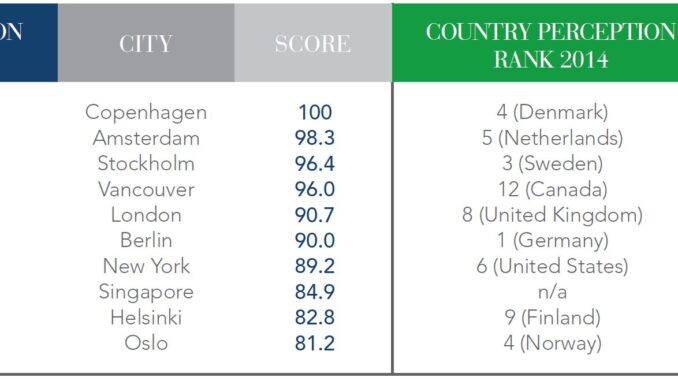
According to the annual ranking by the Global Green Economy Index (GGEI) Vancouver is the world’s fourth greenest city. The most recent GGEI analysis covers 60 countries and 70 cities. It tracks how investors rank the appeal of cities and countries as markets for green investment and it provides a global measure of performance in key efficiency sectors, including buildings, transport, tourism and energy. It also integrates environment & natural capital measuring perceptions and performance in environmental areas like air quality, water, forests and agriculture. According to the GGEI the top three greenest cities are Copenhagen, Amsterdam and Stockholm. The countries corresponding to these cities (Denmark, Netherlands, and Sweden) also rank high, in the top 5 country rankings. Canada is 12th. The Nordic cities have achieved their high standing with the help of their respective national governments, whereas Vancouver has achieved its high green ranking on its own with little help from the federal government.
How did Vancouver do this ?
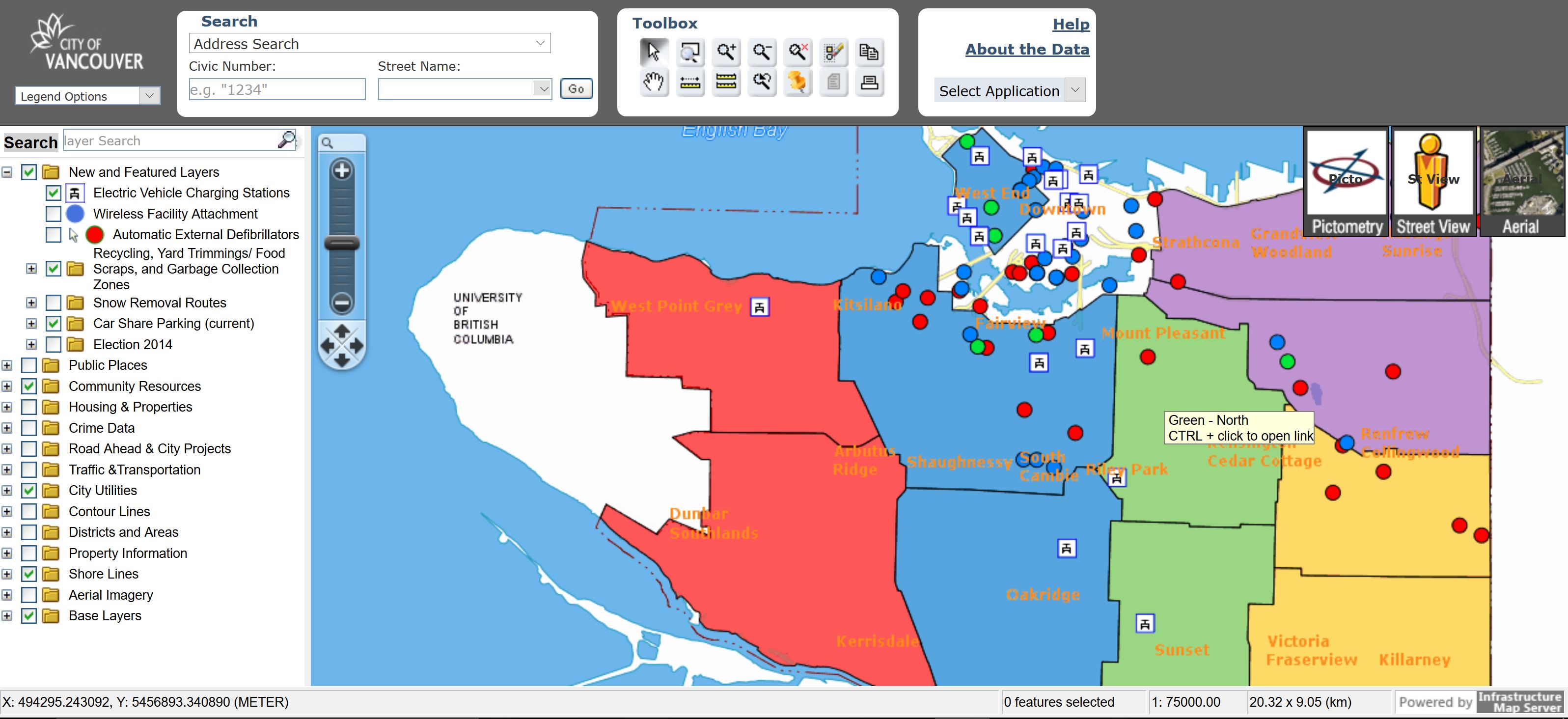 I have blogged on several occasions about geospatial developments at the City of Vancouver. Vanmap, which is the City’s geospatial portal, was an early development that has supported a number of the City’s green initiatives. Vancouver was one of the first cities that made its geospatial and other data open and free.
Yesterday at Ottawa’s City Hall, Andrea Reimer, Vancouver’s Deputy Mayor, described in a fascinating presentation how Vancouver achieved its high GGEI ranking and its plans to rise even higher to become the world’s greenest city by 2020. 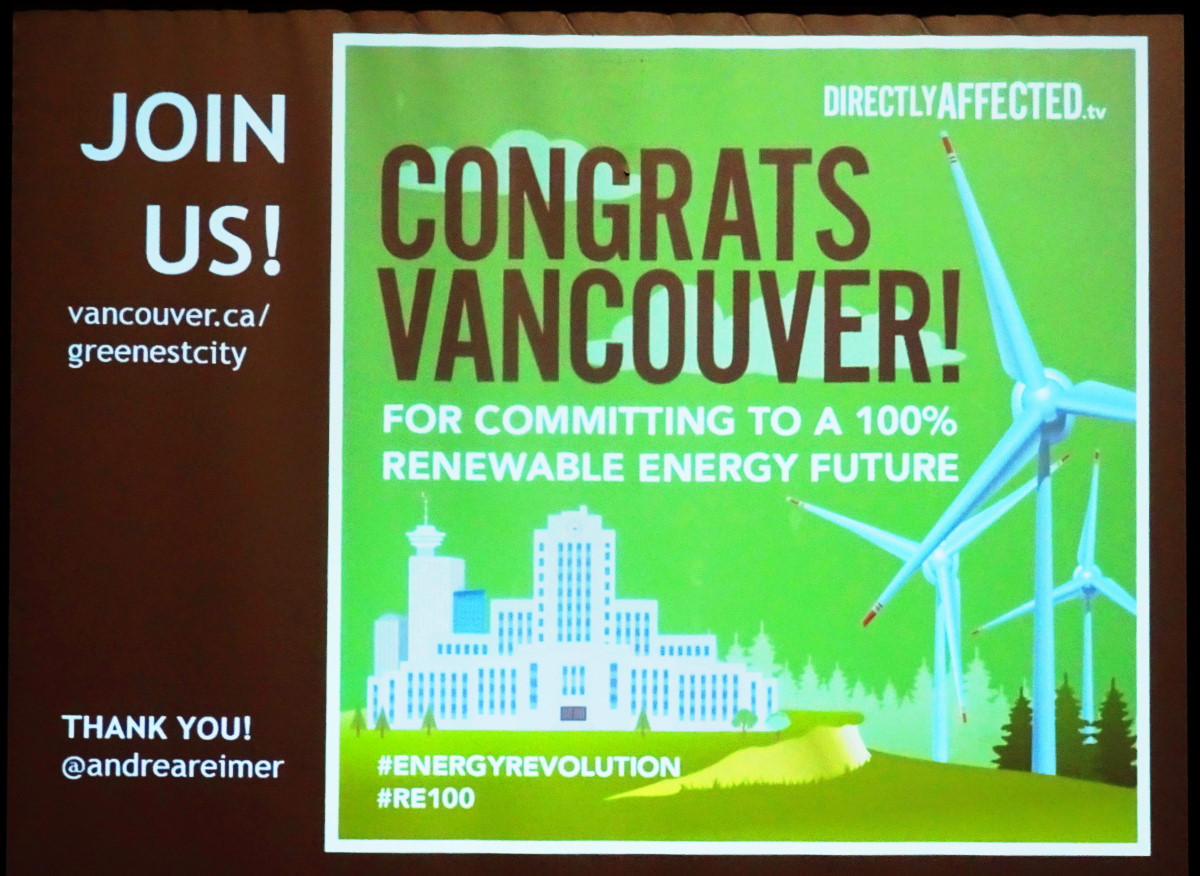 In addition the City has recently committed to running 100% on renewable energy by 2035. This means only green energy sources for electricity, heating and cooling and transportation.
This all started about a decade ago, when a public consultation about greening the city attracted an incredible 2300 people. The enthusiastic response was unexpected. It cost participants ten dollars and the organizers were expecting something on the order of a few hundred people. It turned out that they had to change the venue twice to accommodate everyone. The mega response clearly showed a tremendous interest in green by Vancouver’s citizens. From this beginning Vancouver’s greenest city initiative has continued to be a grass roots movement supported by the City government.
The City started off with some quick start projects which had high visibility and were inexpensive. These included separated bicycle lanes, provision for organic waste (food scraps), a deconstruction bylaw, drinking water stations, community gardens, urban commercial farms, green buildings, city power utility that generated electricity by burning sewage and waste, commercial car sharing, and an urban forest initiative. 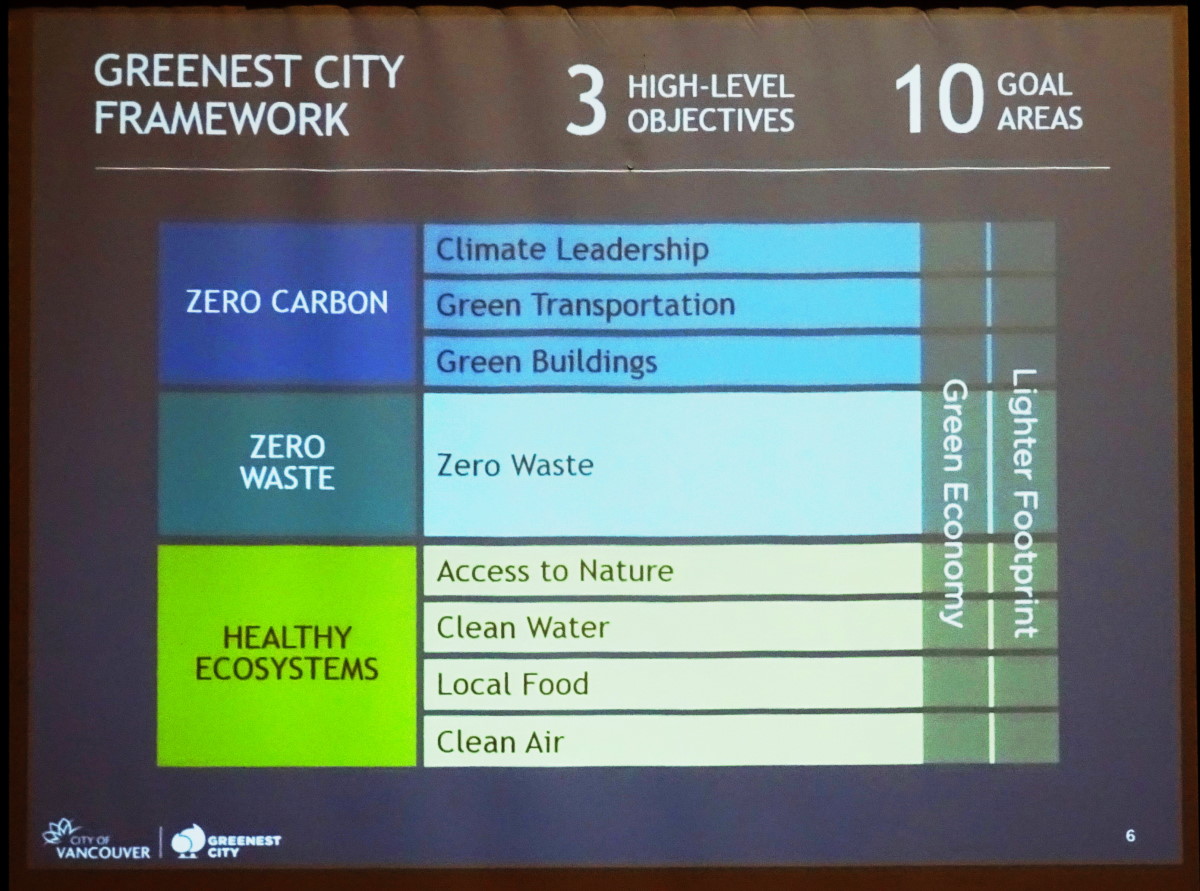
The City developed the Greenest City Action Plan (GCAP) which focussed on 10 goal areas addressing three overarching areas of focus; zero carbon, zero waste and healthy ecosystems. The 10 goal areas were arrived at by a process of public consultation.
The Greenest City Action Plan includes commitments to sharply reduce greenhouse gas emissions, both from City operations and the community; generate 100 per cent of electricity from renewable resources; and implement the greenest building codes in North America. This commitment has helped stimulated the local green economy. 5% of all jobs in Vancouver are green and Vancouver is among the top 10 green technology clusters. World-leading companies such as Westport Inovations (advanced natural gas engine-maker), General Fusion (nuclear fusion), Ballard Power Systems (hydrogen fuel cells) and Saltworks Technologies (waste water remediation) are based in Vancouver. In Vancouver’s case economic development and greening the city have gone hand in hand.
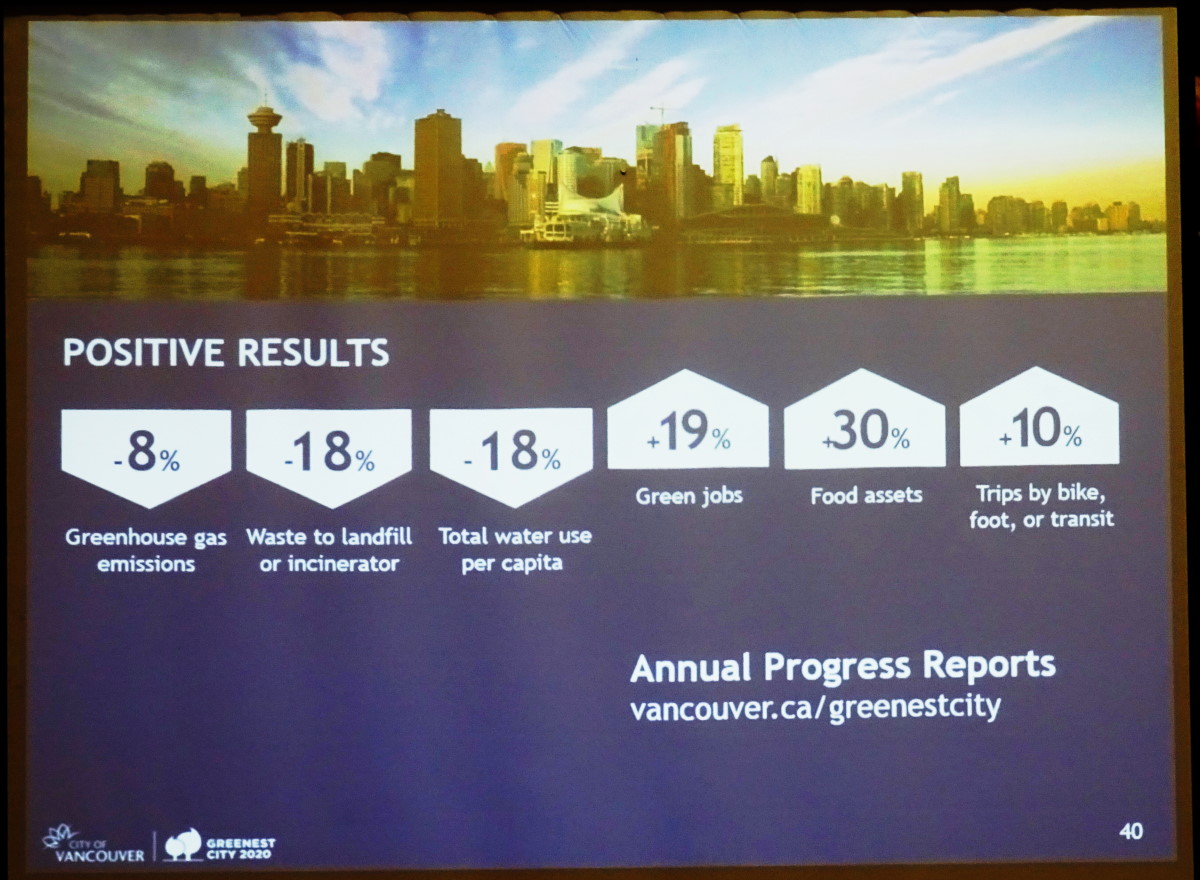 The results of the greenest city initiative to date are impressive; for example, 8% reduction in greenhouse gas emissions, 18% reduction in waste going to landfills or incinerators, 18% reduction in water use per capita, 19% increase in jobs in the green sector, 30% increase in food assets, and 10% increase in trips by bicycle, on foot or using public transit.
Vancouver’s greenest city initiative is an amazing story with concrete measurable achievements. As David Chernushenko, Ottawa City councilman, said in his comments after Andrea’s presentation, there is no reason from a technology perspective that other cities such as Ottawa cannot follow in Vancouver’s footsteps with their own solutions reflecting their unique environment. But the key ingredient that enabled Vancouver’s green revolution is broad public participation, which Vancouver had right from the beginning.

Be the first to comment