
At the IEEE PES Conference on Innovative Smart Grid Technologies in Washington DC, Patricia Hoffman, Asst Secretary Department of Energy, Office of Electricity Delivery and Energy Reliability, gave the keynote address.
The whole is greater than the sum of its parts
In the past the focus for the
Department of Energy and for utiltiies has tended to be on individual technologies such as smart meters and AMI, self-healng networks, synchrophasars, substation automation, and so on. Ms Hoffman’s message is that we need to start focussing on the smart grid as a whole and in particular we need to focus on grid resiliency. Things will happen, floods, tornadoes, hurricanes, derechos and other natural and man-made problems. We need to ensure that the grid is resilient so that we can recover from disasters quickly. The example she gacve was one that I have blogged about, Southern Co.’s use of smart meters to track outages caused by tornadoes in April, 2011 and then help with restoration.
Ms Hoffman then discussed specific areas where there are opportunities to make the grid more resilient.
Transmission operations
There is a lot of data that is becoming available, primarily because about 1000 synchrophasars have been deployed over the national transmission grids. What are needed are improved interoperability, analytic, and visualization to better manage the transmission grid. For example, it took almost a year to analyze the data and determine the cause of the 2003 Northeast blackout. The 2011 San Diego blackout required about 3-4 months, so fault analysis is getting better, but we need to be able to use the available data to predict the state of the transmission grid in real-time.
Distribution operations 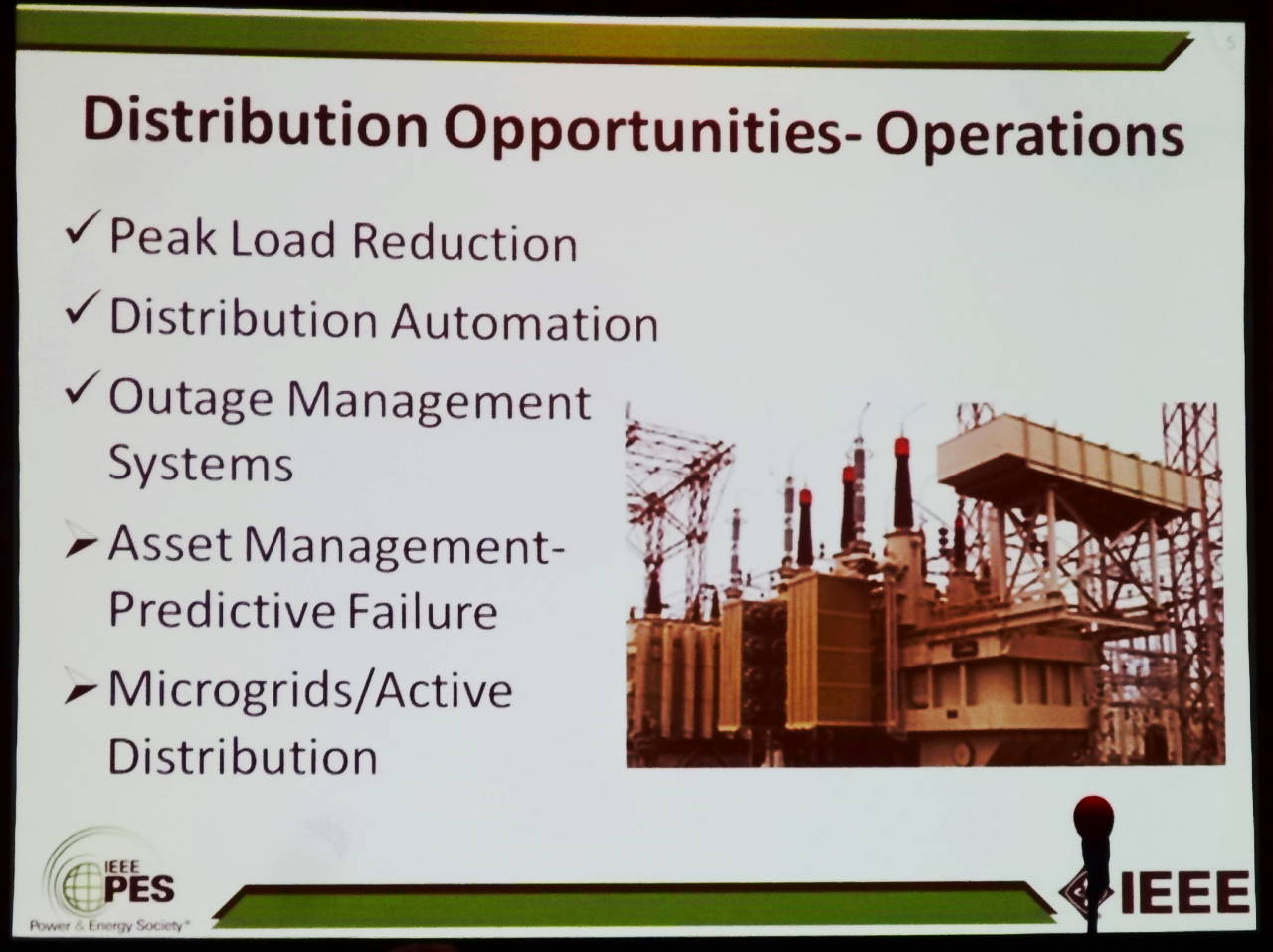
In the area of electricity distribution, Ms Hoffman singled out peak load reduction as the area where there are the greatest econimic and environmental benefits. Reducing peak load means that the construction of new power plants (peakers) that may only be used a hundred hours a year can be avoided. The other areas she identified include distribution automation, especially automated self-healing networks using devices such as intelliRupters, improved outage management, using predictive analytics to replace equipment before it fails, and microgrids.
Customer empowerment
Areas that directly impact the customer are residential diagnostics to help the customer understand how power is being used in the home and ways that it can be used more effectively, at lower cost, and as much as possible moved to off-peak. Photovoltaic cells and plug-in electric vehicles are becoming much more prevalent and utlities need to be prepared for these. Improving reliability and resiliency directly impacts customers by reducing the number and duration of outages. An area that is getting a lot attention is rate structures, for example, pricing electric power to motivate shifting load from peak to off peak. A new technology that is being investigated by DoE is transactive control signals. This is a smart grid signaling approach that communicates prices and other information, such as expected future prices, to encourage the customer to change his/her electric power usage.
Energy infrastructure cyber protection
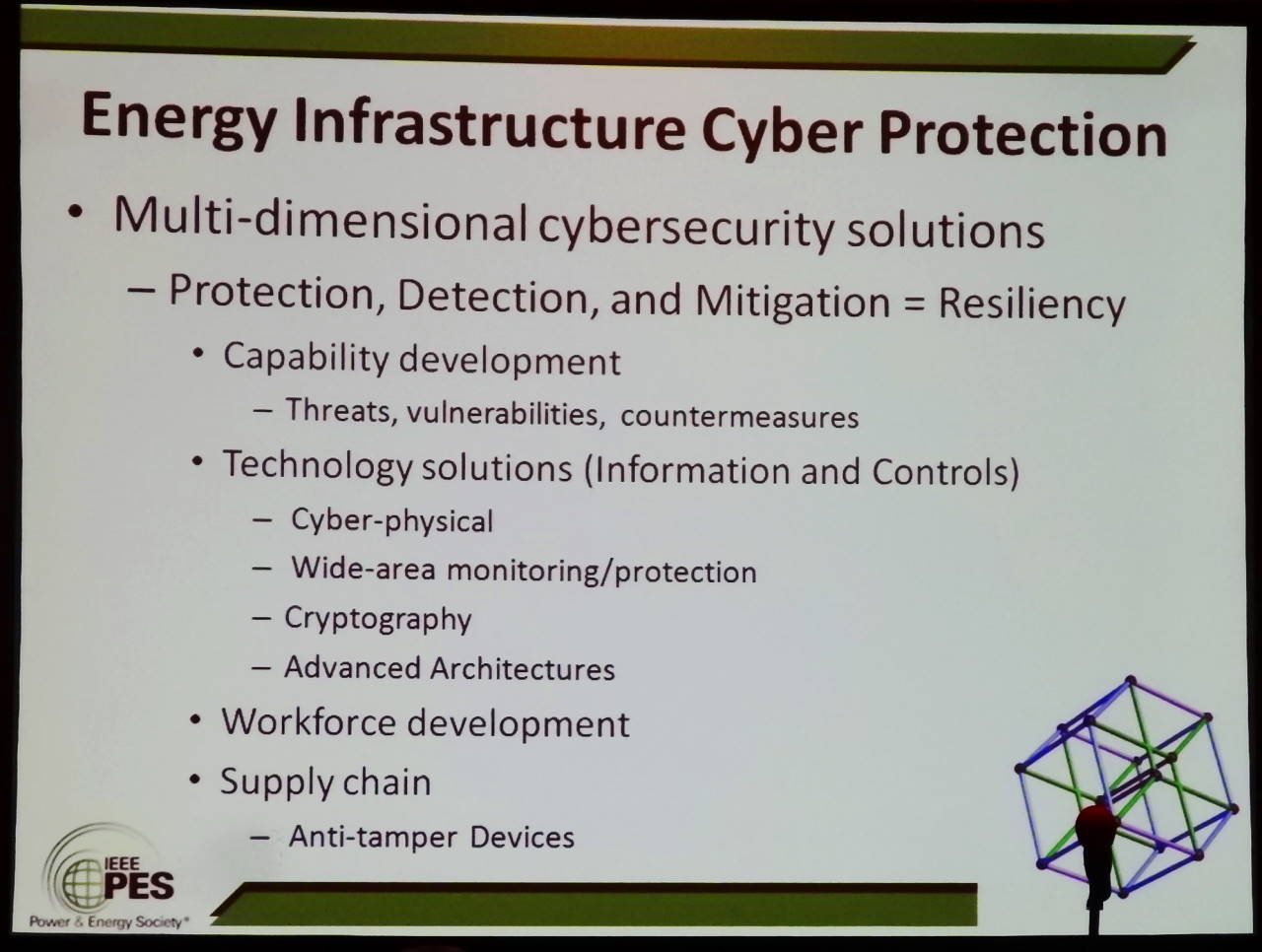 Ms Hoffman’s message on cyber protection is that it needs to be dynamic and multi-dimensional. Infrastructure is complex and changing and new vulnerabilities are detected every day. In addition multiple organizations are responsible for the grid. Effective cyber security management has to deal with a dynamic landscape of control and information systems. There are a broad range of threats and motivations including unintentional, natural phenomena, and those with malicious intent including theft, revenge, and national security. It is also important to recognize the interdependencies among critical infrastructure. A gas explosion can affect the telecommunications and electric power networks. Loss of electric power can affect many other networks including water and telecommunications. Disruption of communications, for example, severing a fiber optic cable can directly affect the electric power grid.
To address these challenges cybersecurity solutions need to be mutli-dimensional.including cyber-physical, wide area monitoring and protection, cryptography, anti-tamper devices and advanced architectures.
One of the most serious challenges that Ms Hoffman singled out specifically is developing the cybersecurity workforce that is going to be responsible for implementing these measures.
Where are we headed ?
The next major challenge is turning the smart grid into a driver of economic development. The example Ms. Hoffman used was Chatanooga. The Electric Power Board (EPB) saw the smart grid as not only benefiting the utility and improving the quality of life of its cusomers, but also as a driver of economic development. The city’s decision to deploy one of the country’s highest capacity fiber-optic networks not only improved power quality, reliability, customer service and energy efficiency but also made Chananooga more attractive to business. For instance, because bandwidth is virtually unlimited, EPB is able to offer its customers Internet upload and download speeds of up to one gigabit/sec, making Chattanooga very attractive for businesses that rely on the internet for critical aspects of their operations.

Be the first to comment