
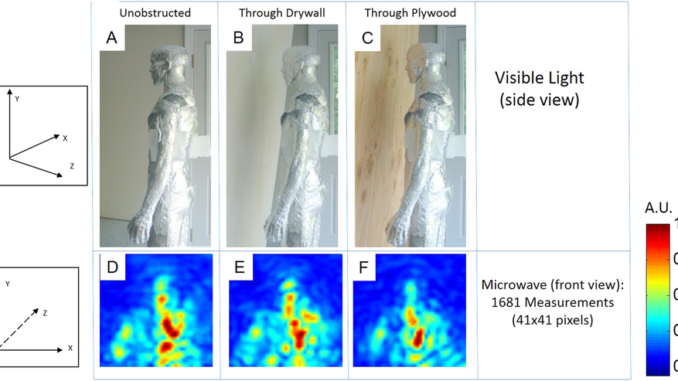
A major challenge for infrastructure companies is mapping infrastructure which is obscured by walls, soil or other materials. For example, detecting underground infrastructure is a remote-sensing challenge that is seeing rapid technological progress. Researchers at MIT have developed a prototype low cost, high resolution camera that can see through materials such as walls and plywood that visible and other types of camera can’t see through. It can also image objects in 3D. This is very early in the development sequence, but the principle behind the camera is very general and promises to have applications in a number of areas including the infrastructure sector.
The prototype camera uses time of flight to create a 3D image of an object. It operates much the same way that radar and consumer devices such as the XBox Kinect work. The camera sends out bursts of microwaves and then tracks how long it takes for the microwaves to be reflected by something and return to the sensor. From the time of flight of the microwaves and the known speed of the microwave burst, it is possible to calculate the location of the bit of an object that reflected the microwave pulse. The prototype camera has a time resolution of 200 picoseconds (a picosecond is one trillionth of a second). This allows the camera to resolve distances with an accuracy of 6 cm, which is more than adequate for many infrastructure applications.
The camera is also capable of multispectral imaging. This means that it does not take a picture only at one wavelength, but at several. Every 10 milliseconds MIT camera’s microwave emitter sweeps through the frequency range of 7.835 GHz to 12.817 GHz. Different material reflect the microwaves differently depending on frequency. The result is an image with different colours that makes it possible to distinguish between different materials.
To test the prototype camera MIT placed a mannequin covered in aluminum foil behind a drywall wall and a sheet of plywood. The aluminum is detectable at the wavelengths used at MIT. The mannequin was placed approximately 2.1 meters in front of the imaging system and the partition approximately 15–30 cm in front of the mannequin.
The camera is comprised of a microwave emitter and a reflector. The reflector is over a meter wide. Acquiring an image takes on the order of an hour. The approach is general enough that the MIT researchers believe that the camera could be made significantly smaller by using shorter wavelengths, millimeter waves instead of microwaves. However, for many infrastructure applications the size of the camera may not be a problem.

Be the first to comment