
Inertial locating is an innovative technology that is used to accurately map underground pipe networks. But to date the technology has required non-pressurized pipes. Now a PHMSA-sponsored project has demonstrated that the technology can be applied to small-diameter pressurized gas lines with no disruption of service to customers.
The Reduct DuctRunner inertial mapping technology, about which I have blogged previously, allows mapping networks of (unpressurized) pipes with various diameters for distances of up to 2 km (1.25 Miles) with a precision of 15 cm (6 Inches) horizontally and vertically.
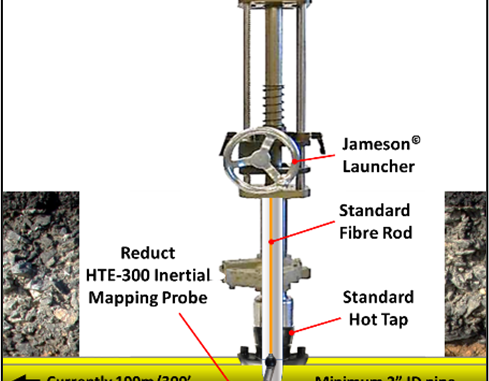
As the underground congestion increases, accurate mapping data of gas infrastructure is very critical for ensuring public safety. To improve underground pipeline locating tool applicability, a recent technology development and demonstration project was sponsored by the Pipeline and Hazardous Materials Safety Administration (PHMSA) and Operations Technology Development (OTD). The project was performed by a partnership between the Gas Technology Institute (GTI), Reduct and PRISUM Technologies (Condux International) and has shown that inertial mapping technology can now be inserted through a vertical Hot Tap Entry (HTE) for mapping live (pressurized) gas pipe networks as small as 2 inches (5 cm), with no disruption in service to downstream gas customers.
Currently best practices for recording the location of new underground infrastructure are to survey it after installation and before covering the trench. Appropriate survey tools are total stations, RTK, and LiDAR. However, for (deeper lying) existing infrastructure these technologies cannot be used. Also, trenchless technology is increasingly being used with the result that cross bores have become a major problem in many jurisdictions. 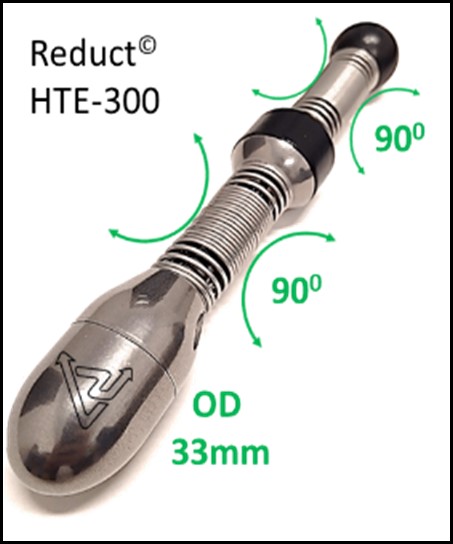 An innovative technology that is being increasingly applied to locating existing pipe networks or those installed by way of horizontal drilling is inertial locating. Using this technology, it is possible to map networks of (empty) pipes with diameters ranging from 29 mm (1.1 inches) and above for distances of up to 2 km ( 1.25 Miles)) with a precision of up to 15 cm (6 Inches) in XYZ. The output of such a system is a 3D model.
Whereas conventional electromagnetic (EM) and ground penetrating radar (GPR) technologies have proven their value, they both require “boots on the pavement” and each has deficiencies that limits its applicability. EM methods only work for conductive materials, are generally not reliable for measuring depth and severed tracer wires for plastic pipes are a common problem. Soil conditions, nearby electromagnetic noise sources, and accessibility limits the usefulness of GPR.
Inertial mapping relies on a battery powered autonomous probe (no cable is required) with on-board gyroscopes, accelerometers, and odometers. The mapping tool records changes in direction and speed at a hundred samples per second to create an accurate, high frequency 3D profile of the pipe segment being traversed. Inertial mapping avoids the major limitations of surface-based EM and GPR techniques; it is not sensitive to soil conditions and extraneous electromagnetic noise, works with all types of pipe materials and is safe because it does not require boots on the pavement.
 The significant breakthrough realized in this PHMSA-sponsored project is for the mapping probe to enter a pressurized small diameter pipe through a standard vertical hot tap and making the 90-degree turn into the mapping direction. This eliminates the need to disrupt service to customers because the pipe remains pressurized. The Reduct/GTI/Prisum partnership successfully demonstrated the new solution by mapping several 2 inch (5 cm) and 4 inch (10 cm) gas pipes owned by gas companies operating in the Chicago area. The longest run performed during these demonstrations was 300 feet (100 metres) in each direction but the Ductrunner developers believe this distance can be increased significantly.
This latest advance in inertial mapping dramatically broadens the applicability of the technology and represents a major breakthrough in mapping underground pipe networks of various sizes and in different environments. It is expected that the first commercial units of the live gas line solution will become commercially available within months.

Be the first to comment