
In the last few years there have been important advances in technology for detecting underground infrastructure including capturing ground penetrating radar (GPR) scans at highway speeds, combined GPR and LiDAR scanning for simultaneous above and below-ground mapping, software to simplify the interpretation of GPR scans, inertial mapping of pipe networks, and acoustic locating to name a few. Most recently a new technology originally developed for military purposes uses AM radio waves to detect underground assets.
Background
The $10 trillion global construction industry is facing a crisis. For many of the world’s advanced economies including Japan, Germany, U.S., South Korea, and U.K. construction productivity has been stagnant or even declining for decades. Virtually all of the funding for infrastructure was sourced from government who were looking for a social return on the investment. Since the mid 2000s, an increasing proportion of investment in infrastructure has come from private sources; pension funds, insurance companies and sovereign wealth funds which together manage over $60 trillion. These sources of investment are expecting a financial return and that is driving a growing investment in construction technology to improve productivity. Historically, investment in research and development by the construction industry has been very low compared to other industries. Several years ago a McKinsey Global Institute study compared the degree of digitalization of nearly 30 industries and concluded that construction ranked right at the bottom with hunting. But there are signs of a change. Venture capital investment in technology startups in the construction sector is growing especially since 2018.
Detecting underground infrastructure
In the last few years there have been important advances in technology for detecting underground infrastructure. Advances in ground penetrating radar (GPR) now make it possible to safely capture scans at roadway speeds. One of the important challenges of GPR is interpreting the scans which has required a trained geotechnician. New software developments are simplifying the interpretation of GPR scans, enabling surveyors and other professionals to use GPR technology effectively. LiDAR is being applied to efficiently capture the location of newly installed underground pipelines. The simultaneous capture of above and below-ground scans using LiDAR and GPR creates a complete assessment for construction projects. Inertial mapping can be used to map underground pipe networks for up to two kilometers. Advances in acoustic locating show the technology can be effective in detection underground objects down to 30 feet.
Detecting underground infrastructure with AM Gradiometer
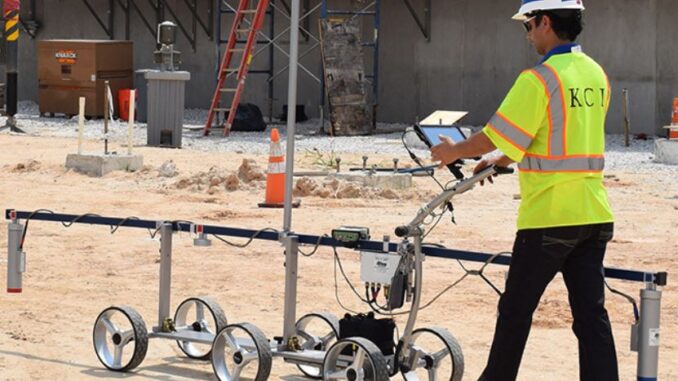
KCI is an engineering, planning and construction firm with customers across the United States. KCI recently had the opportunity to pilot and is now utilizing an innovative technology AM Gradiometer (AMG) to detect and map underground infrastructure. This is a patented tool that uses AM-band transmissions from radio station towers to detect subsurface objects. The device’s antennas detect AM radiofrequency signals reflected from underground assets. The device consists of multiple receiver antennas. The spacing between the antennas determines the depth at which the device detects objects. A typical configuration includes three antennas. When closely spaced they detect shallow targets (5-10 feet). Intermediate-spacing detects targets at medium depths (10-20 feet), and more widely-spaced antennas can detect deep targets (30-50 feet). The data can be exported in several forms including as a spreadsheet, a Google Earth map, and a CAD file.
An AM Gradiometer scan is performed in a grid pattern over an area of planned excavation. The device can be pushed on a cart or carried by hand. The AM Gradiometer also includes GNSS capability and the ability to be tracked with a total station for accurate georeferencing. The device can detect electrical conductors, metal pipes, non-metallic conduits, liquid or air-filled void space, natural gas or fuel lines, brick or concrete sewer lines, shielded fiber optics cables, and hydrocarbon or saline moisture plumes.

Be the first to comment