
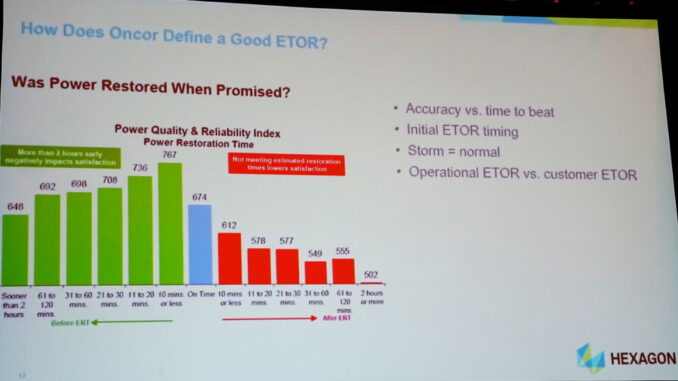
A key to better customer service is being able to estimate the time when power will be restored after an outage. A reliable restoration date and time makes it possible to make plans for the outage period. In a fascinating presentation at HxGNLIve in Las Vegas, Greg Nichols, Program manager at Oncor Electric, a major power utility with 3.5 million meters in Texas, explained why it turns out that this is very hard to do and how Oncor has managed to improve its estimates from 40% to 50-60 % which is still short of Oncor’s 70-80% target. The really interesting part of this is that Hexagon has worked closely with Oncor on this and has developed an advanced restoration time engine which is being shared so other utilities using Hexagon’s G/Electric will be able to benefit from Oncor’s experience.
Oncor is preparing for a time in the not too distant future, when today’s utilities will no longer be monopolies, but will have to operate in a competitive market. One of the strategic goals to make Oncor more competitive is customer service. As part of improving service Oncor is looking at how it handles outages. Getting the estimated time of restoration (ETOR) correct means to within -60/+30 minutes. Historically Oncor has been able to get ETORs correct 40 % of the time.
The process of resolving an outage is broken down into stages: outage creation, pending stage, crew assigned, crew enroute, crew onsite and outage resolved. There is intricate balancing of crews availability, travel time to outages, trafic delays, details of the outage and requirements to resolve the outage. Oncor distinguishes between how it estimates restoration time for internal purposes and what it communicates to customers. The internal estimated time of restoration is adjusted every minute, but to optimize communication with the customer, the first estimate is provided to the customer within 10 minutes and after then only changes greater than an hour are communicated and not more frequently than twice per hour.
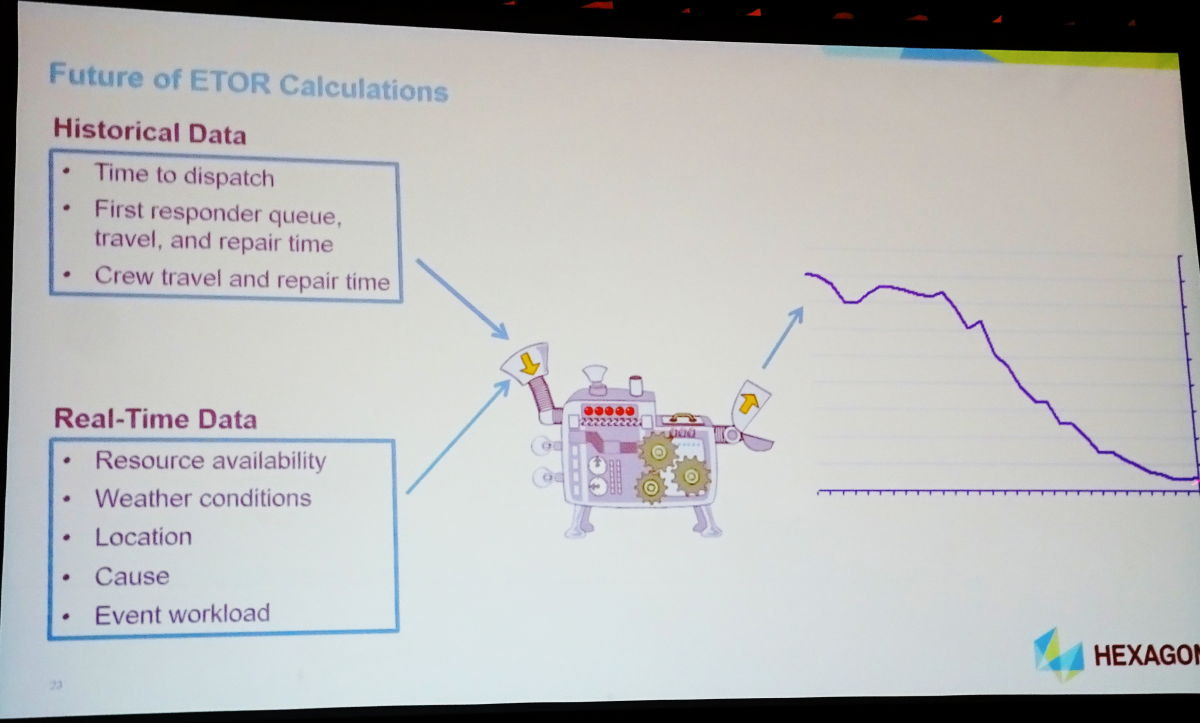 In their first attempt to improve the estimated time of restoration, Oncor looked at factors such as time to dispatch; first responder queue, travel and repair time; and crew travel and repair time for which they had fairly reliable historical data. They found that estimated restoration times based on historical data alone did not get them to where they wanted to be to achieve their 70-80 % target. They concluded that they needed to take into account real-time factors especially location of the outage and location of crews as well as crew availability, weather conditions, cause of the outage, and event workload. Phase 2 of the project will incorporate these factors.

Be the first to comment