
USS Ford
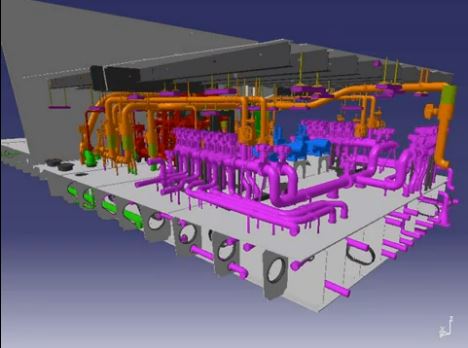
Nov 8 the U.S. Navy will be christening the USS Gerald R. Ford, the Navy’s newest aricarft carrier, and a very different ship from any previous carrier. Among other firsts it is the first Navy ship designed using what the Navy calls a “3D product model”, aka BIM.
But what is most revolutionary about the Ford is its use of electricity to power things that used to be steam driven. The Ford’s propulsion system is still steam-driven. The steam is generated by two A4W nuclear fission pressurized water reactors (PWRs) designed by Bettis Atomic Power Laboratory and Knolls Atomic Power Laboratory and built by Westinghouse Electric Corporation. But much of the equipment which used to be steam-driven on previous aircarft
carriers is electrical on the Ford including weapons systems, aircraft
catapults, aircarft arrestors, and weapons elevators.
 With respect to electrical generating capacity, the Navy says the Ford has 250% the capacity of the Nimitz, an earlier generation of nuclear powered carrier. The Nimitz has eight steam turbine generators each of which can produce 8,000 kilowatts (8 MW) of electrical power for a total 64 MW. So I calculate that the Ford can generate 250% of this or 160 MW.
But the ship that was just launched last Monday goes even further in its use of electrical power.
 USS Zumwalt
The USS Zumwalt is a guided missile
destroyer. What differentiates the Zumwalt from any previous Navy ship
is that it is entirely electrical including the propulsion systems, ship’s services and weapons systems.
To support this the Zumwalt has the capacity to generate 78 megawatts (MW) of power. It uses an Integrated Power System (IPS) that provides power to propulsion, ship’s service, and combat systems from the same gas turbines.
The propulsion system is an all electrical drive system. Two Rolls-Royce Marine-Trent 30 (MT30) 36 MW gas turbine generators power the all-electric drive and other systems with an integrated power system (IPS). The MT30 has 80% commonality with the Rolls-Royce Trent 800 aero engine used on the Boeing 777.

Be the first to comment