
I’ve blogged about the Delhi Mumbai Industrial Corridor, (DMIC) a huge US$ 90 billion project 1,483 km in length linking Delhi and Mumbai. The objective of the DMIC is to create a base for economic development by providing access to the best state-of-the-art infrastructure. This project includes nine large Industrial zones of about 200-250 km2., a high speed freight line, three ports, six airports and a 4000 MW power plant. An influence region of 150 km on either side of the freight line comprises the DMIC. It strikes me that what is being created is a megaregion, a concept that is getting a lot of attention in the United States,
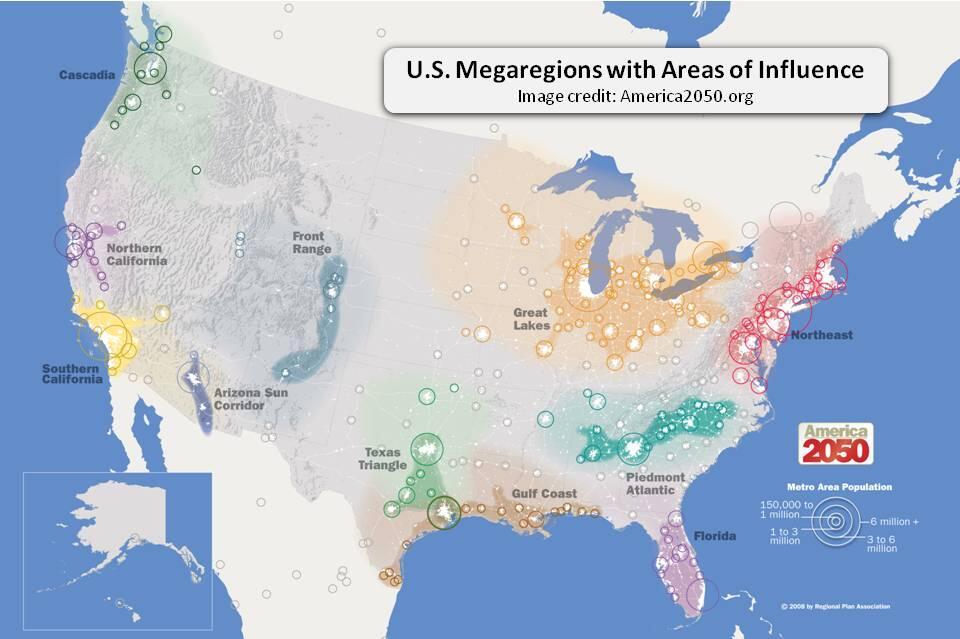 A megaregion is a new scale of geography that blurs the traditional boudaries between metropolitan regions, like what the DMIIC is doing with respect to Mumbai, Delhi and other smaller cities. These population centers include Interlocking economic systems, shared natural resources and ecosystems, and common transportation systems. Population growth and increasing urbanization are the driving forces behind megaregions.
America2050 has defined 11 megaregions in the United States. Megaregions are defined by relationships that define a common interest.. According to Amerca2500 the five major categories of relationships that define megaregions are:
- Environmental systems and topography
- Infrastructure systems
- Economic linkages
- Settlement patterns and land use
- Shared culture and history
Most of a country’s rapid population growth and economic expansion is expected to occur in these megaregions.
These aggregations are so large that they need to be modeled and managed as smart cities. For example, the Delhi Mumbai Industrial Corridor (DMIC) is intended to be comprised of seven smart cities. According to URENIO these smart cities are compact, vertical developments. They use digital technology to create smart grids for better management of civic infrastructure. They have an efficient public transportation system. They recycle sewage water for industrial use. Green spaces, cycle tracks and easy accessibility to goods, services and activities are designed to foster a sense of community.. They have underground utility corridors for parking, sewage disposal and communication lines. Public transport is available within a 10-minute walk from home or office.

Be the first to comment