
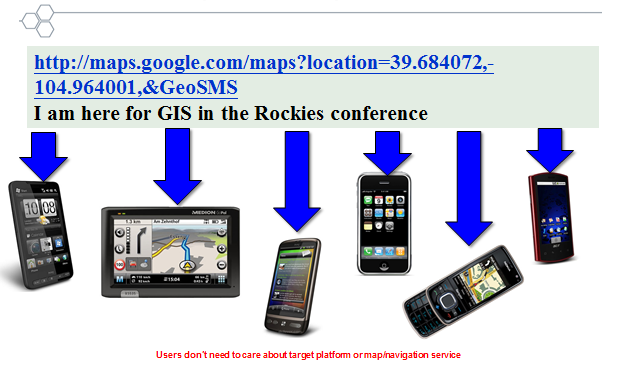
I have frequently blogged about some of the important geospatial standards that have been fostered by the Open Geospatial Consortium, most recently about a new Energy and Utilities Domain Working Group (DWG) for the electric, gas, oil and water services industries, the recently adopted GeoSMS standard which is an extended Short Message Service (SMS) encoding and interface for exchanging location content between devices or applications, and the new Geosynchronization Services (GSS) standard for synchronizing distributed geospatial data stores.
Last week at the GIS in the Rockies annual conference in Denver Carl Reed of the Open Geospatial Consortium gave an overview of some of the directions geospatial standards are evolving. It was really quite amazing to hear about such a range of application areas where OGC standards are making it possible for the exchange of information between different devices from different vendors.
GeoSMS and GSS
Carl gave several examples of how the GeoSMS simple messaging protocol and GeoSynchronization Services (GSS) are being applied in the real world. An important example is a mobile use case involving an earthquake in a densely populated area. A combination of GeoSynchroization Services (GSS), GML, and WFS standards allows first responders in the field to get situation assessments including maps on a variety of hand held devices.
Distributed geospatial updates
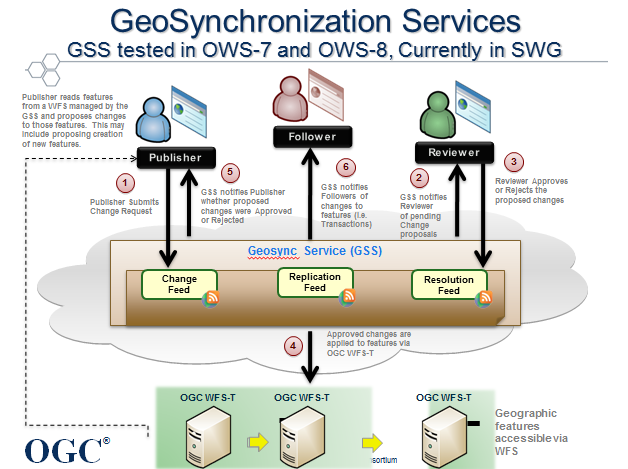 Another very relevant use case that is being tested as part of an OGC testbed involves using GeoSynchronization Services (GSS) to enable a large enterprise to receive real-time geospatial updates published by many users and sources, review them, and then insert those updates into web feature services (WFS) operated by many organizations in many different locations.
Integrating indoor and outdoor navigation
Imagine not only getting directions from your house to a shopping mall, but getting directions from your house to the specific counter in the hardware store where plumbing fixures are displayed. 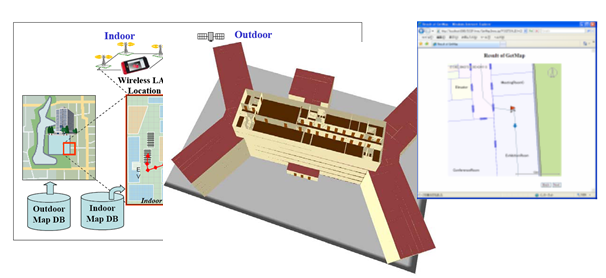 This type of integrated indoor/outdoor navigation applications are being developed using OGC CityGML and WMS standards.
Augmented reality standard
Augmented reality involved superimposing imagined structures on the real world. It is being widely used by architects and designers to visualize what a new building or other structure will look like in situ. At the OGC there is a Augmented Reality Markup Language (ARML) that is under development as a profile of the widely used OGC KML standard developed by Google.
Linking citizen observatories
Recently there has developed an wareness that “it is no longer sufficient to develop passive lists or reports to ‘inform’ citizens of changes in our environment. We need to engage with citizens and ask how they can ‘inform’ us.” (Prof. Jacqueline McGlade, Executive Director, European Environment Agency). As a result the concept of a citizen observatory has evolved which allows citizens to monitor and report on environmental issues such as biodiversity loss, environmental degradation, and the impact of climate change.
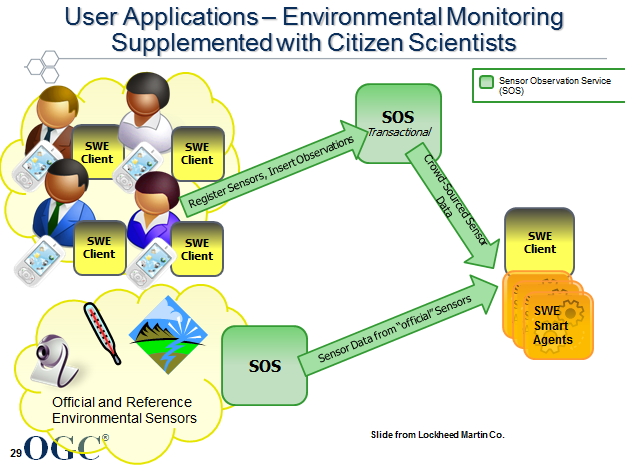 The Citizen Observatory Web (CobWEB) is intended to link these citizen observatories, providing a standards-based way of linking to sensors and mobile devices and enabling crowd-sourced, geospatially-based information about our environment.
It will rely on the OGC Sensor Web Enablement (SWE) standard, that provides interoperability interfaces and metadata encodings for real time integration of heterogeneous sensor webs involving devices such as flood gauges, air pollution monitors, stress gauges on bridges, mobile heart monitors, Webcams, and robots as well as space and airborne earth imaging devices into the information infrastructure.
Internet of things
It is projected that the Internet of things, the interconnection over the internet of everyday intelligent objects, will include15 billion devices ranging from pollution monitors to refrigerators by 2015. It will involve indoor/outdoor location, sensor webs, building information models (BIM), intelligent devices comprising the smart grid, devices for environmental monitoring, and household appliances.
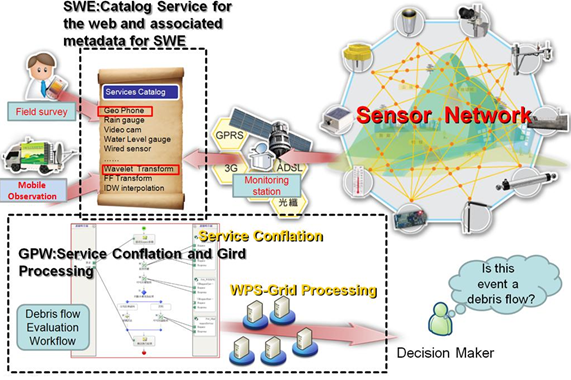 It will require standards such as the Sensor Web Enablement (SWE) standard to allow all these devices, from many different vendors, to intercommunicate. Carl gave two examples, one involving tracing fresh meat, absolutely critical in tracing meat as a source of infection, and another application used to monitor debris flow in Taiwan.
Importance of location standards
The most important things that I came away from Carl’s talk with are first the wide range of domains where geospatial standards are being applied and, secondly, the realization that standards are becoming even more important than before, because we are on the brink of interconnecting billions of devices from hundreds of thousands of different vendors in many different countries over the internet. Without standards it will be impossible to turn this data into actionable information.
The other aspect of this new world of interconnected devices is that location is also becoming more important because, thanks to inexpensive GPS chips and the development of new GNSS systems by Europe and China and others, sensors these days can report their location.

Be the first to comment