
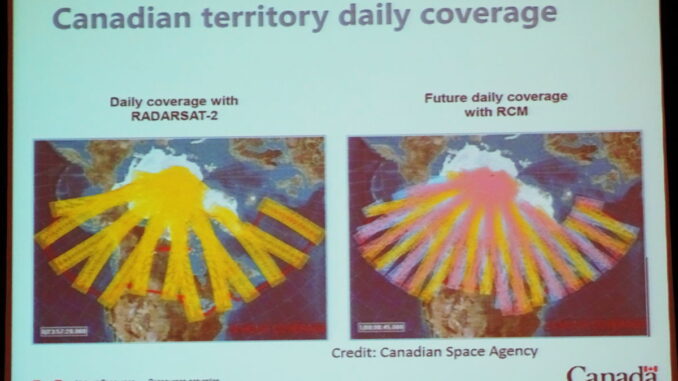
Canada’s first synthetic aperture radar satellite was launched in 1995. Since then Radarsat-2 was launched in 2007 and continues to operate. In June of this year the Radarsat Constellation (RCM) was launched. At the GeoIgnite conference Sergey Samsonov, Canada Centre Remote Sensing (NRCan), explained that in addition to the technical improvements such as a revisit time of four days and data latency for some applications as low as 10 minutes, RCM data will be made available at no cost. This is a different business model from Radarsat-1 and Radarsat-2 and is intended to reduce entry costs for developers and entrepreneurs. The RCM data will be available through the Earth Observation Management System. In addition earlier this year the Canadian Space Agency and the Canada Centre for Mapping and Earth Observation made RADARSAT-1 images of Earth available to researchers, industry and the public at no cost. The 36,500 images are available through the Earth Observation Data Management System.
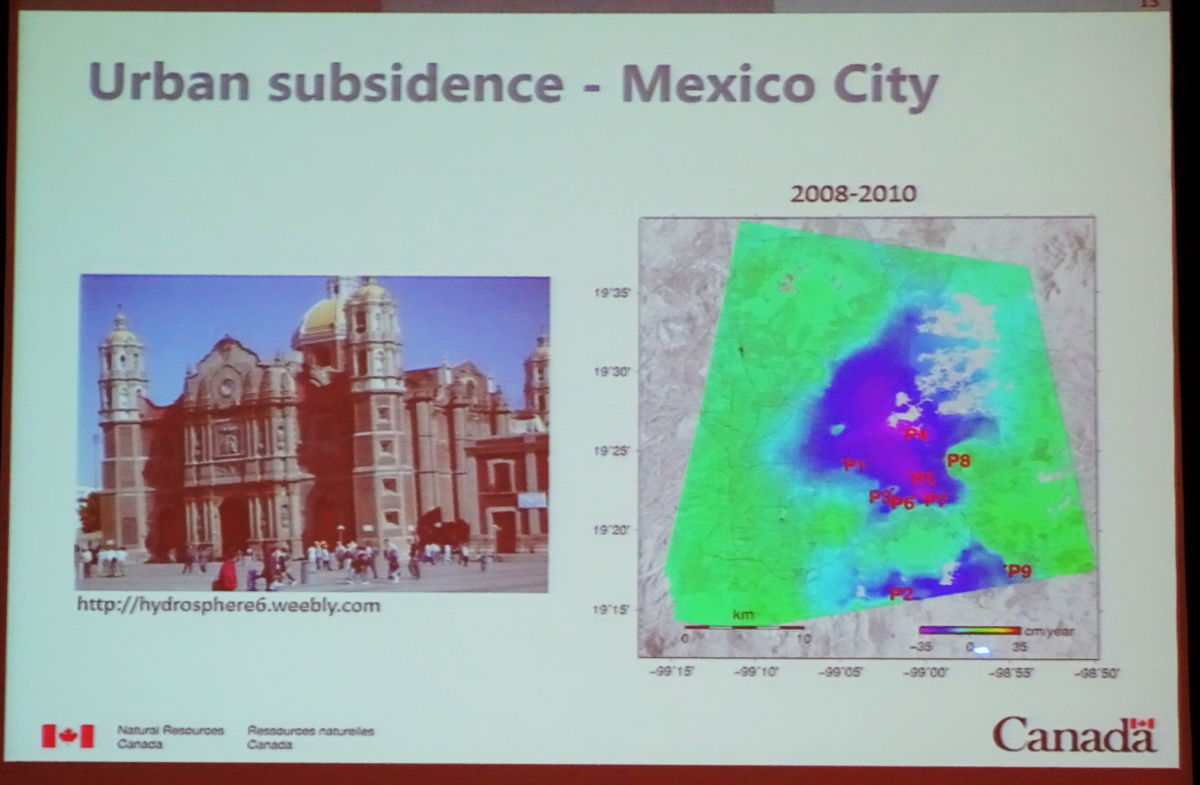 One of the primary benefits of radar is that it is not affected by cloud cover. Radarsat-2 and RCM are capable of one meter resolution, although five meter is more typical. In addition the Radarsat satellites are capable of using interferometry to measure centimeter movements and deformations of the Earth’s surface in the horizontal and vertical directions. In his talk Sergey Samsonov showed some examples from Radarsat-2 of subsidence in Vancouver, Seattle, Mexico City, Alberta, and other locations detected by radar interferometry. I have blogged about an application Network Alert developed by Planetek that uses satellite radar interferometry to detect ground subsidence and to alert municipal water network operators of possible water leaks.
The new constellation dramatically improves the ability to monitor changes on the Earth’s surface. The revisit time for the new constellation is much shorter. While the previous satellites had a revisit time of 24 days, the new RCM satellites will revisit the same location every four days with a greater frequency in Canada’s fat north. The time between data acquisition and the data being available with the RCM constellation is remarkable. The data latency for the new RCM constellation depends on the type of data. For ships in Canadian waters it is 10 minutes. For other maritime surveillance it is 30 minutes. For Canadian and global disaster management it is 2 hours – and remember it is not affected by cloud cover. For ecosystem monitoring applications the daya will be available in 24 hours. Pre-defined recurrent observation scenarios (standard coverages) will be made available to users in advance of acquisition.
The RCM is designed for three main areas: maritime surveillance (ice, surface wind, oil pollution and ship monitoring), disaster management and environmental monitoring. While the mission design initially focused on maritime security requirements, land security, particularly in the Arctic, will be dramatically enhanced. In addition economic growth is also being targetted. Developers and entrepreneurs are being encouraged by an open data policy to develop a wide range of applications in Canada and internationally.
Be the first to comment