
New rules for commercially operating UAVs in the U.S. have been published by the FAA as Part 107 of the Federal Aviation Regulations. These cover commercial uses of drones weighing less than 55 pounds. First and foremost the rules requires that the UAV be kept within unaided sight. However, you can request a waiver of most operational restrictions if you can show that your proposed operation can be conducted safely. As I blogged a year ago Xcel Energy obtained a waiver to fly UAVs for beyond visual line of sight (BVLOS) operations. Furthermore on July 15, 2016, President Obama signed the FAA Extension, Safety, and Security Act of 2016. The 2016 Act requires the FAA to establish a process to allow certain UAV operations related to utilities, pipelines, and oil and gas production to be conducted beyond the visual line of sight (bvlos) of the operator and either in the daytime or nighttime.
The maximum speed is 87 knots and you can’t fly a small UAV over people who are not directly participating in the operation. But also interestingly, operations are allowed from a moving vehicle if flying over a sparsely populated area. Since transmission lines traverse sparsely populated corridors, utilities are now using UAVs piloted from moving vehicles for vegetation management for transmission lines.
Secondly, to operate a small UAV under Part 107, you need a remote pilot airman certificate with a small UAV rating. The drone itself does not have to be registered with the FAA. The maximum allowable altitude is 400 feet above the ground. But interestingly it can fly higher if the drone remains within 400 feet of a structure. This allows drones to be used on construction sites of tall structures, for example.
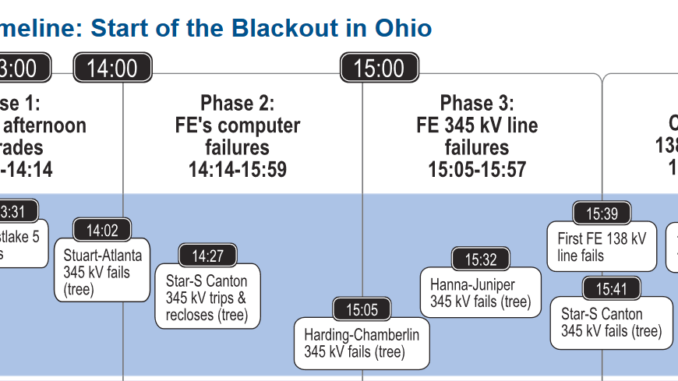
Tree contacts account for 30% of outages in North America. For example, trees caused the 2003 blackout of the Northeast. The new regulations mandated in the 2016 Act would enable low cost, fully automated scanning of transmission lines for vegetation management as required by NERC (NERC FAC-003-3). By combining LiDAR scanning on a UAV platform with automated extraction of transmission lines spans, pylons and vegetation and identification of vegetation encroachment risks, it is now conceivable that in the near-future outages due to vegetation interaction with transmission lines can be dramatically reduced because scanning is becoming much less expensive.

Be the first to comment