
At the NRECA TechAdvantage conference in New Orleans Gary McNaughton, MultiSpeak Techical Coordinator gave a comprehensive overview of where the MultiSpeak interoperability standard is and where it is headed. If you’re not familiar with MultiSpeak, it has been developed under the auspices of NRECA and is intended as an industry-wide standard for the exchange of information for electricity distribution utilities and all vertically-integrated segments except power marketing and generation. It is used by more than 725 electric coops, investor-owned, and municipal utilities in 19 countries and is widely recognized and supported by North American software vendors.
Cybersecurity
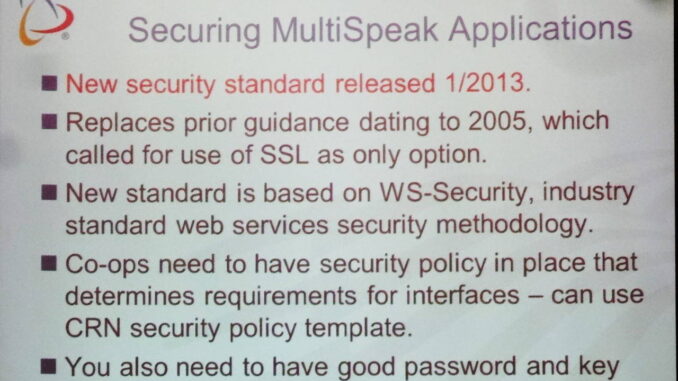
In light of President Obama’s recent Executive Order on cybersecurity for critical infrastructure, security has become even more critical and Gary’s message is that utilities need to get very serious about it. To support this a new security standard for MultiSpeak was released in January 2013. It goes beyond secure sockets (SSL) and transport layer security (TLS) and implements message-level security. The standard requires that vendors support four security options, which they have agreed to do.
- None (for debugging)
- SSL or TLS
- Message-level – by message
- Message-level – by session
It is up to the utility to decide which of these it needs to implement. There is a Cooperative Research Network (CRN) security policy template that is designed to help utilities to choose the appropriate option. The standard has been submitted to Smart Grid Interoprability Panel (SGIP) for inclusion in the Catalog of Standards for the smart grid.
Use cases
The MultiSpeak team has developed over 300 use cases for specific business processes such as connecting a customer. They cover business processes for demand response, meter data management, meter prepayment, outage management, and asset management. So far they do not include GIS-related use cases (MultiSpeak has supported geospatial data types for years.)
Harmonization with CIM
MultiSpeak and the Common Information Model (CIM) have been converging in many ways over the years. But according to Gary, at this point there is no plan to harmonize the two models in Version 5. And it is not clear if they will ever be harmonized.
MultiSpeak 3
The big news is that there will be no further bug fixes and enhancements for Version 3, which is the most widely used version of MultiSpeak. Gary said there was no reason for utilities to stop using Version 3, which is 10 years old now, unless the additional functionality in later versions is required.
MultiSpeak 4
Versions 4.1.5 and 4.1.6 have been released, with enhancements specifically to support the MultiSpeak Regional Demonstration project. It is expected that vendors will begin implementing support for this Version 4.1 in the next few months. The big advantages of 4.1 are a more consistent data model and support for AMI, DR, MDM, AVL, and work management. A nice thing about. MultiSpeak’s web services implementation is that it means that a utility can run several versions of MultiSpeak concurrently.
MultiSpeak 5
Work has begun on a new version which will include work management enhancements and, most importantly, modernized web services support. A prerelease will be available in May 2013.
Enterprise Service Bus
Gary made a persuasive case for using Multispeak in all but the simplest implementations with an enterprise service bus because it eliminates some of the problems associated with point to point messaging over TCP/IP. For example, TCP/IP does not guarantee that a message is received or that several messages will be received in the expected chronological order.

Be the first to comment