
At the NRECA TechAdvantage conference in New Orleans Craig Miller and David Pinney of the Cooperative Research Network (CRN) gave an overview of a joint project between the Depatrment of Energy (DoE), NRECA, several electric power coops, Oakridge National Lab (ORNL), National Renewable Energy Laboratory (LREL), and Pacific Northwest National Lab (PNNL), that has important implications for all utilities that are attempting to prioritize future smart grid investments in their distribution networks.
Background
About four years ago DoE invested $33.9 million in a smart grid demonstration project or more accuratelu a portfolio of projects conducted by CRN. The research projects focused on distribution automation and demand response. One of the things that CRN did as part of this demonstration project was to survey National Rural Electric Coop Assn (NRECA) members to determine what they saw as the most important barriers to implementing a smart grid. The barriers that were reported by the respondents were, in rank order,
- Customer resistance
- Data volume and computational complexity (analytics) – utiltiies were facing 100K to 200K times as much as data that they were currently managing
- Communications – moving the data
- Interoperability – many incompatible systems
- Cybersecurity
- Cost/benefit – at that time there was little data on the costs and expected benefits of various SG technologies to help prioritize investment
Recently the membership has been resurveyed. After four years it was found that the perception of the relarive importance of the barriers has changed. In the most recent survey respondents identified cost/benefit as the highest priority barrier to smart grid adoption and CRN has developed a project to specifically address cost/benefit.
As a first step the project researchers looked at the cost/benefit models being used by vendors of smart grid product and services. What they found was such a wide range of models with different assumptions, different data, different grid models, and different ways of estimating costs and benefts, that it was impossible to compare different smart grid investment options and vendors. As Craig Miller put it, it was not even a question of comparing apples and oranges, it was more like attempting to compare apples, oranges, and ’57 chevies.
Open Modeling Framework (OMF)
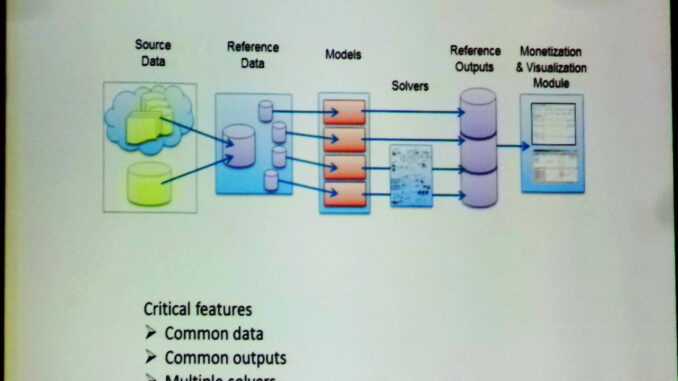
This led to a joint project between DoE, CRN, ORNL, and PNNL to develop a common framework for modeling distribution grids and estimating the costs and benefits of alternative investment decisions that woudl allow comparison of different options The framework would provide standardized data sets, for example, NOAA weather data, and computational modules including modules for modeling grid physics, such as GridLAB-D™, but would allow different data sets and computational modules to be used. The framework would incorporate a monetization and visualization component that would perform financial analyses that could be compared across different smart grid investment options. The most important features were
- common data
- common outputs
- multiple solvers (computatuional grid modules)
- run mgmt
All of these components can be customized, but the frameowrk is designed to make the outputs and the subsequent analysis comparable.
OMF is comprised of open source components and runs in the cloud. PNNL is working on the solvers (grid modeling software), with a particular focus of improving performance. ORNL is working on the monetization and visualization component. Currently OMF takes Milsoft grid topology for input, but in the future the Intention is to support other vendors as well as the MultiSpeak and CIM standards.
OMF live demonstration
During the presentation OMF was actually demonstrated. We were shown how to setup and run a scenario that involved conservation voltage reduction (CVR). The grid configuration (feeders) were brought in from Milsoft. Various ways of visualizing network topology were demonstrated (surprisingly none include a geospatial representation though GIS is on the roadmap apparently). Different ways of modeling demand were shown. For exmaple, there is a residential demand model that simulates appliances and other sources of domestic demand. There is a feeder model and ultimately they intend to incoporate vendor specific equipment models, for example for Cooper or Schneider Electric transformers. For this CVR simulation, they introduced a generalized volt/var controller.
A network with CVR and without CVR was simulated for a location in California over a period of three months. Using the output from the grid simulation, financial analyses were performed for the two cases, with CVR and without, and the cost and benefit of the CVR option computed.
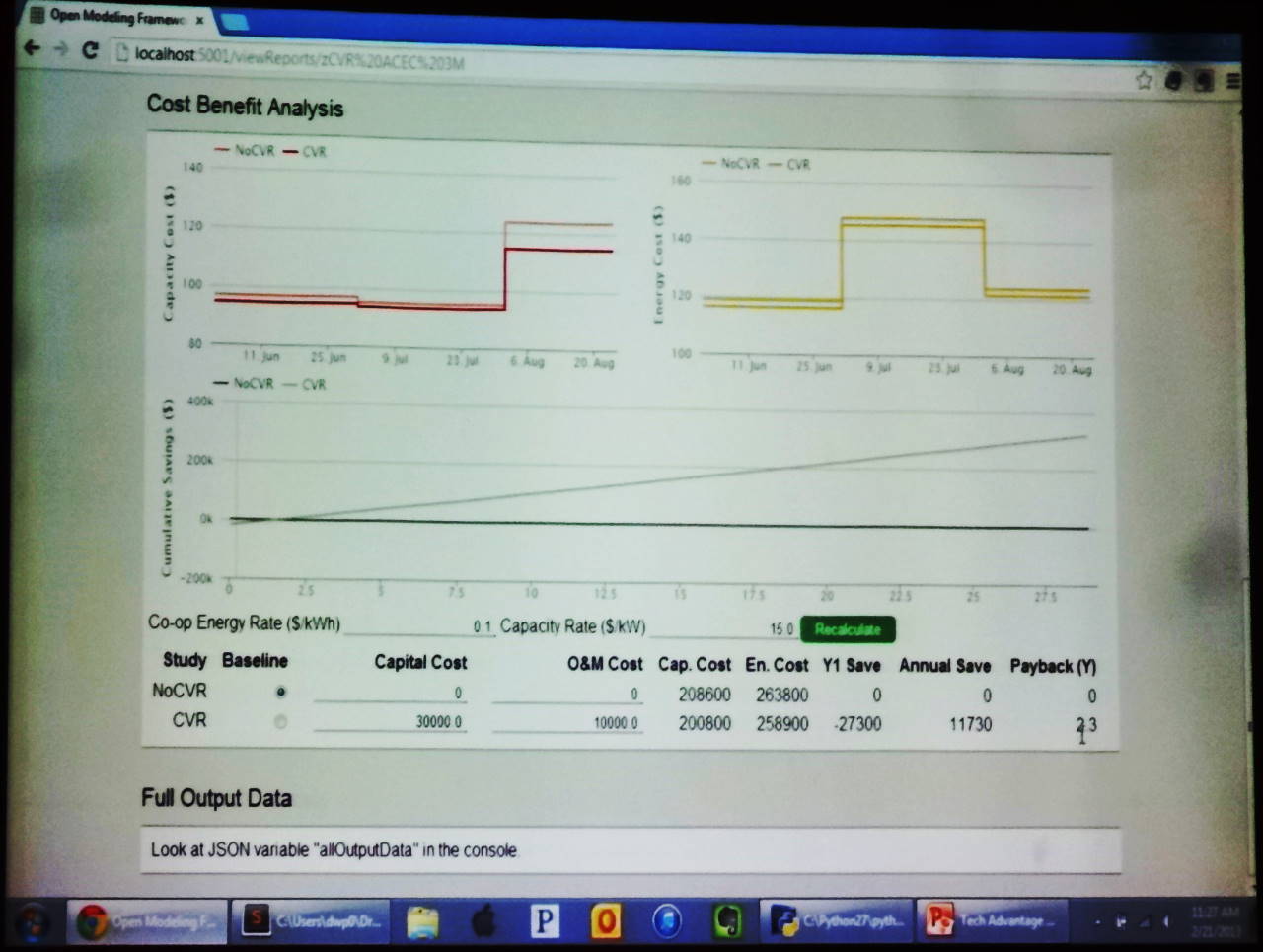 It was possible to look at physical parameters, for example, to determine if CVR was effective in shaving peak loads. It was found that in some cases CVR reduced peak load, but not always. The financial analysis determined that there was a net benefit from CVR, and that the payback was estimated to be about 2.3 years.
Since the monetization analysis runs using the ouptut from the grid simulation, it can be rerun with different financial assumptions without having to rerun the grid simulation.
The power of OMF is that it can be used to compare different smart grid investment options, for example, residential solar with batteries, utility solar with batteries, CVR, and wind generation.
Criag Miller said that OMF will be formally released this summer and will be open to all utilities.

Be the first to comment