
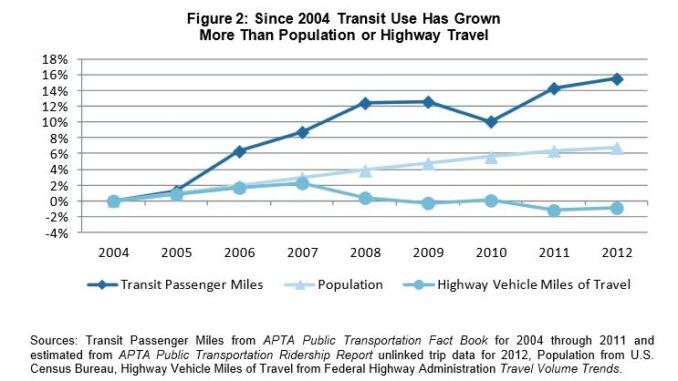
The American Public Transportation Association (APTA) has reported that public transportation use in the United States in 2013 reached 10.7 billion trips/year which is the highest number in 57 years. Ridership data has been collected ridership information since 1917. The highest U.S. public transit ridership number in history was 23.5 billion trips in 1946.
Over the 18 year period 1995-2013, public transit ridership grew 37.2 %, faster the population growth of 20.3 % for the period. APTA starts its analysis in 1995 number because after that ISTEA legislation and other surface transportation bills led to increased funding for public transportation.
The APTA analysis shows the 2005 gas price shock, the Millennials’ desire for alternatives to cars and the Baby Boomers’ return to urban areas, are important contributing factors that have led to the highest public transit ridership since 1956.
Growth in trips in New York was higher than for the entire U.S. , but other cities that have invested in high frequency public transportation and transit-oriented development policies are experiencing significant ridership growth. Since the end of the recession; 59.3 % of ridership growth occurred outside of New York City.
Incredibly, 45 % of American households do not have access to any public transportation at all. A recent survey of public sector officials and senior-level real estate executives (developers, investors, lenders and advisors) conducted by the Urban Land Institute and EY found that the highest priority for investing in infrastructure was public transit services (bus and rail).
In 2013 heavy rail (subways and elevated trains) ridership increased by 2.8 % across the country as 8 out of 15 transit systems reported increases. Commuter rail ridership increased by 2.1 % in 2013 as 20 out of 28 transit systems reported increases. Light rail (modern streetcars, trolleys, and heritage trolleys) ridership increased 1.6 % in 2013 with 17 out of 27 transit systems reporting increases. Bus ridership increased by 3.8 % in cities with a population of below 100,000.

Be the first to comment