
At the Data Analytics for Utilities
conference in Toronto today, David O. Jermain gave a fascinating presentation on the state of plug-in electric vehicles (PEVs) in Southern California and how they have affected the local utility, Southern California Edison (SCE).
Utility folks have been of two minds about PEVs, whether to treat them as a massive electricity load growth opportunity, like air conditioners several decades ago, or as just another type of hair dryer. (But PEVs are actually quite different from either air conditioners and hair dryers because hybrid PEVs like the Chevy Volt can generate as well as consume electricity and PEV’s batteries could potentially supply electricity to external devices.)
PEVS in Southern California
David provided some very suggestive statistics about the deployment of PEVs in SCE’s service area and the number of calls related to PEVs that the SCE call centre gets.
#PEVs
- 2010 1000
- 2011 1650 (65% increase)
- 2012 5200 (300% increase)
Two thirds of these PEVs charge at level 1 (120 V). One third charge at level 2 (240 V).
Calls received by the SCE call centre suggest that at long last, PEVs may be beginning to take off. Calls to the SCE call centre that relate to PEVs have increased by 350% over the last year. The number of email inquiries relating to PEVs has increased by 360%. The number of pageviews on the SCE web site that relate to PEVs has increased 14-fold.
# pageviews
- 2011 1,600
- 2012 23,000
Since California probably leads the U.S. in the deployment of electric vehicles, what is happening there right now may be what the rest of North America will see in a few years.
How do PEVs affect the local distribution utility
Some people at utilities worry about whether the local distribution network would be able to handle a scenario in which everyone goes home after work and plugs in their PEV. The concern is that the resulting surge or spike could overload transformers and worse. There is also a concern that customers would require a lot of support from customer service folks. SCE has developed a very elaborate workflow to integrate PEVs and PEV customers, but so far it really hasn’t been necessary to use it.. So far PEVs haven’t created problems for the local distribution grid and SCE’s customer satisfaction statistics have not been negatively affected either.
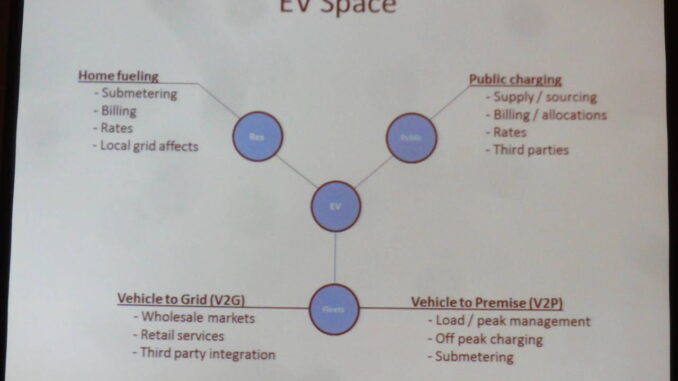
But from the perspective of the market, PEVs present challenges. David broke these down into issues relating to home fueling, public charging and how to handle fleets, for example, the Department of Defence and companies like Frito-lay have bought a considerable number of PEVs. The issues involve rates, submetering, the relationship with third party vendors who provide charging services, demand response, and so on.
Load shaping
One of the very interesting opportunities where PEVs could actually improve the reliability of the grid is in load shaping to balance intermittent energy sources like solar PV and wind. Germany has been using a variety of techniques for years to sculpt load to balance wind and other intermittent energy sources. A fascinating study by the Pacific Northwest National Laboratory
(PNNL) looked at the possibility of using battery capacity in plug-in
electric vehicles to mitigate imbalances from wind generation in the
power grid.
Another interesting possibility is where PEVs could act as residential batteries during outages or to reduce costs where time of use pricing is available.

Be the first to comment