
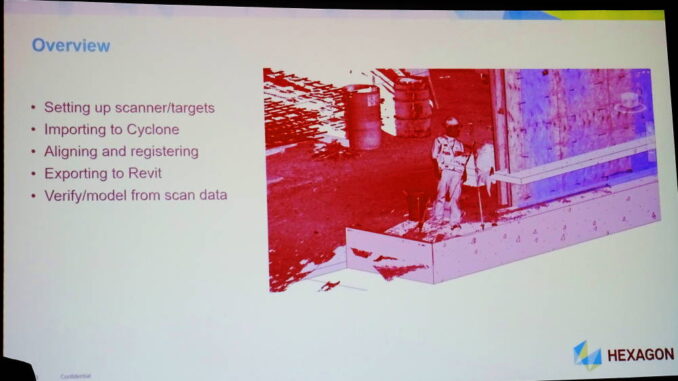
At HxGNLive in Las Vegas this week a very interesting presentation with practical implications for anyone involved in construction, whether buildings or horizontal infrastructure was provided by Stanley Lawrence, Reid Flamm, and Michael Moore of Datum Tech Solutions, a Hexagon partner who focus on bridging the divide between the model and the field for owners. They described a very practical approach applying laser scanners to ensure that the owner is reassured during construction that what is actually being built is what was designed . Since this is a Hexagon event they reported used Leica ScanStation P30/P40 scanners with Cyclone software. The model is designed in Revit. I expect the process is general and could be used with other hardware and software.
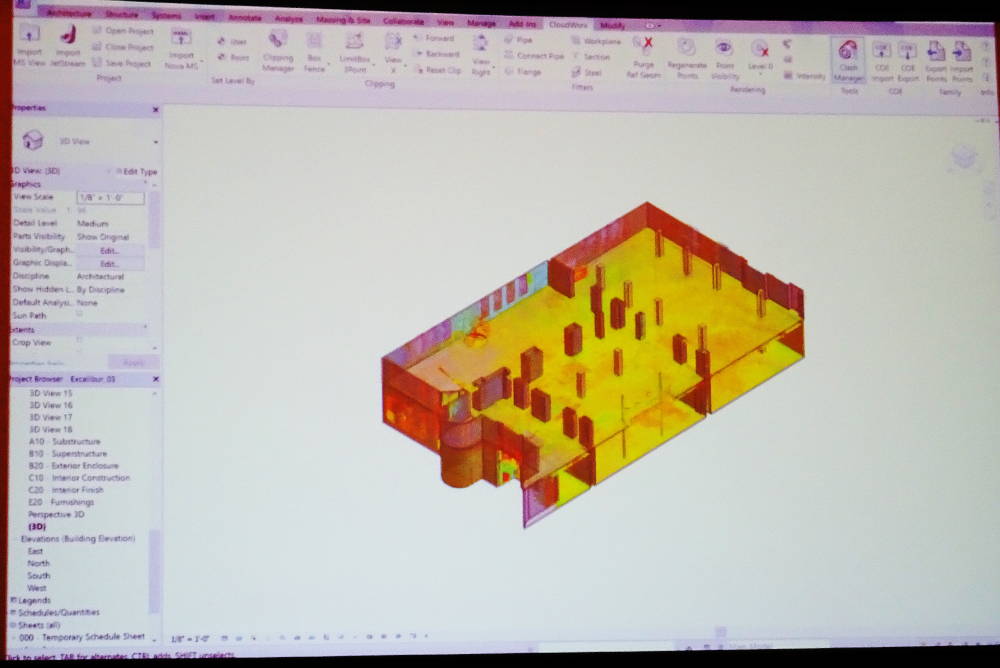 The detailed process involves setting up the scanner and capturing control points and then performing scans. The point clouds are imported into Cyclone and then exported to a PC. The data is registered and aligned and a ModelSpace coordinate system is setup for Revit. The scanned data and coordinate system are imported into Revit using CloudWorx. The scanned data is used to manually create a level of detail (LoD) 350 Revit model. To verify that their model accurately reflects what was scanned, they take their scanned data back out into the field and verify it with a Total Station. Then they use Autodesk Point Layout (APL) to compare what has been built to what was designed and look for divergences.
They report that this process is very efficient so they are able to carry out scans frequently during construction to catch problems early. For example, they will scan right after pouring concrete for floors or after installing electrical wiring, plumbing or HVAC for a floor. In addition to keeping the owner in the loop during construction, at the end of construction they are able to provide the owner with scans of the final building. They also can provide scans from during construction to provide digital “as-builts” of hidden infrastructure such as electrical wiring, HVAC and plumbing. Owners find that this information is useful for facilities management during operations and maintenance.

Be the first to comment