
At GeoAlberta 2015 Susan Ancel of EPCOR, a diversified water and electric power utility headquartered in Edmonton, Alberta described a unique solution to the problem of knowledge transfer from older, experienced to new, younger employees. EPCOR builds, owns and operates electrical transmission and distribution networks, water and wastewater treatment facilities and infrastructure in Canada and the United States.
I have blogged extensively about some of the workforce challenges that utilities in the developed economies are facing. These are often related to the aging workforce and in some countries to a shrinking workforce.
I have blogged about the shrinking workforce in countries around the world like Japan and Germany, where there have been declining populations. The shrinking workforce is acting as a brake on the German economy. Recently Germany liberalized its immigration laws and for the first time in a decade the population of Germany is actually increasing.
In the U.S. because of its policy of encouraging immigration, the shrin king workforce is not the result of population decline, but the result of a decreasing participation rate. One explanation for the decline is the aging workforce. Boomers are retiring at a rapid rate. This has created a serious problem for many utilities where it has been estimated that over half the work force will be eligible to retire in the next few years. But there is another trend that tends to mitigate this, the percentage of older workers who remain on the job post-retirement is trending upwards. For the age group 65 to 74 the proportion of workers still working is nearly twice what it was in the 1990s. In the long term the problem remains, finding young workers to replace the older workers when they retire.
A recent report from PricewaterhouseCooper’s (PwC) Human Resource Services practice based on data from 29 utilities representing nearly a quarter of a million employees identifies some very interesting workforce trends, some new, in the power utility industry.
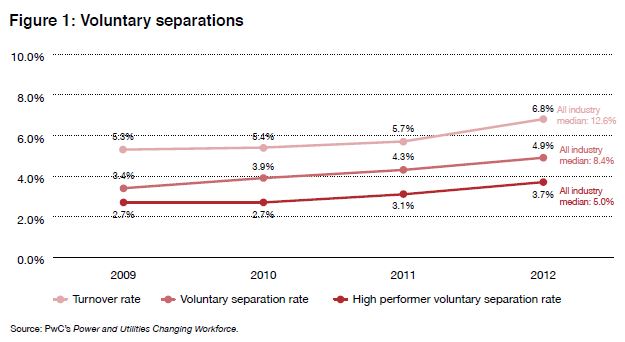 PwC research indicates that utilities are losing workers at an accelerating rate. The voluntary turnover rate increased by a full percentage point between 2010 and 2012, and for high performers and early tenured employees the rate of separation was especially high.
Critical knowledge loss
Older utilities workers tend to communicate information orally rather than documenting it in a database. When these workers leave, critical knowledge leaves with them. This impacts productivity and creates risk for the utility, especially when they leave before replacements can be effectively on-boarded.
Younger workers tend to be much more tech savvy. This is critical for the electric power industry as it moves toward the smart grid. But younger workers lack the electric power that only experience can provide. They desperately need to have access to information that is stored in the brains of older workers.
Knowledge transfer
PwC recommend that utilities organizations need to adapt rapidly to these technology, resource and demographic trends. In particular, they need to evolve an efficient and effective approach to succession planning and knowledge transfer. PwC points out that an aging workforce, deeply knowledgeable but prone to resist change, need to be fully integrated participants in the change effort.
At EPCOR succession planning resulted in Project Knowhow that put handheld devices into the hands of older workers with a cloud-based application that enabled them to rapidly take field notes. For example, they could take a picture and record the location of a transformer that was moved from its design location to avoid soggy, frequently inundated land. The could add notes like “I had to replace this transformer twice because of water damage, so we decided to move it 100 meters to the northwest.” Susan credits the power utility in Sendai, Japan with the idea behind Project Knowhow. In Japan in a similar project handhelds had been put in the hands of experienced workers several years before the Fukushima disaster. The information gathered from older workers was instrumental in quickly dealing with the after effects of the tsunami.
Operational effectiveness is critical for utilities, but with a static or even decreasing workforce, productivity has to improve and continue to improve. Driven by goals of improving productivity and improving the quality of their decision making through data-driven analytics, utilities are recognizing the importance of understanding their core business processes and implementing standardized, streamlined IT systems for these processes. PwC recommends that as a first step these processes need to be documented (before the knowledge about them walks out the door) by projects such as EPCOR’s Project Knowhow to safeguard core institutional knowledge as part of change management practices.

Be the first to comment