
There has been impressive progress in developing open standards for the integration of geospatial and AEC (architecture, engineering and constcruction) views of city infrastructure which provides a standards-based basis for full-lifecycle management from design through to operations and maintenance of infrastructure projects.
At GeoBusiness 2017 in London, Nigel Clifford, CEO of the Ordnance Survey, described a project that is intended to create a smart city model for four square kilometers of Manchester called cityverve. The objective is to apply Internet of Things (IoT) technologies to a real city. It is supported by Manchester City Council, Manchester Science Partnerships, the University of Manchester, Ordnance Survey, Cisco, BT and other tech players and well as government and Innovate UK. It is intended to provide an open platform of platforms. Among the fundamanental things that will be required to do this is open standards for modeling city infrastructure and to make this accessible to the geospatial and AEC communities.
Years ago private Dutch engineering and construction companies began adopting an integrated geospatial/BIM approach to construction. I blogged previously about the firm Royal BAM Group nv / BAM Infraconsult that adopted integrated BIM and GIS because many of its projects require full life-cycle BIM. At the first GeoBIM conference in Amsterdam, Jothijs van Gaalen gave some real world examples of Design, Build, Finance and Maintain (DBFM) highway construction that included GIS+BIM integration. BAM’s motivation for investing in BIM+GIS are market developments especially more complex construction assignments and an increasing demand from customers for service provision throughout the entire life cycle of a project. As another example, ARCADIS Netherlands has delivered a number of projects that integrate geospatial into the design process.
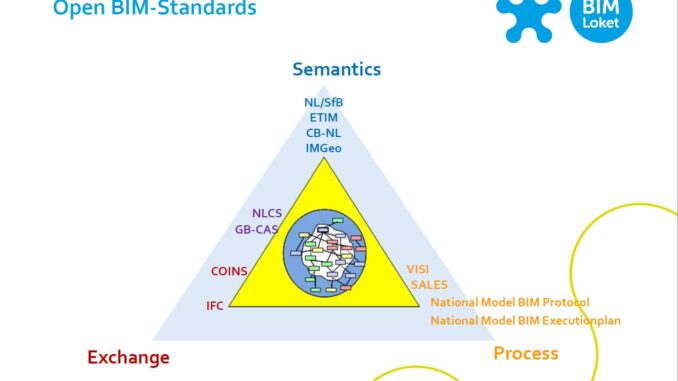
The Netherlands has also led in the development and application of open BIM/geospatial standards in the construction industry including NL/SfB, BS&I, ETIM, CB-NL, IMGeo, CityGML, NLCS, GB-CAS, COINS, IFC, VISI, SALES, National Model BIM Protocol, and National Model BIM Implementation Plan. The Netherlands has created a BIM Loket (BIM Gateway) that is intended to be a national portal for information about BIM and open BIM standards in the Netherlands including related geospatial standards.
In the AEC world Industry Foundation Classes (IFC) are the open and neutral data format standard for the exchange of building information models (BIM) that is widely used in the AEC (architecture, engineering, and construction) sector. The IFC standard was developed and is supported by buildingSMART International.  The IFC BIM standard is used in the construction industry in many countries and is mandated in some such as Finland. The first versions of IFC were intended for buildings (vertical BIM). Recently buildingSMART initiated the IFC for Infrastructure project to extend the IFC standard to support linear transportation infrastructure (horizontal BIM or BIM for Infrastructure) such as rail, road, bridges, and tunnels.
In the transportation infrastructure world the widely used LandXML standard, which is supported by 800 members in the roads and highway transportation sector, includes alignment, road, rail, survey, terrain, land parcels, drainage, wastewater, and water distribution systems. LandXML is not associated with a recognized international standards organization and has had limited support for the past few years.
In the geospatial world a widely used international geospatial standard for cities is CityGML.  Thomas Kolbe and co-workers are the developers of the CityGML standard that has been adopted by the Open Geospatial Consortium. Kolbe et al. are translating a vision of the city as an interactive system comprised of functional components, utility networks connecting components, and interdependencies between utility networks into standards-based intelligent models that can be used to analyze urban environments for a variety of purposes including risk- and disaster management energy consumption, carbon balancing and city life-cycle management.
Currently CityGML includes 3D geometry, topology, semantics, and appearance for urban environments. CityGML also supports a standard mechanism for adding extensions, called Application Domain Extensions (ADEs). There are several Application Domain Extensions (ADEs) that have been developed to extend CityGML to other domains. For example, I blogged about a basic extension UtilityNetworksADE that was proposed for city utility networks. The INSPIRE Data Specifications Annex III contains use case encodings and a data model for Buildings the development of which was strongly influenced by CityGML. There have been attempts to integrate or at least develop a mapping between IFC and CityGML.
 The major breakthrough in bringing the architectural and geospatial views onto a common footing is the OGC LandInfra Conceptual Model developed by the OGC in cooperation with buildingSMART International and approved as an OGC standard in August, 2016. LandInfra was developed by Bentley Systems, Leica Geosystems, Trimble, Australian Government Department of Communications, Autodesk, Vianova Systems AS, and buildingSMART International and provides a unifying basis for land and civil engineering standards including the OGC’s InfraGML and buildingSmart International’s IFC for infrastructure standards.
buildingSmart International’s IFC-Alignment project uses this common conceptual model of alignments for roads, railways, tunnels and bridges. The objectives of the IFC-Alignment project is to enable the exchange of alignment information through the full infrastructure lifecyle from planning through design and construction to asset management. A Candidate IFC-Alignment Standard is open for review now.
InfraGML is the OGC’s application schema supporting land development and civil engineering infrastructure facilities. InfraGML supports a subset of the existing LandXML standard. InfraGML is comprised of several parts;
- Part 0: LandInfra Core Encoding Standard
- Part 1: LandInfra Land Features Encoding Standard
- Part 2: LandInfra Facilities and Projects Encoding Standard
- Part 3: LandInfra Alignments Encoding Standard
- Part 4: LandInfra Roads Encoding Standard
- Part 5: LandInfra Railways Encoding Standard
- Part 6: LandInfra Survey Encoding Standard
- Part 7: LandInfra Land Division – Encoding Standard
The Candidate OGC InfraGML encoding Standards was released for public comment in January of this year. In April the Candidate OGC InfraGML 1.0: Part 7 – LandInfra Land Division – Encoding Standard was released.
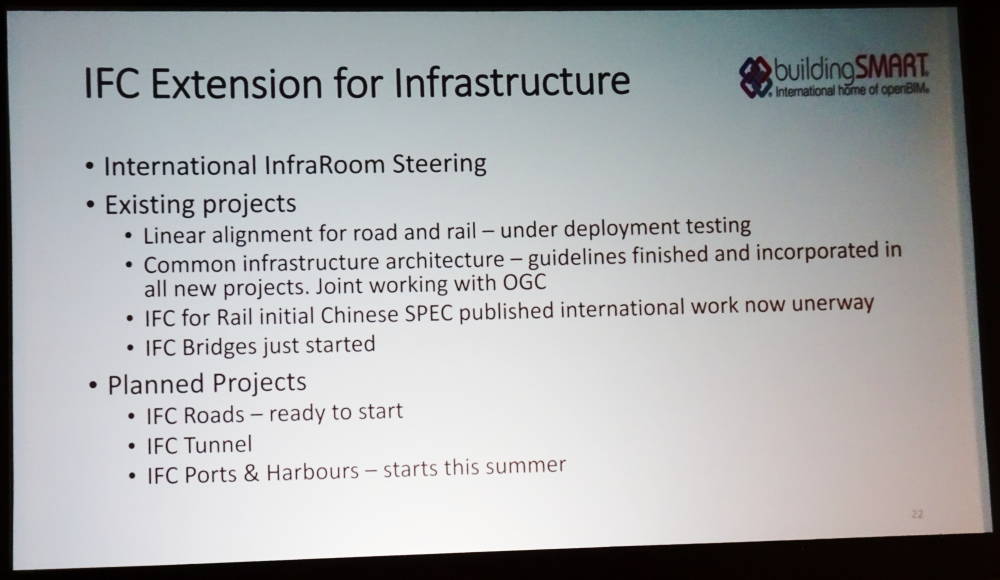 At GeoBusiness 2017 in London, Phil Jackson of buildingSmart UK and UK Representative Infrastructure Room provided an update on the progress in extending IFC for infrastructure based on a common BIM/geospatial conceptual model;
- Linear alignments for road and rail – under deployment testing
- Common infrastructure architecture – developed jointly with OGC
- IFC for rail – an initial Chinese specification has been published
- IFC Bridges – just started
and several more are in active planning or ready to start;
- IFC for ports and harbours – starts this summer
- IFC for roads – ready to start
- IFC tunnel – planned
Thus it appears that building geospatial and AEC standards for transportation and land management based on a common conceptual model and developing in parallel is well advanced.

Be the first to comment