
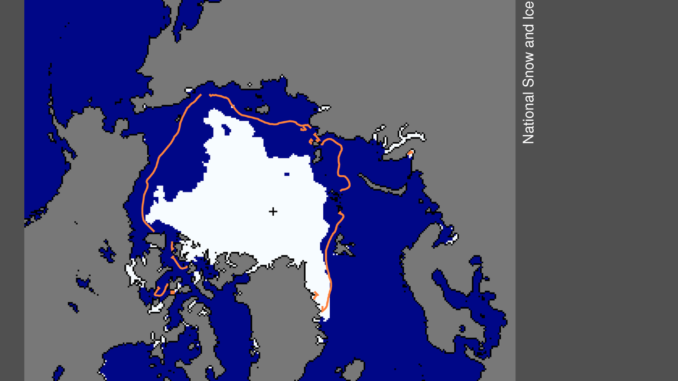
Record low Arctic sea ice volume projected

The extent of Arctic sea ice is one of the most accessible sources of data showing the effect of global climate change.   The National Snow and Ice Data Center (NSIDC) began monitoring Arctic sea ice extents in 1978 using passive microwave satellites at a resolution of 25 km.  September 2007 was the lowest summer Arctic sea ice extent observed since NSIDC began monitoring and recording sea ice extents in 1978.

This year according to the NSIDC Arctic sea ice extent is below the 1979 to 2000 average and above the extent for 2007.  The southern route of the Northwest Passage is free of sea ice according to imagery from the University of Bremen and the NSIDC Multisensor Analyzed Sea Ice Extent (MASIE) analyses.

Data from the Advanced Microwave Scanning Radiometer – Earth Observing System (AMSR-E) sensor, processed by the University of Bremen, show ice tracking near 2007 levels. The AMSR-E instrument has higher resolution (6.25 km) than the Defense Meteorological Satellite Program (DMSP) F17 Special Sensor Microwave Imager/Sounder (SSMIS) with 25 km resolution.
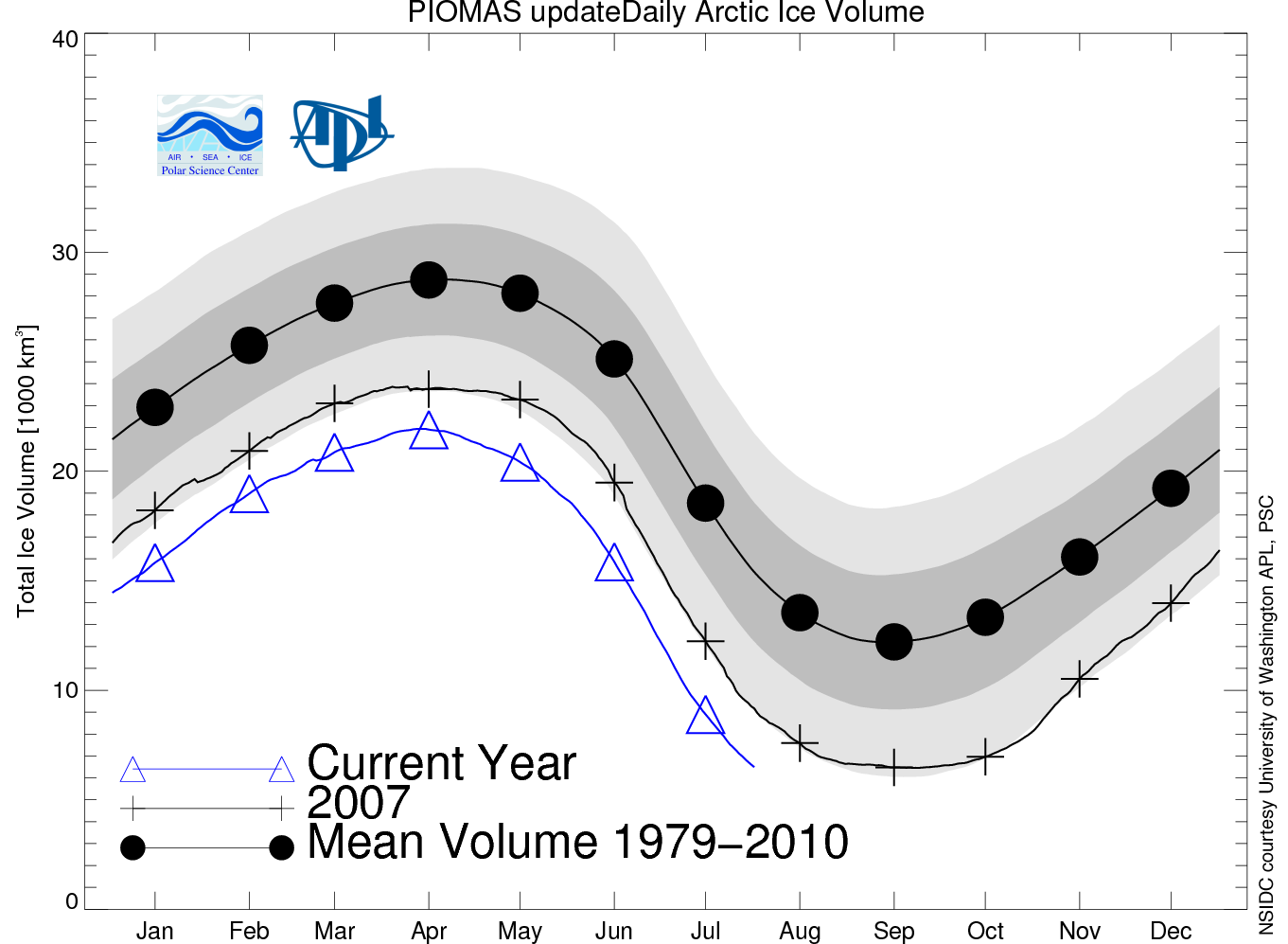
Arctic Ice Volume PIOMAS Estimation NSIDC 20110816_Figure5 Ice volume

Estimating ice volume requires a computer model.  The University of Washington’s Pan-Arctic Ice Ocean Modeling and Assimilation System (PIOMAS) model combines data on sea ice concentration with models of ocean and atmospheric conditions to estimate total ice volume.  Estimates generated by the model suggest that ice volume is not only well below the 1979 to 2010 average, but below the volume for 2007.  The PIOMAS model forecasts that this year’s minimum volume in the next month will be below 2007 and could even reach a record low volume.

Geoff Zeiss

Geoff Zeiss

Geoff Zeiss has more than 20 years experience in the geospatial software industry and 15 years experience developing enterprise geospatial solutions for the utilities, communications, and public works industries. His particular interests include the convergence of BIM, CAD, geospatial, and 3D. In recognition of his efforts to evangelize geospatial in vertical industries such as utilities and construction, Geoff received the Geospatial Ambassador Award at Geospatial World Forum 2014. Currently Geoff is Principal at Between the Poles, a thought leadership consulting firm. From 2001 to 2012 Geoff was Director of Utility Industry Program at Autodesk Inc, where he was responsible for thought leadership for the utility industry program. From 1999 to 2001 he was Director of Enterprise Software Development at Autodesk. He received one of ten annual global technology awards in 2004 from Oracle Corporation for technical innovation and leadership in the use of Oracle. Prior to Autodesk Geoff was Director of Product Development at VISION* Solutions. VISION* Solutions is credited with pioneering relational spatial data management, CAD/GIS integration, and long transactions (data versioning) in the utility, communications, and public works industries. Geoff is a frequent speaker at geospatial and utility events around the world including Geospatial World Forum, Where 2.0, MundoGeo Connect (Brazil), Middle East Spatial Geospatial Forum, India Geospatial Forum, Location Intelligence, Asia Geospatial Forum, and GITA events in US, Japan and Australia. Geoff received Speaker Excellence Awards at GITA 2007-2009.

View article by Geoff Zeiss

Be the first to comment

Leave a Reply

Your email address will not be published.


*