
Last night, September 2 at 11:51 p.m. EDT at the Arianespace satellite launch base in Kourou, French Guiana (UTC-3) the VV16 mission launched 53 satellites, ranging in weight from 145 kg to 7 kg. Among them was GHGSAT-C1 or “Iris”, a 16 kg Canadian satellite that detects methane emissions from specific facilities at high resolution.
Background
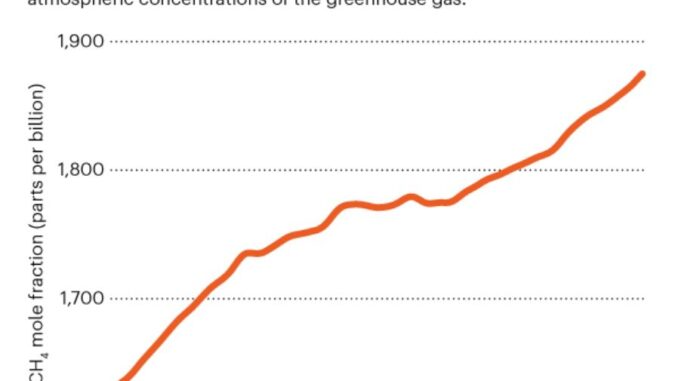
Annual emissions of methane (CH4) have risen by almost 10% in the past two decades primarily resulting from emissions from the oil and gas industry and livestock. A recent Environmental Defense Fund (EDF) study concluded that methane emissions from the U.S. oil and natural gas supply chain in 2015 amounted to about 2.3% of gross U.S. gas production and are about 60% higher than EPA estimates.
A 2016 study found that just a few natural gas wells account for more than half of the total volume of leaked methane gas in the United States. An extensive aerial infrared camera survey of 8000 production sites in seven U.S. oil and gas basins found that 4% of surveyed sites had one or more observable methane high-rate emission plumes. Furthermore the large variability in methane emissions for similar equipment and facilities in different geographies supports the hypothesis that equipment malfunction is a major source of emissions. To identify the sources of methane emissions oil and gas companies are increasingly attempting to detect and monitor emissions from their facilities including oil and gas wells, tank farms, and compressor stations.
An additional important business driver is the global carbon market which is currently estimated to be about $50B and growing. This provides a financial motivation for industrial emitters to measure and manage their emissions.
Until recently methane emissions have been measured on the ground in a a slow, laborious process using a hand-held scanner. Government-funded aircraft overflights or satellites have captured emissions over broad areas but with insufficient resolution to identify individual facilities as sources.
Satellite-based methane emissions measurement
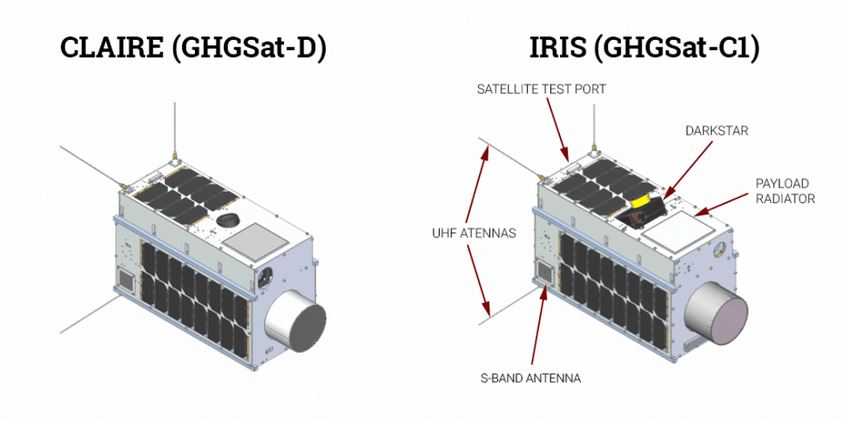 In 2016 a privately-funded startup GHGSat launched a proof-of-concept cubesat named “Claire” weighing 15 kg to measure methane emissions from individual oil and gas wells, refineries, compressor stations, landfills, animal feedlots, rice paddies, and natural sources. The objective was to provide a satellite-based methane measuring device that would enable private industry to estimate emissions from its own facilities anywhere in the world. About the size of a microwave oven Claire orbits the Earth every 90 minutes. Its field of view is 12 km x 12 km and it has a spatial resolution of about 50 metres. Claire is able to measure emissions from over 1,000 sites per year. The GHGSat-C1 or “Iris” satellite that was just launched has higher resolution (25 metres) and will be able to measure emissions much more rapidly with a 10x performance improvement compared to Claire.
Be the first to comment