
In his foresighted talk at Geo Business in London, industry insider Adam Box raised warning flags for the construction industry – if the industry is unable to change from within there are signs that major players outside the industry are beginning to do it.
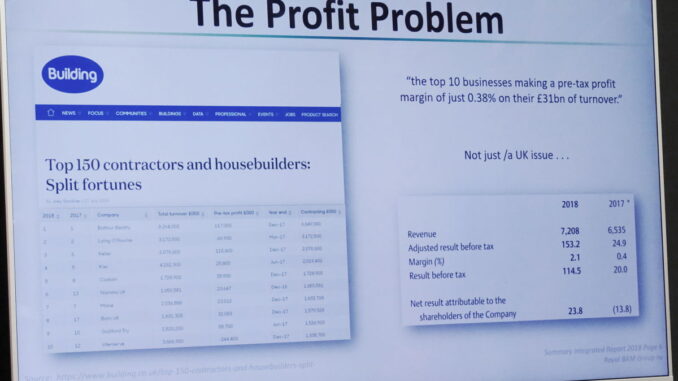
Adam cited some of the big challenges facing the construction industry, notably the lack of productivity gain for the past 40-50 years and very low margins. He sited data that the 10 largest construction companies with a total of £ 31 billion in turnover had a before taxes profit of 0.38 % – that’s right, less than one per cent. Some see this as the result of a lowest bid procurement model, but whatever the cause with the growing importance of attracting private investment in infrastructure construction, it is hard to see how this level of financial return is likely to attract interest from private investors.
The McKinsey Global Institute estimates that the world will need to spend $57 trillion on infrastructure through 2030 to keep up with global GDP growth. This is a massive incentive for the construction industry to transform productivity and project delivery through new technologies and improved practices
In a report McKinsey & Company suggests that the construction industry is ripe for disruption. 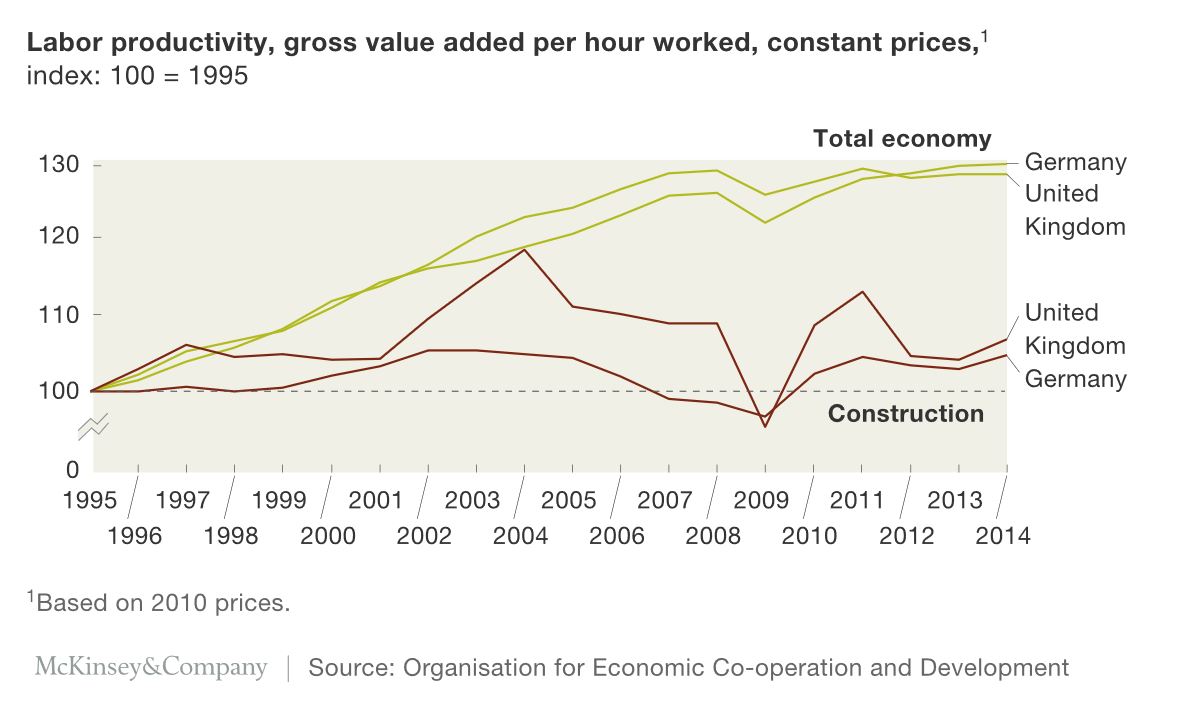 The McKinsey report presents data that shows that large construction projects typically take 20 percent longer to finish than scheduled and are up to 80 percent over budget. Construction productivity has actually declined in some markets since the 1990s and financial returns for contractors are relatively low and volatile, Construction has been slow to adopt process and technological innovations. R&D spending in construction lags other industries. Construction R&D is less than 1% of total industry revenue compared to 3.5-4.5 % in the auto and aerospace sectors. And construction spending on IT is low compared to other industries.
Adam referred to some changes within the industry aimed at addressing the productivity problem such as modular construction and prefabrication, BIM, reality capture and modelling, and integrated building, but this has not had a major impact on the industry as a whole which in many countries represents 10% of GDP. There are structural issues inhibiting improving productivity improvement – the traditional fragmented supply chain and an adversarial business model of construction are often cited.
There are a number of examples of industries that have faced similar problems and managed to transform the industry from within through IT – automobile manufacturing in Germany and Japan, low cost airlines worldwide, retail banking worldwide, optics in Germany and Japan, and others, There are also other industries that did not see the writing on the wall and were transformed from without – the retail book industry and other retail sectors by Amazon, the taxi industry by Uber, hospitality by AirBnB, and others.
At a recent BIMForum conference in Las Vegas Dr. Barbara Jackson of the University of Denver offered what I would categorize as a hurricane warning to the construction industry; change is coming like a very fast train and either the industry has to change itself or someone from outside will do it. Because in construction resistance to change is much greater than the motivation to innovate and change, under 30 year olds are saying that the construction companies they want to work for don’t exist, so they leave. She hopes to help the industry to transform from within by effecting a culture change through encouraging the under 30s folks not to leave but to stay and transform the industry.
Adam sees signs that the industry is attracting interest from technologies and investors outside of the traditional construction industry. He mentioned Elon Musk’s Boring Company which already has municipal transportation projects in Chicago (won against industry veteran Mott MacDonald) as well as Las Vegas, Washington DC, and Los Angeles. Google is building a city of the future in Toronto. Amazon is selling entire houses for $20,000. Wework is disrupting the commercial office space sector. All of the big technology players (Google, Apple, Amazon, Facebook) are already indirectly disrupting the electric power generation industry with commitments to billions of dollars of renewable power generation which has driven over $15 billion in investment in wind and solar power generation. Others like MGM are going off grid for their power.
If major owners see that working with the non-construction construction industry eliminates or reduces the likelihood of project overruns and reduces costs, what is now a trickle could become a stampede which will leave the traditional industry with the low margin projects while the new players cream off the exciting, new high margin projects. Given the construction industry’s traditional resistance to innovation, this is beginning to look more likely.

Be the first to comment