
The Centre for Advancement of Trenchless Technologies(CATT) has just released the report of a survey designed to better understand the current state of subsurface utility engineering (SUE) practices, barriers, and acceptance across Canada. The most important conclusion of the survey is that most organizations rely on as-built records (which are frequently inaccurate) and surface site inspections (which can only infer the location of most underground utilities) for underground utility location information. Furthermore, this information is used primarily during the construction phase of a project, not during planning and design, when accurate underground utility information has its greatest value. It was found that many organizations still do not update or request reliable as-builts during construction projects. The survey found that for most organizations SUE is conducted on a project-by-project basis, instead of being a standard process as part of construction projects.
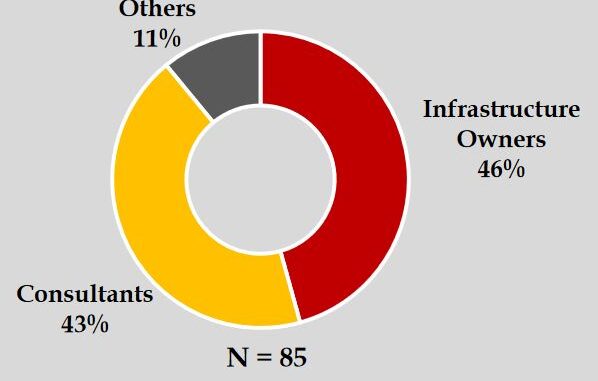
The target audience for the survey included infrastructure owners, consultants, contractors and technology providers – the main stakeholders in the SUE industry. 84 % of respondents were from Ontario with the remainder from other provinces. 46 % of respondents were infrastructure owners, and 43% engineering consultants. 70% of the infrastructure owner respondents represents large municipalities. More than half of the respondents had five or more years of experience with SUE on construction projects. The remainder reported one year or less of experience with SUE.
Analysis
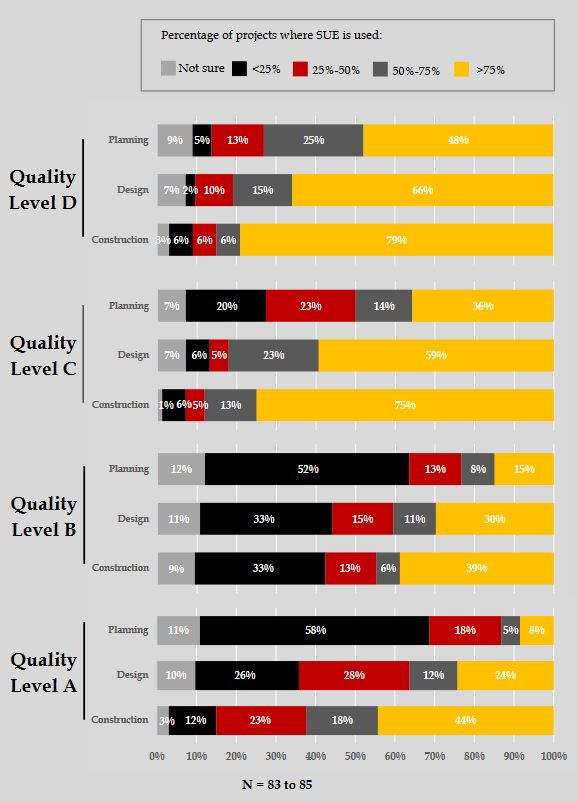 The survey revealed that Quality Level D (as-builts and other records) and Quality Level C (surface site inspections) comprise the most frequently used information about the location of underground utilities. Only 15 % of respondents regularly used more reliable Quality Level B (remote detection) data during the planning phase of construction projects and less than a third used remote sensed data during the design phase. For those using remote sensing technologies, 79% reported using electromagnetic methods, 16 % ground penetrating radar, and 15 % magnetic methods.
Two thirds of infrastructure owner respondents reported that their organization requires combining as-builts into their records or GIS system and about the same proportion reported updating their records database during construction. But 59% said that they do not periodically review, verify and update utility records. Very few of these, only 4%, said they are planning to implement a SUE program.
Almost all of the respondents (87%) were aware of SUE and many (70 %) had some SUE experience. 59% of the respondents were aware that SUE reports and drawings need to be stamped by a professional engineer (P.Eng.) or Professional Geoscientist ( P.Geo.).
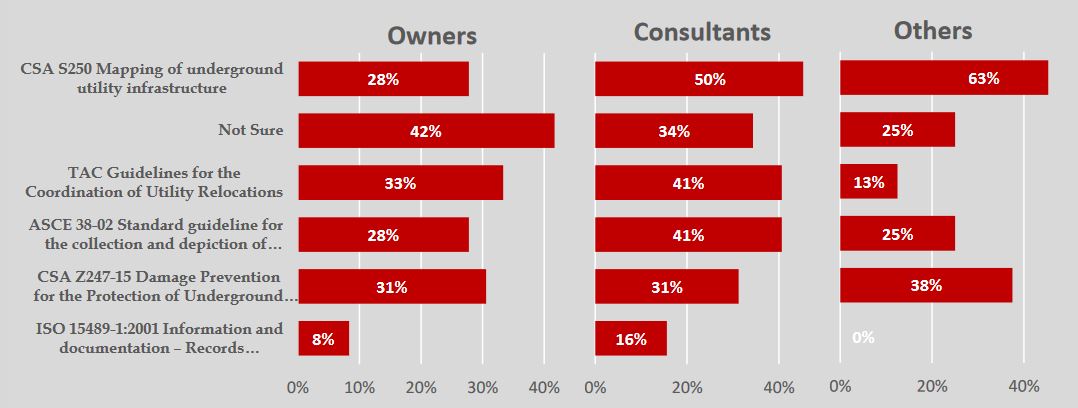 Respondents were asked about their familiarity with standards relating to underground utility information including CSA S250 Mapping of Underground Utility Infrastructure, TAC Guidelines for the Coordination of Utility Relocations, ASCE 38-02 Standard Guidelines for the Collection and Depiction of Existing Subsurface Utility Data, CSA Z247-15 Damage Prevention, or ISO 15489-1:2001 Information and documentation — Records management. Less than half of survey respondents reported awareness of some of these standards. The best known standards were CSA S250, ASCE 38-02 and TAC Guidelines. Very few respondents were aware of ISO 15489-1:2001.
Be the first to comment