
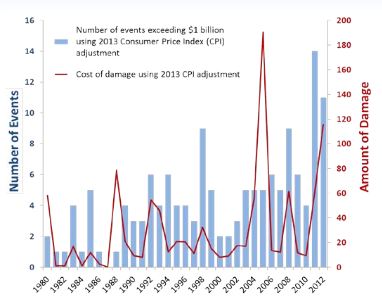
Energy is essential for economic development. The effects of climate change include Increasing temperatures, decreasing water availability, more intense storm events, and sea level rise. These will affect the ability of the United States to exploit, produce,and distribute fossil fuels and generate and distribute electricity, as well as affecting the demand for energy. The Department of Energy has released a study that assesses the impact of climate change on the energy sector.
Some of the events that have occurred in the last few years that motivated this effort include
- August 2012: Millstone Nuclear Power Station in Connecticut shut down one reactor because the temperature of the intake cooling water from the Long Island Sound was too high
- September 2011: High temperatures and high electricity demand tripped a transformer and transmission line near Yuma, Arizona, starting a chain of events that led to shutting down the San Onofre nuclear power plant with power lost to the entire San Diego County distribution system of 2.7 million power customers with outages as long as 12 hours
- July 2012: In one of the worst droughts in American history, companies that extract natural gas and oil via hydraulic fracturing faced higher water costs or were denied access to water for 6 weeks or more in several states, including Kansas, Texas, Pennsylvania, and North Dakota.
- Summer 2010: Below-normal precipitation and streamflows in the Columbia River basin resulted in insufficient hydropower generation to fulfill load obligations for the Bonneville Power Administration. BPA experienced a net loss of $164 million in fiscal year 2010, due to low water volumes.
Impacts of climate change
Thermoelectric power generation facilities are at risk from decreasing water availability and increasing air and water temperatures, which reduce the efficiency of cooling.
Increasing temperatures increase evaporative water losses and water use in upstream watersheds, decreasing water availability for hydropower.
Cooling water availability could be limited by low flows, high water temperatures, or both.
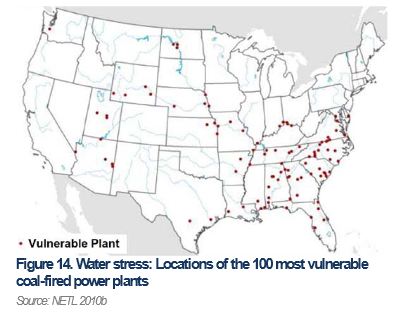 The National Energy Technology Laboratory evaluated the potential water-related vulnerabilities of all coal-fired power plants in the United States and found that nearly 350 plant (60% of 580 plants) are located in areas subject to water stress (i.e., limited water supply and/or competing water demand from other sectors).
Increasing temperatures also reduce the efficiency of conventional thermal power plants. For example,the power output of natural gas-fired combustion turbines is estimated to decrease by approximately 0.6 %–0.7% for a 1°C increase in air temperature. For combined cycle power plants, output can decrease by approximately 0.3%–0.5% for a 1°C increase in air temperature. For nuclear power plants, output losses are estimated to be approximately 0.5% for a 1°C increase in air temperature.
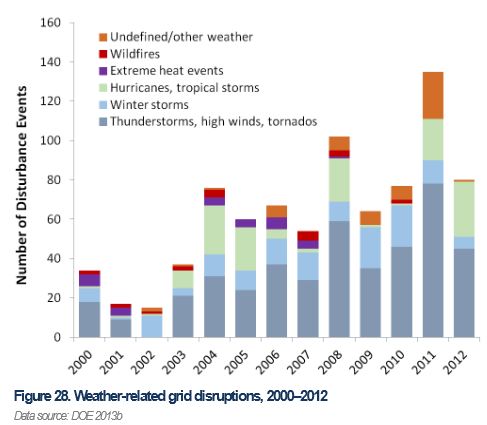 Energy infrastructure located along the coast is at risk from increasing intensity of storms and higher storm surge and flooding, which affects oil and gas production, refining, and distribution, as well as electricity generation and distribution.
Oil and gas production, such as shale gas and oil and oils sands, is vulnerable to decreasing water availability.
Renewable energy resources, particularly hydropower, bioenergy, and concentrating solar power can be affected by changing precipitation patterns, more frequent and more intense droughts, and increasing temperatures.
For example, PV panels become less effcient as temperature rises. This is one of the reasons that Minnesota is a better location for solar PV power generation than locations in the South.
Electricity transmission and distribution systems operate less efficiently when air temperatures are higher, and they face risk of physical damage from more intense and frequent storm events and wildfires.
According to the IEA Approximately 7 % of power is lost in transmission and distribution. Increasing temperature increaes these losses. For example, a study of the California power grid projected that during the hot periods of August in 2100 a 5°C increase in air temperature could decrease transmission line capacity by 7%–8%. The same study projects that a 5°C warming in 2100 could cause substation capacity to fall by 2%–4%.
Onshore oil and gas operations in Arctic Alaska are vulnerable to thawing permafrost, which may cause damage to existing infrastructure and restrict seasonal access. On the other hand, offshore operations could benefit from a longer sea ice-free season.
Increasing temperatures will likely increase electricity demand for cooling and decrease fuel oil and natural gas demand for heating.
Interdependencies
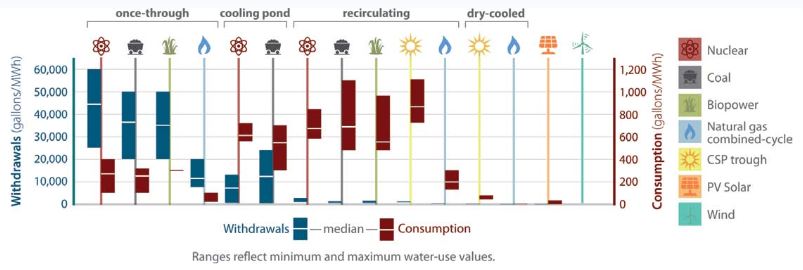 There are interdependencies within the energy sector. For example, oil and gas transmission systems depend on electric power for monitoring and management equipment as well as for pumping. Ther are also interdependencies between the energy sector and other sectors. The energy, water, food/land nexus is the best known. For example, in the U.S. half of water withdrawals go to conventional thermal power plants fo cooling.
Water needed for energy
- Energy resource extraction
- Fuel processing
- Thermal power plant cooling
- Carbon capture and storage
Water needed for land
- Agriculture
- Industrial municipal commercial and residential uses
- Natural ecosystems
Energy needed for land
- Resource extraction and conversion
- Agriculture
- Transportation
- Industrial municipal commercial and residential uses
Land needed for energy
- Energy resource extraction
- Energy infrastructure, including dams/reservoirs, mines/wells, power plants, solar and wind farms, power lines, pipelines, and refineries
- Bioenergy cropland
- CCS
Land needed for water
- Water capture and watershed
- Ground cover vegetation
There are also interdependencies between the energy sector and other sectors such as transportation and communications. The transportation sector requires energy for motive power, and the energy sector relies on transportation to provide the necessary coal, oil, and natural gas resources to operate. The communications sector requires electricity to operate, and the smarter grid is based on communication systems.

Be the first to comment