
Energy and water are valuable resources that strongly correlate with economic development. Water and energy are also highly interdependent. In the United States about half of water withdrawals are used for power generation. Water is also used in the extraction, transport and processing of fossil fuels; and, increasingly, in irrigation to grow crops like corn used to produce biofuels.
Energy is required by the systems that collect, transport, distribute and treat water. About 25 percent of United States’ electricity goes to moving and treating water, according to a 2005 California Energy Commission report.
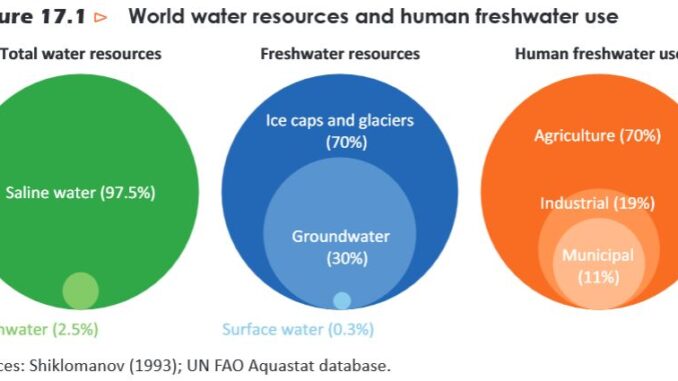
According to the IEA, globally agriculture is the principal user of water, accounting for 70% of water use, followed by industry (including mining and power generation) at 19% and municipal networks, which provide water for public and private users, at 11%.
Global water withdrawals for energy production in 2010 were estimated at 583 billion cubic metres (bcm), about 15% of the world’s total water withdrawals. Most of this is for cooling where the water is returned but typically at a higher temperature. Water consumption where water is withdrawn but not returned accounted for 66 bcm.
Risks
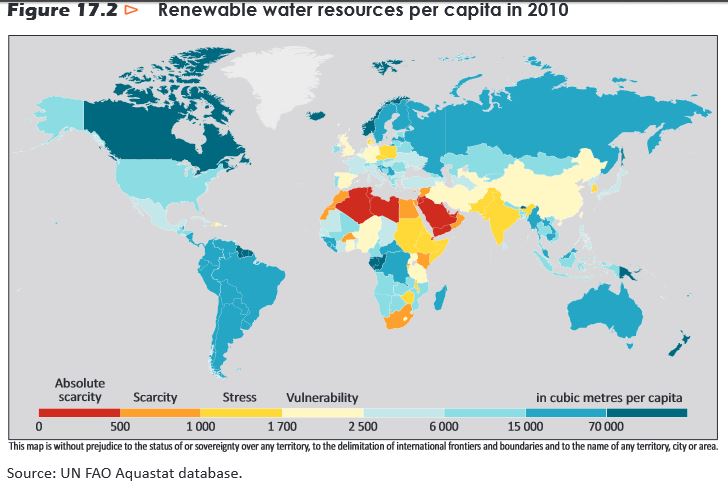 The vulnerability of the energy sector to water constraints depends on geography and type of power production. Regions where water is scarce face serious risks, but with climate change regions currently with adequate water resources can face constraints related to droughts, heat waves, and regulations. Countries with a high proportion of their generating capacity in thermal plants with once-through cooling (using freshwater) and hydropower are especially susceptible to water shoratges.
 Less water-intensive power generation technologies
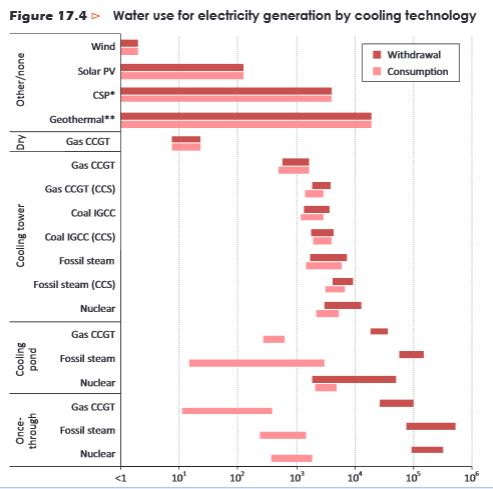
Water is growing in importance as a criterion for assessing the physical, economic and environmental viability of energy projects. Water withdrawals per unit of electricity generated are highest for fossil fuel thermal generating plants – coal-,gas- and oil-fired plants operating on a steam-cycle and nuclear power plants with once-through cooling. If cooling towers are used, water withdrawais are 20-8 times less, but water consumption is higher because of greater evaporation. Combined-cycle gas turbines (CCGTs) generate less waste heat per unit of electricity produced because they have higher thermal efficiency, and therefore require less cooling. Both their water withdrawal and consumption are the lowest among fossil-fuel thermal power plants.
Water requirements for renewable electricity generating technologies range from negligible to comparable with thermal generation using wet tower cooling. Non-thermal renewables, such as wind and solar photovoltaic (PV) use very small amounts of water, which makes them well-suited for a future that will be both more carbon- and water-constrained. In addition to lower water use for direct electricity generation, these renewable technologies have little or no water use associated with the production of fuel inputs in contrast to biofuels. They also have negligible impact on water quality compared to thermal plants (fossil-fuel or nuclear) that discharge large volumes of heated cooling water into the environment. Geothermal and concentrating solar power (CSP) technologies have water needs that range widely, depending on the particular generating technology and cooling system employed.
Base case
IEA New Policies Scenario: This scenario includes policy commitments and plans that have been announced by countries, including national pledges to reduce greenhouse-gas emissions and plans to phase out fossil-energy subsidies, even if the measures to implement these commitments have yet to be identified or announced. This broadly serves as the IEA baseline scenario.
The IEA projects that under this scenario, by 2035 withdrawals are projected to increase by about 20%. In this scenario consumption increases much more dramatically, by about 85% driven by a shift towards higher efficiency power plants with more advanced cooling systems and by expanding biofuels production.
Low-carbon scenario
450 Scenario: This scenario sets out an energy pathway consistent with the goal of limiting the global increase in temperature to 2°C by limiting the concentration of greenhouse gases to around 450 parts per million of CO2.
Energy efficiency, wind and solar PV contribute to a low-carbon energy future without intensifying water demands significantly. Compared with 2010, withdrawals in this Scenario rise by only 4% in 2035, though consumption doubles due to much higher biofuels production. This scenario would tend to increase solar PV and wind power generation, compared to water intensive low-carbon technologies such as nuclear power, power plants fitted with carbon capture and storage equipment and concentrating solar power requiring water cooling. Dry cooling is also starting to be used with concentrating solar power generation. Construction of the first utility-scale concentrating solar power plants (CSP) in Africa has been announced. The plants minimize water use by employing dry cooling technology.

Be the first to comment