

A number of national governments around the world have mandated or are planning to mandate building information modeling (BIM).
United States
In 2003 in the United States the General Services Administration (GSA), through its Public Buildings Service (PBS) Office of Chief Architect (OCA), established the National 3D-4D-BIM Program. In 2006 the GSA mandated that new buildings designed through its Public Buildings Service use building information modeling in the design stage. At that time GSA had an inventory of more than 342 million square feet of office space. GSA owns about half of that space, in 1,500 buildings, and leases the rest. For all major projects receiving design funding in
Fiscal Year 2007 and beyond, GSA requires spatial program BIMs be the
minimum requirements for submission to OCA for Final Concept approvals
by the PBS Commissioner and the Chief Architect. But projects are encouraged to go above an beyond the minimum BIM requirement. All
GSA projects are encouraged to deploy mature 3D, 4D, and BIM
technologies. One of the important drivers was a shrinking workforce. GSA’s workforce shrank from more than 40,000 to about 12,500 in 2006.
Singapore
 Singapore’s goal is simple, to implement the fastest building permitting in the world. The Building and Construction Authority (BCA) led a multi-agency effort in 2008 to implement the world’s first BIM electronic submission (e-submission). The BIM e-submission system streamlines the process for regulatory submission. Project teams only need to submit one building model, which contains all of the information needed to meet the requirements of a regulatory agency. In 2010, nine regulatory agencies accepted architectural BIM 3D models for approval through e-submission. This was followed by the acceptance of mechanical, electrical and plumbing (MEP) and structural BIM models in 2011. To date, more than 200 projects have made BIM e-submissions.
In 2010 the BCA implemented the BIM Roadmap with the aim that 80% of the construction industry will use BIM by 2015. This is part of the government’s plan to improve the construction industry’s productivity by up to 25% over the next decade
United kingdom
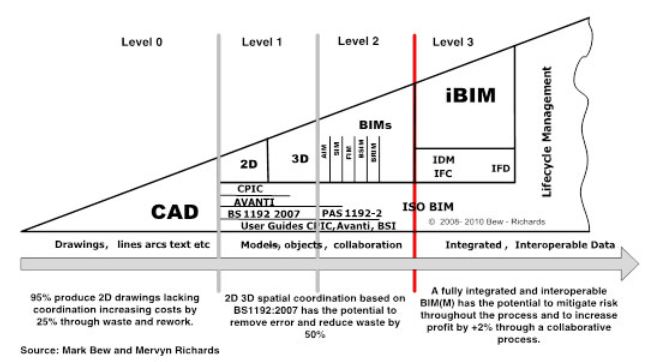 The overarching aim of the Government’s initatives in the construction industry is to reduce the cost of Government construction projects by 20% and to reduce the UK’s carbon intensity in line with its EU carbon committments. To reach its goal for the construction industry the UK Government has undertaken several initatives, one of which is a commitment to BIM in Government projects over a 5-year time frame, and mandating BIM Level 2 from 2016 on. The objective is to encourage industry to participate in this effort, and to position the UK to become a world leader in BIM. The inital focus is on the design/build part of the lifecycle, but the government has said that “the 20% saving refers to CapEx cost savings however we know that the largest prize for BIM lies in the operational stages of the project life-cycle” The UK Government has explicitly targeted Level 2 BIM in the BIM maturity model UK maturity ramp, defined as “file based collaboration and library management.” Level 2 BIM is a series of domain specific models (e.g. architectural, structural, services etc) with a single environment where structured data can be shared based on COBie UK 2012.
Norway
In
Norway, the civil state client Statsbygg decided to use BIM for the
whole lifecycle of their buildings. In 2007, 5 projects had used BIM.
By 2010, all of Statsbygg projects were using IFC/IFD based BIM. In
addition The Norwegian Homebuilders Association has encouraged the
industry to adopt BIM and IFC.
Denmark
Danish state clients such as the Palaces & Properties Agency, the Danish University Property Agency and the Defence Construction Service require BIM to be used for their projects.
Finland
The state property services agency, Senate Properties, requires the use of BIM for its projects since 2007.
Hong Kong
The Hong Kong Housing Authority will require BIM for all new projects from 2014.
South Korea
The Public Procurement Service made BIM compulsory for all projects over S$50 million and for all public sector projects by 2016 .
Netherlands
In 2012 the Dutch Ministry of the Interior (RGD) requires BIM for large building maintenance projects.

Be the first to comment