
I recently had the fortunate opportunity to travel through four countries in Europe along the Danube R and enjoy the Christmas markets etc., along the way.
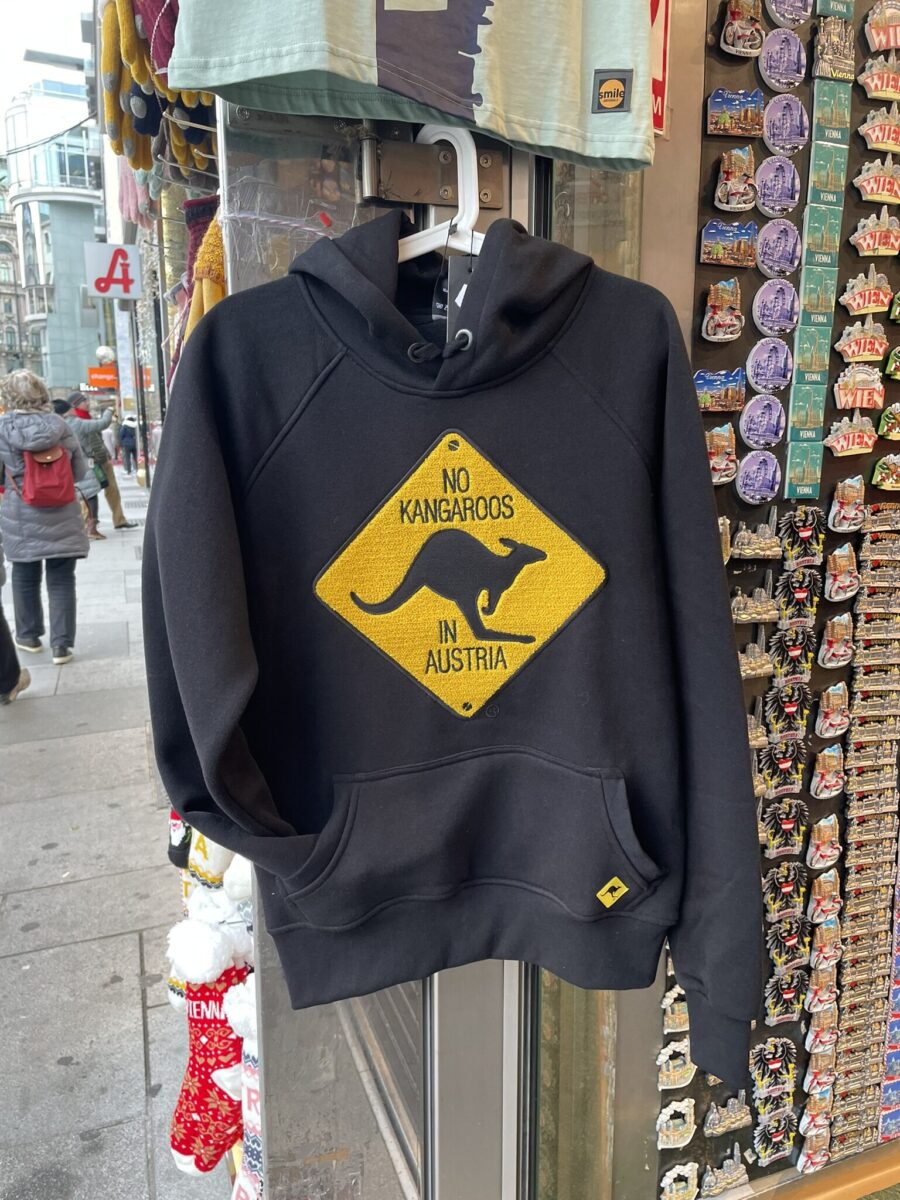 While in Vienna, I took this picture.
I laughed so hard and bought the complimentary socks! How many of our students would get the joke?
With 35+ years working in Geographic Education including as a high school geo teacher, department head, Pre-Service/Fac. of Education instructor, Fellow of the RCGS, CanGeoEd Executive and current President of the Ontario Association for Geographic & Environmental Education, I fear this “joke” will be lost on an increasing number of our society. The fact that this shirt exists, tells you something about basic geographic literacy. A sad statement in today’s “global” society but how can this be?
To me, it all starts with education. We are currently living in a period of time that education, is perhaps one of the most important and challenging areas facing our society. This has never been more evident than in the area of Geographical Education and Literacy. A
lthough my thoughts and observations could likely be applied on a national or perhaps global scale, I will focus these to my home province of Ontario. I would like to sit here and write a glowing account of what is currently happening in Ontario and its’ Geography and Social Studies classes, however I can’t.
Don’t get me wrong, to start, we are the only Provincial jurisdiction left in Canada to still have an independent Geography curriculum! In addition, we have some amazing teachers and some fabulous things happening in many classrooms. We have an incredibly dedicated and devoted group of educators through organizations such as OAGEE (Ontario Association of Geographic and Environmental Educators), however we are faced with a ‘mountain’ of challenges and one might argue are in fact an ‘endangered species’ headed for ‘extinction’.
To begin, why is it, that in a world full of challenges, of ‘globalization’, ‘global security’, ‘global this’ and ‘global that’, that our students are not learning about the ‘globe’? It seems to me that our province, country, continent, world, has never before needed a stronger geographical perspective for our students. Canada’s, let alone Ontario’s economic well-being is increasingly dependent upon the ability to compete successfully in a global marketplace with interrelated supply chains, a geographically literate (locally, provincially, nationally, internationally) workforce is more critical than ever before. As our province, nation and the world face increasing environmental pressures, a perspective in geography offers a critically needed understanding of the relationships between human activity and the condition of our planet.
Why is it then, that in the province of Ontario, our students have mandatory courses in Geography, for approximately 180 hours (or less), over 12-plus years of schooling? Today students are required to take approx. 35 hours of geography in both Grade 7 and 8 (Actually no specific time requirement, we hope for 35 hours. This is determined at the school level). In high school, there is ONE mandatory course (110 hrs) in Geography: Grade 9 – Exploring Canadian Geography. This has been preceded with a ‘sprinkling’ of ‘geography’ through Social Studies from Grades 1-6. (Grade 5 has little to no geographical component at all!)
At no other point in their K-12 academic journey are students, required to learn about the world and its global connections, interactions, issues and challenges, from a geographical perspective. Disappointing, as courses dealing with such topics as Physical Geography (Forces of Nature), Travel & Tourism, , The Americas, Canadian & World Issues, World Human Geography, Environment & Resource Management and World Geography: Urban Patterns & Interactions and courses focused on the ever increasing importance of Geomatics. These are all ‘on the books’ in the current Senior Gr. 11/12 Curriculum documents.
Why then are these courses which deal with such timely issues, not thriving?
In fact, a disturbing trend now in Ontario secondary schools, is that many secondary schools now offer nothing more than Grade 9 geography at all!. The answer as I see it, is a complex one.
Let’s start with what exactly is Geography?
This is where we ‘geographers’ run into difficulty in terms of a clear definition of exactly what our discipline is about. It is not hard then to understand that if we have a problem defining exactly what our subject is about, that others (i.e., Education policy makers, principals, parents, etc.) would default to the old ‘Capes & Bays’ perception of geography, where all we are concerned with is an ‘inventory’ of place names and features.
Translation, “Why then, is this important and therefore relevant for our children to know?
Response: Guess it’s not, thus no geography. One cannot underestimate the importance of ‘perception’, as this affects decisions which administrators make as to which courses are offered in the secondary panel and those parents approve of and students take. Perception of the value of course codes: Geography is not labeled as a science credit thus enrollment suffers.
Geographers know, however, “…geography combines the physical and human aspects of our world into one field of study. This combination focuses on the interdependent parts of our world to provide a practical framework for addressing local, national and global questions.” (Directions in Geography p. 9)
Today’s geography is a problem solving discipline, dependent upon strong critical thinking skills and the application of spatial tools such as GIS, aerial photos, etc. Geographic thinking is central to areas, for example, like the countless spatial apps we now depend on through our phones, epidemiology, examining the how, where and why AIDS has spread throughout the world.
It is the economics of oil and the Middle East (location) and the politics of freshwater access to the world’s 8+ billion individuals. If policy makers and the public in general understood these definitions of Geography, our discipline could be seen as relevant and important. “Geography motivates us to look at our past, study the present and to predict the future. We can determine where things are, why they are there and where they’re headed from here” (Grosvenor).
As Gritzner put it, geography is about, “What is where, why there, why care?” (Gritzner, Charles F., 2003) ‘Why Geography?’, Journal of Geography, 102: 2, 90 — 91)
So let’s assume we can all agree and understand exactly what geography encompasses, its relevance and importance. Guess those classes will thrive now! Not so fast… Let’s take a look at who is teaching in our geography classrooms. There is a growing acceptance in education, at the secondary level, (long established in the elementary), that ‘non-specialists’ are equal to ‘specialists’ when it comes to academic background/training and teaching. The result has been an increasing number of teachers teaching ‘Geography’ without any or very little geography in their academic backgrounds. (*Note: this trend is not exclusive to Geography as other academic areas are experiencing this as well.)
Unfortunately, one can no longer assume that those teaching the subjects are knowledgeable or have formal training in those areas themselves. One can argue being a ‘teacher’ first is more important than the subject. I agree with this to a point. However, we need BOTH. Sadly, this trend is also emerging within our Faculties of Education. Increasingly, curriculum pedagogy courses – or combinations thereof- are being delivered by individuals without a strong disciplinary background. I have personally witnessed this occurrence as the next generation of “Geography teachers” are being taught by individuals with little to NO disciplinary background.
Okay, let’s assume we all understand the nature of the discipline and have teachers with a strong academic background and enthusiasm for the subject. Those classes are full now right?! Oops, forgot to mention, if you don’t have teachers with the academic background, often the courses available are not even offered in the school! When introducing my teacher candidates at the Faculty of Education to the Geography Curriculum for Ontario, many of them were ‘shocked’ to see the number of courses available under the Geography ‘umbrella’. Many had gone through high school and had never heard of most of the courses ‘on the books. EX. Geotechnologies, Forces of Nature, Environment & Resource Mngt, Travel & Tourism).
Why not get some training for teachers who may want to further their geographic background?
Although the College of Teachers specifically outlines the professional expectations of teachers to continue with professional development (PD) and ongoing learning in their areas, the reality is there is very little support for teachers and PD. Most PD days held throughout the year are focused on new non-subject specific initiatives, etc. coming ‘down’ from the
Ministry of Education and/or local issues
Boards typically have money available for acquainting staff with the latest ‘ministry initiatives’ (flavour of the month) and often send teachers to conferences on such topics with all expenses paid. For a subject-based presentation, such as an OAGEE conference, teachers may be left paying for everything, even supplying teachers to cover their absence. Lack of support for curriculum-specific professional development prevents our teachers from constantly improving and building upon what they know and keeping them current and relevant in our classrooms.
Recently, the Ontario gov’t released a new CGC1W1 (Grade 9) course, which is a de-streamed model. Thus all ability levels etc. are in one class. This release came with no professional development for teachers. This new release represents the “Figure it out yourself” model. OAGEE, our provincial subject association’s big focus this year has been on the new gr 9 program and helping our classroom teachers. This is made more difficult for our teachers as many cannot get permission to attend. One of OAGEE’s responses has been to provide a free, evening webinar series done by our volunteers for everyone, including non-OAGEE members.
One area of the discipline that is extremely timely, valuable, and relevant and has future career opportunities are those related to Geomatics and Geo-technologies.
The power of a GIS and the geographic analysis that comes with it is applicable and relevant to so many businesses, industries, governments, etc. Officially, in the Ontario Curriculum, there are two specific courses related to Geomatics/Geo-technologies offered at the grade 11 & 12 levels. On “paper” the newly released Grade 9, CGC 1W1 did have a “win” for us, in that GIS has been imbedded throughout the course. However, the reality, once again, is most schools in this province do not offer these courses, and in the case of our new Grade 9 program, few teachers have the training or background to implement the new expectations that have been added in the new CGC1W1. If one looks elsewhere in the province as well, programs at the college level in Geomatics have also been cut, leaving fewer opportunities for those who wish to pursue their education in such an important area.
Okay, so let’s pretend, we understand the nature of the subject, we have specialist teachers, great PD support and unlimited resources! We must be running all those Geography courses!
Try again! During the late 1990’s the curriculum which was released at that time involved a ‘collapsing’ of pre-existing academic departments into ‘mega’ departments of various subjects. In the case of Geography, this led to being under the umbrella of ‘Canada & World Studies’, which officially includes the subjects of Geography, History, Economics, Law and Politics. In theory, this became the new ‘department’. In some local specific cases, I have heard of courses related to Family Studies, Phys-Ed, etc. being ‘subsumed’ under this same umbrella as well. What this meant was the curriculum leadership provided by department heads now covered a minimum of five academic areas.
In the past, as a Geography Department Head, I could offer leadership and direct curriculum support for teachers teaching in geography classrooms and providing professional disciplinary input to non-specialist administrators (decision makers). Today, I would be responsible for that same leadership in four other academic areas that I am not even qualified to teach! Recently, we are witnessing the “rise” of Social Science departments at the expense of Geography. For Geography, this is a “slippery slope”. I personally took on the challenge of preventing the loss of a Geography-defined “teachable subject” and Methodologies course here at the Faculty of Education, Queen’s University, from being replaced with a “Social Science” teachable and corresponding course. (Which would mean the watering down of any geography-specific programming). The end result was the addition of a Social Science program, leaving the geography in place – for now. The pressures are mounting, and I am concerned regarding the future.
A colleague who mentors teacher candidates from another Ontario Faculty of Education, has hosted beginning teachers in her “Geography” classrooms who under this label of a Social Science teachable, have no formal geography in their backgrounds.
You can imagine the challenges for both host, teacher candidate and future students.
The impact upon our future new teachers and students is significant. I have witnessed a growing reality, given the limited number of “Geography” classrooms at the gr 7-12 level in Ontario available for our teacher candidates. We are graduating new teachers that have never been in a Geography classroom as part of their Bachelor of Education and certification process.
The easy answer now is, using this “Social Science” label, we can technically stick them in any of the courses on offer (history, geography, anthropology, sociology, economics, law etc.) and call them “certified”. My heart has gone out to students, with full honours degrees (or more) in Geo and graduate, never getting into a Geography classroom. To me, this is criminal. I really hope our heart surgeons are not being certified as heart specialists based on experience as foot/bone surgeon!
You get my point!
On top of all this, add to the compression of high school in Ontario from a five-year to a four-year program (1999). Now there is one less year to work with and students are still required to earn their credits, now in four years. The result is reduced opportunity for ‘optional’ courses such as geography. In the past, students were required to take ‘one senior social science’, which traditionally meant geography, history, law or politics. Now, the ‘pool’ of courses that students may choose from is much larger with the result that fewer students are choosing geography as an option.
This “pool” of options has grown significantly. From psychology to philosophy, the role of the indigenous voice, the decolonization of curriculum all being added to an already crowded curriculum makes it tough for courses that are not deemed to be apart of that sacred ground of a “mandatory” course.
At the beginning of this article, I mentioned the perception of the value of course codes: (all courses in Grade 7-12 in Ontatio are given a code to identify the departmental jurisdiction of the course). One cannot underestimate the value of the “correct”, “acceptable” course code for both administrators, parents and post secondary institutions. In a society that only values STEM subjects, lack of the proper code influences choice for course selection. Geography is not labeled as a science credit and thus enrollment suffers, and yet the value of the course content may be of significant interest to students, but they can’t afford not to have the “correct” code on their transcript.
Remember that discussion at the beginning on the definition of Geography?
Another element impacting our programs relates to the Ministry of Education’s major push on ‘Literacy & Numeracy’. Another colleague offers the following: “From an elementary perspective … the loss of geography in school (is) because of the emphasis on Literacy and Numeracy. Geography (and Social Studies and History) are being seen as ‘add- ons’ not a part of those two initiatives. More PD and education for teachers needs to focus on how to use Geography as the context piece for Literacy and Numeracy.”
In geography, both literacy and numeracy are large components of the discipline. For example, data analysis is central to any distribution patterns and mapping that may be done. Population pyramids, adiabatic lapse rates, etc. all require numeracy skills. Perhaps our students should be getting MORE geography as both literacy and numeracy skills will be strengthened doing ‘geography’!
More ‘Geography’? Alex Trebek, (long time host of JEOPARDY), in accepting his gold medal (2010) from the Royal Canadian Geographical Society, made the following observation: “History is about the past, Geography is about the future and that is where today’s students will spend their lifetimes”.
So what about the future? At one time, the Toronto District School Board released an interesting study related to student performance in academic areas and graduation rates. One key finding of that study was the following: “It is interesting that Geography is a slightly stronger predictor of future achievement than Mathematics (although the differences are minor). This is important to note because current educational practice emphasizes Literacy and Numeracy outcomes, and these are often translated as English and Mathematics. Geography and Science also have Literacy and Numeracy elements that are part of integrated curriculum. Their strength in predicting future achievement shows the importance of examining a broad range of subjects (a reason for the importance of credit accumulation, for example), and the potential limitations of focusing on a narrow range such as English and Mathematics only.” (The Grade 9 Cohort of Fall 2004 Robert S. Brown Copyright © (June 2010) Toronto District School Board)
The implications of this finding and what it will mean for geography programs remains to be seen. Hopefully, this recognition of Geographic Literacy as an important element in predicting future achievement will raise the profile and value of a Geographic Education.
In the future, what is important here is that our students are geographically literate and have a working knowledge and understanding of our world, and a ‘global’ awareness of the issues facing us. For some students who may want to pursue their education in this area we need recognition and support from our post-secondary institutions as well. As it now stands, no university (in Ontario) requires courses in geography at the secondary level to pursue a degree in Geography. What is the message here to our teachers and students?
I truly believe there has never been a period in our earth’s history that a geographic education has been more important. We need to support those in the classrooms and educate policymakers about exactly what we do.
We need to be passionate about raising awareness of the value and relevancy of geographic literacy in our interconnected world. The ‘mountains’ of challenges we face need to be confronted and prevent our currently ‘endangered’ discipline from ultimate ‘extinction’. We need our students to understand why “There are no kangaroos in Austria”.
Be the first to comment