
The pain of compromise long outlives the sweetness of a low-price.
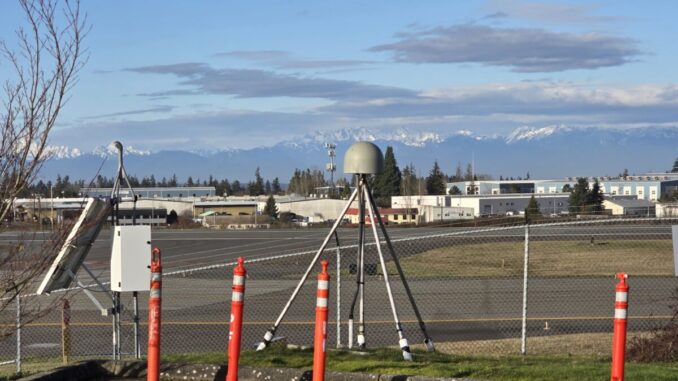
A little field maintenance on this GNSS reference station (on a near-spring-like-day) gave cause for some reflection.
Continuously operating reference stations (CORS) can and do serve a very broad range of applications: scientific, public safety, engineering, construction, agriculture… we could go on for hours discussing this.
However, to be suitable for any-and-all applications, a CORS needs to meet certain quality standards: construction, hardware, stability, geodetic reference, continuous QA/QC, and be accessible by these broad end-use communities with a minimum of proprietary roadblocks.
 There are very-well-managed, high-quality networks of such geodetic infrastructure around the globe. And with a recent boost in development to support the coming wave of positioning for vehicle autonomy, even more. For the most part, the developers of positioning for autonomy are very diligent in establishing reference networks or leveraging existing geodetic-grade networks for corrections services. The stakes are high (safety of life), so the more responsible firms doing such development seek high quality, as that is also a specific requirement of the downstream solution integrators.
There are though, reference stations popping up that are not as thoughtfully established. It is possible to create shake-n-bake infrastructure at extremely low costs, and for applications without strict quality and performance requirements, it can be quick, cheap, and simple.
For instance, as a fun exercise I did a home built GNSS “rover” from parts under $100 USD and some open-source software, plus an antenna (that I comically topped with a dome of a large plastic spoon). If I wanted to spend the money, I could send it to a lab in Europe that does much of the modelling of antennas (for IGS, NGS, etc al). And then voila, I have a rover I could begin selling, and duct-tape a pole to my shed to sell corrections. No, a hard no.
There is nothing necessarily wrong with all super cheap GNSS gear, if one is fully aware of the limitations. This means that the operators of cheap networks need to be aware of, and forthcoming about the limitations of thier own infrastructure. All too fiten I run into warning signs: no geodesists involved, super-cheap gear, lack of guidelines, single-base solutions only, and complete over-selling of performance.
In optimal conditions, even my home-built rover could deliver survey-grade precisions. However, the real-world conditions out there is rarely so optimal. Challenging sky-view, multipath hazards, solar activity, etc. One key problem is that some folks who peddle such solutions use the term “centimeter” for precision without qualifiers. Is that relative or absolute? Is it 1 or 2 Sigma? Is that 2D or 3D? I recently saw someone bragging that their results were under 2mm…. Wow. Anyone who has worked on the serious side of GNSS would find that comical. It makes me wonder if the priorities of such outfits are more about the MLM or currency scheme aspects.
If GNSS geodetic and reference infrastructure is based on such razor thin margins that super-cheap gear has to be used, could it ever serve the broad communities that the formal networks do? If there is no potential revenue from say, a remote area, then there would be no incentive to put stations there. Science and state networks on the other hand, serve such broad areas.
Some seem to think that super cheap can serve all, but when questioned about crucial elements of such infrastructure, the rationalizations fail to hold up. It’s not that some folks are deliberately misleading potential users, it is often that they lack the background themselves to know the difference.
There’s a place for a broad range of GNSS services. Not every application needs high precision, or certain performance levels. One can choose a fit-for-purpose service. You might only need 1m precision for certain mapping applications, or 60 cm, 30cm, 10cm for asset inventory, etc. For these ranges, cheap can be good. If such services are sold with his emphasized, this would be great for everyone.
If the stakes are high, for instance, a huge construction project, where even brief disruptions or errors can be costly, then going cheap may not be a good idea. Or if there are legal liabilities, like a property survey. The lowest common denominator does not cut it when the stakes are high.
You simply choose the right tool for the job.



Be the first to comment