

Budget 2025 doesn’t specifically mention Earth Observation or mapping, but its investments in digital, defence, and launch infrastructure make geomatics central to how sovereignty will be implemented in practice.
Canada’s 2025 Federal Budget, tabled on November 4, places sovereignty at the centre of national policy — not only territorial and defence sovereignty, but also control over data, compute, and digital infrastructure. The theme runs through almost every major investment, from cloud architecture to space launch and defence modernization.
For Canada’s geospatial community, this shift carries deep implications. Spatial data, mapping, and Earth Observation are the information systems that make sovereignty visible and measurable. Budget 2025 may not explicitly mention “GIS” or “mapping”, but it lays the groundwork for a sovereign digital and spatial infrastructure on which those capabilities depend.
Building the Pillars of Digital Sovereignty
One of the clearest messages in this year’s budget is the push to strengthen Canada’s control over data and digital infrastructure. That plan to build digital sovereignty is most visible in three areas: cloud infrastructure, measurement, and cyber defence.
- Sovereign AI Infrastructure and Cloud: Budget 2025 commits $925.6 million over five years, starting in 2025-26, to build large-scale national AI compute and cloud infrastructure, including a Sovereign Canadian Cloud. The goal is to give Canadian researchers and businesses secure, domestic access to the computing power they need, rather than relying on foreign platforms. Ottawa describes it as a step toward keeping the country’s data and AI capacity in Canadian hands. (Budget 2025 – Seizing the Full Potential of Artificial Intelligence)
- Measuring AI’s Impact: To understand how artificial intelligence is reshaping work and industry, Statistics Canada will receive $25 million over six years (and $4.5 million ongoing) to launch the Artificial Intelligence and Technology Measurement Program (TechStat). The initiative will track how AI is being adopted and what it means for jobs, productivity, and the economy. (Budget 2025 – Chapter 1 Seizing the Full Potential of Artificial Intelligence)
- Cyber and Defence Networks: The budget also sets aside $10.9 billion over five years to upgrade the digital systems that keep Defence, the Armed Forces, and the Communications Security Establishment running. (Budget 2025 – Chapter 4 Rebuilding, Rearming, and Reinvesting in the Canadian Armed Forces)
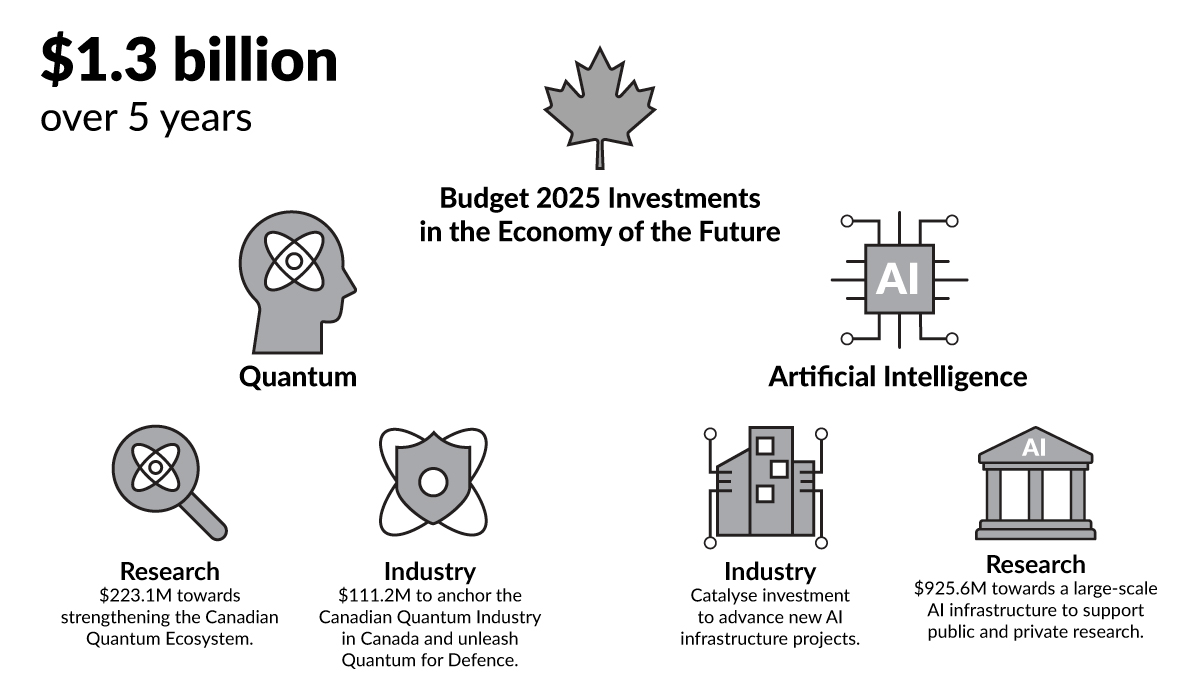
These investments fall under a broader $1.3 billion “Economy of the Future” package, which also funds new research in quantum science for dual-use purposes. The same section of the budget expands the Canada Infrastructure Bank’s mandate to invest in AI infrastructure projects, marking a quiet but important shift: data systems are being treated as public infrastructure. The Minister of Artificial Intelligence and Digital Innovation will also begin working with industry on new agreements for AI infrastructure builds.
Taken together, these moves show how Ottawa’s view of sovereignty is changing. It’s no longer only about territory or resources, but about who controls the data, networks, and computing power that keep the country running.
For the geospatial and geomatics industry, that shift is already familiar. Every map, model, and dataset depends on where data lives and how much trust can be placed in it. A more self-contained digital backbone means better ground to stand on — for mapping, for Earth observation, and for the everyday work of keeping Canada’s information about itself in Canadian hands.
A Sovereign Launch Capability
Among the clearest signals in this year’s budget is a 182.6-million-dollar commitment over the next three years for the Department of National Defence to establish a sovereign space launch capability. It’s a modest sum by global standards, but a landmark step for Canada, and a telling one. By placing the program under DND, Ottawa is treating launch infrastructure as a matter of national security, not just science or industry.
The announcement is expected to create new momentum for companies like Maritime Launch Services in Nova Scotia and Reaction Dynamics in Quebec, both of which have been working toward domestic launch for several years. Beyond its economic value, the measure could also help rebuild Canada’s upstream space ecosystem, from propulsion and integration to mission readiness, while giving the country something it has never had before: reliable, home-grown access to orbit.
Modernizing Meteorology and Earth-Observation Infrastructure
Budget 2025 also provides $2.7 billion over nine years to Environment and Climate Change Canada’s Meteorological Service of Canada to replace its high-performance computing (HPC) systems and add redundant capacity for forecasting. (Budget 2025 – Chapter 4 Modernising the Meteorological Service of Canada)
Though presented as a weather initiative, this is effectively a modernization of the country’s Earth Observation and data-assimilation infrastructure. Modern forecasting depends on satellite imagery, radar, and continuous environmental sensing; upgraded compute power will allow faster integration of EO data for climate modeling, flood prediction, and disaster management.
For the private sector, this expands demand for analytics, modeling, and data-integration services that combine EO and geospatial intelligence.
What’s Not in the Budget (for Now)
The budget puts real money behind space and data infrastructure, but it doesn’t take the next step. There’s no new Earth-observation mission on the books, and nothing new about the RADARSAT Constellation.
The National Space Council, announced in last year’s budget as a way to bring the different departments together, also doesn’t appear. There is no update on who’s running it or what it’s doing.
For now, Canada’s space governance and investment decisions remain spread across multiple departments — Defence, ISED, the Canadian Space Agency, and Environment and Climate Change Canada — with coordination expected to evolve as these new programs take shape.
Dual-Use Innovation and Industrial Renewal
The budget also introduces a $4.6 billion, five-year Defence Industrial Strategy, including $656.9 million through Innovation, Science and Economic Development Canada to commercialize dual-use civilian–military technologies. (Budget 2025, Chapter 4: Protecting Canada’s Sovereignty and Security)
Aerospace and space are explicitly listed among the focus areas. It’s clear the government now sees security and industrial innovation as two sides of the same coin. The logic is straightforward: technologies that make the country more secure also deserve the kind of long-term backing usually reserved for defence programs.
For companies working in Earth Observation and geomatics, this opens practical doors. The same tools used for climate monitoring and resource management are now being applied to areas such as Arctic surveillance, wildfire tracking, maritime awareness, and infrastructure protection. It’s less about creating new programs than about fitting into the ones that already matter.
The 2025 budget casts infrastructure as the engine of national renewal, not just in roads and energy grids, but in the digital systems, data networks, and industrial capacity that will define how Canada competes and defends itself in the decades ahead. It frames this moment as a “generational opportunity,” echoing the post-war reconstruction led by C.D. Howe – a time when building the country meant investing in the tools that made it work.
That vision depends, quietly but completely, on geospatial capability.
- Every new investment, whether be in strategic infrastructure, climate adaptation, or digital systems, starts with data that describes the ground it stands on. From flood mapping and environmental modeling to corridor planning and energy infrastructure, geomatics provides the measurements, analysis, and monitoring that make long-term planning possible.
- The same is true on the digital side. AI systems, automation, and digital twins all rely on accurate, spatially referenced data to function.
- Defence and public-safety initiatives will continue to depend on mapping, positioning, and real-time awareness.
As Canada rebuilds its economic and physical foundations, geomatics is part of that architecture. Surveyors, mappers, GIS specialists, and Earth-observation analysts turn information into operational knowledge — into the evidence that drives construction, policy, and preparedness.
Budget 2025 doesn’t need to spell that out; it’s written between the lines of nearly every investment it makes.



Be the first to comment