
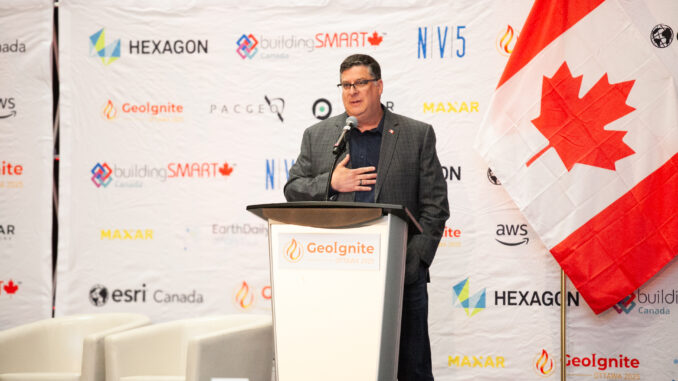
At the GeoIgnite 2025 conference in Ottawa, keynote speaker Keith J. Masback, one of the most recognized leaders in geospatial intelligence (GEOINT), delivered a powerful talk on where GEOINT is heading, and why its evolution is reshaping not just defense, but the way we respond to global challenges.
Masback, a former CEO of the United States Geospatial Intelligence Foundation (USGIF) and a senior leader at the National Geospatial-Intelligence Agency (NGA), offered a rare and candid glimpse into the future of spatial intelligence. Drawing from decades of experience in the U.S. military, government, and private sector, he outlined a path forward that merges AI, remote sensing, and real-time data into a new era of decision-making.
From Static Maps to Living Intelligence
“We are living through a transformation,” Masback said. “GEOINT is no longer about static maps. It’s becoming dynamic, predictive, and embedded in every sector. From national defense to environmental monitoring.”
This evolution is powered by the convergence of technologies: high-resolution satellite data, cloud-native platforms, machine learning models, and global sensor networks. What once took days or weeks to analyze can now be processed in near real-time, enabling governments and industries to act before disasters strike.
The Rise of ‘Composed Intelligence’
Masback introduced the idea of composed intelligence. A framework where human judgment, AI analytics, and spatial data are combined to support better decisions.
“We’re moving into a post-platform era,” he explained. “It’s not about one tool or one agency anymore. It’s about an ecosystem. GEOINT today is about turning data into decisions and doing so responsibly.”
He emphasized the need for human-centered design in GEOINT systems, warning that while AI may be advancing, the human element is irreplaceable. Analysts, policymakers, and even storytellers will play a critical role in interpreting data ethically and communicating it effectively.
GEOINT for the Public Good
A particularly compelling part of Masback’s keynote was his call to apply GEOINT far beyond the military. Climate resilience, wildfire detection, infrastructure monitoring, agriculture, and even public health all stand to benefit from smarter spatial intelligence.
“Geospatial data is no longer just strategic infrastructure,” Masback said. “It’s humanitarian infrastructure. It’s how we build safer, smarter societies.”
A Challenge and Opportunity for Canada
For Canadian professionals in the defense, intelligence, and geospatial sectors, Masback’s insights were both validating and challenging. He underscored the importance of cross-sector collaboration, the adoption of open data principles, and the critical role that Canada’s vast and vulnerable ecosystems play in shaping global GEOINT priorities.
With its Arctic presence, forest reserves, and emerging digital twin programs, Canada is well-positioned but it must lead with innovation, policy, and partnerships.
Masback’s talk concluded on a reflective note: “This is not just a technological revolution. It’s a cultural one. We need to be ready to ask better questions, think beyond borders, and commit to the ethical use of intelligence.”
In a world marked by uncertainty, climate instability, and geopolitical shifts, GEOINT may be one of the most vital tools we have for seeing clearly and acting wisely.


Be the first to comment