
This is the third in a series of interviews exploring Canada’s geospatial education and workforce crisis.
As the federal government accelerates infrastructure and defense investments, a quieter unraveling is underway: college and university programs in geomatics and geospatial science are shrinking, underfunded, or shutting down entirely. While policymakers call for national resilience, industry leaders warn that the skilled talent needed to deliver on those goals is being cut off at the source.
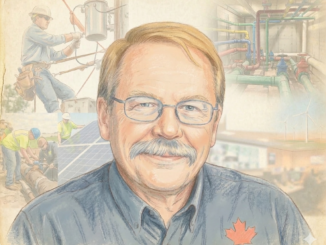
In this instalment, we speak with Dr. Tim Webster, a veteran geospatial educator and applied research leader at the Applied Geomatics Research Group (AGRG), Nova Scotia Community College. With decades of experience across education, research, and industry collaboration, Webster offers a frank assessment of the disconnect between Canada’s stated ambitions — and the weakening pipeline meant to support them.
From your perspective, how would you describe the state of geomatics education in Canada today?
I think all post-secondary institutions are under fiscal pressure right now. Our college is running a deficit, and Dalhousie — the only university in Nova Scotia offering a PhD — is running the largest deficit in the region. Part of this comes from the reliance on international students. NSCC may not be in as much trouble as some, but across the board, colleges and universities are looking for savings — and sometimes that means cutting programs.
It’s short-sighted. This technology is critical to many of the challenges society is facing and will continue to face.
Are you seeing similar cuts across disciplines, or is geomatics particularly vulnerable?
I’m not following all disciplines closely, but what I see is institutions doing the easier things first — not hiring back part-time instructors, cutting labs, not replacing retiring staff. In some cases, they’ll have to go deeper. I wouldn’t say geomatics is being uniquely targeted, but we are expensive. The software isn’t cheap. Surveying gear, drones, computing setups — they all cost money. That makes our programs easy targets when budgets tighten.
Has your own research group been affected?
Not directly. We’re fortunate in that we operate entirely on external funding. We have projects funded through NSERC, but we also do a lot of work for government agencies and private industry. That gives us some insulation. But if broader economic pressures continue, I wouldn’t be surprised if even that becomes harder.
RELATED READ:
- Canada’s Surveying Workforce Crisis: SAIT’s Carina Butterworth on Fixing the Pipeline
- ‘We’re Losing Talent We Can’t Afford to Lose’: NAIT’s Patrick Whitehead on Geospatial Program Closures
- Treat Geomatics Like a National Asset, Not an Afterthought
At the same time, industry is sounding the alarm about talent shortages. How do you explain that disconnect?
It’s real. Employment in this field is strong, and employers want people who can hit the ground running. If you come out of a program ready to work — no need for retraining — you’ll get hired.
But the disconnect might be in the structure of programs. For example, at NSCC we used to offer an advanced diploma. Now it’s a one-year certificate for people who already hold degrees. Those graduates do well in the job market. But I don’t know what employment looks like for students coming straight out of high school with a two-year diploma. That may be where the challenges lie.
What specific roles or skills are in short supply?
We hear a lot about the need for people with a critical eye — not just someone who runs data through software, but someone who understands what the data are saying. There’s also a gap in hands-on technical skills.
For instance, topographic and bathymetric LiDAR operators are in demand. Even if institutions can’t train on every system, going deep on one — understanding the planning, execution, and post-processing — would go a long way. That’s an area we don’t cover right now, but the need is definitely there.
With the federal government committing to massive infrastructure and defense investments, do we have the workforce to deliver?
That’s the contradiction, isn’t it? We’re gearing up for a national build-out — in infrastructure, defense, climate resilience — all of which depend on geospatial intelligence. But instead of expanding the training programs that support that work, we’re cutting the pipeline. Surveying, mapping, remote sensing, GIS — none of it happens without skilled people. And those people come from colleges and universities that are now underfunded or being shut down. If we’re serious about delivering on these national priorities, we need to strengthen the foundations — not weaken them.
What supports or policy changes would help bridge that gap?
Programs that subsidize graduate hiring are useful. They let employers take on someone new at a reduced cost, with less risk. If it works out, great — hire them full-time. CICan, for example, has an internship program we’ve used. More programs like that could make a difference — as long as they’re not overly bureaucratic.
Many of the new roles in geospatial — drone ops, AI-enabled analysis — don’t even show up in official labour codes. How does that invisibility hurt the sector?
It’s a big issue. Geomatics skills are often buried under IT. A drone operator is a remote sensing person. Someone doing machine learning on imagery still needs a geospatial mindset.
If someone in an engineering firm spends half their time doing GIS work, that should be reflected in job classifications. Right now, it’s not. And that invisibility affects everything — funding, planning, workforce projections. We’re doing more with geospatial data than ever before, but we’re not tracking that reality in policy or stats.
ALSO READ: Canada’s Blind Spot: The Government Can’t See Its Own Geospatial Sector
What would it take for geospatial to be recognized as a national strategic asset?
Maybe that’s the problem — it’s everywhere, but it belongs nowhere. It supports so many different sectors that it doesn’t get recognized on its own.
Government could start by issuing challenges — funding real geospatial problem-solving across climate, infrastructure, risk modeling. That would create visibility and also help young people see a future in this field. And we need to be using the best tools, not just what’s safe or standard. Let’s lead, not lag.
How do we get young people into the field in the first place?
Awareness is a huge issue. Most students don’t even know this field exists. Geography as a school subject has lost value. Maybe we need to introduce the tech sooner. Explain how their phones work and apps like how Google Maps happens and what it took to have all that data and connected information. That gets attention.
We also need both entry points — people straight out of high school training as survey techs, and people with science degrees layering on GIS or remote sensing expertise. We need both. Forest inventory with LiDAR, flood risk modeling — these aren’t abstract ideas. They’re critical.
What are your views on the interprovincial barriers regarding licensing?
Those interprovincial barriers should be removed. If someone has a recognized qualification, it should be valid across the country. Trade barriers like that don’t help anyone. We used to have a national lobbying organization that gave Canadian institutions and companies a stronger voice. Something like that again would be useful.
Are there international models we can learn from?
Europe comes to mind. The EU encourages cross-institution collaboration. The European Space Agency is setting standards with open data access. We’ve made progress in Canada — our national LiDAR data is accessible — but something like RADARSAT data is still hard to get. Sentinel data from ESA is far easier. So yes, we could learn a lot from how they do things.
If you had the attention of policymakers today, what’s the one concrete action you’d ask for?
Start using the tools. Really use them. Make decisions based on geospatial data. Fund projects that make this technology visible and valuable. That will drive adoption, attract talent, and build momentum. If students see this tech making a real-world difference — not just sitting in labs — they’ll want to be part of it.


Be the first to comment