
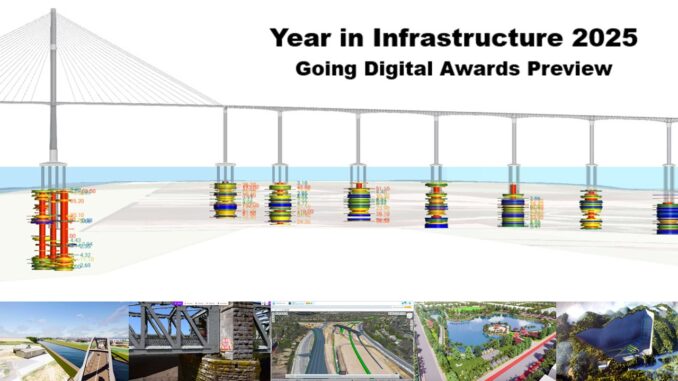
These annual awards showcase the power of digitization in delivering efficiency gains for infrastructure planning, design, construction, and operations.
The Year in Infrastructure – Going Digital Awards selects finalists from global nominations for categories representing innovation in key aspects of the digitalization of the AEC and infrastructure sectors. This is one of, if not the, premier annual global infrastructure awards program. Categories focus on infrastructure industry sectors, which include transportation, energy, facilities, and more, across all phases of the infrastructure lifecycle—planning, design, construction, and operations.
Finalists will make presentations at the event, befordees and a panel of jurors who will select winners. While we do not have the benefit of the presentations from which to select our favorites in advance, based on the submitted project descriptions and what we have been able to find about respective projects online, we’ve highlighted some finalist projects we find intriguing. YII is hosted by Bentley Systems and will be held in Amsterdam, Netherlands, 14-16 October 2025. YII had previously been held in London, Singapore, and Vancouver, Canada in 2024.
Winners and finalists will be honored at the Going Digital Awards gala dinner and featured in the annual Infrastructure Yearbook.
You can check out the finalists for each of the 12 categories, but we’d like to highlight a selection of finalists from several of the categories that substantially include geomatics elements—our “hot picks”, so to speak. It goes without saying that all finalist entries are award-worthy; however, we like to make our picks based on trends in the respective industry sectors that seek to address points of pain that would otherwise have stifled increased productivity.
While the projects themselves are impressive, often from sheer scale and scope, what these awards focus on is the benefits realized by the digitalization of various aspects of the projects, through the use of modeling, visualization, analysis, project management, and collaboration:
Bridges and Tunnels
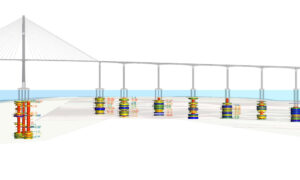
Highlighting advances in geotechnical modelling and analysis software, in support of the Salvador-Ilha de Itaparica bridge project in Brazil. The bridge is part of a new road system that will improve connectivity between Salvador de Bahia and Itaparica Island in Brazil. This past decade has seen a rapid replacement of legacy 2D-based approaches to geotechnical modeling and analysis, with 3D and integration into collaborative project environments.
Finalist firm Sener applied these tools to “generate accurate 3D geological models and perform simulations of soil-structure interaction. Through advanced modeling and analysis, they gained clear visualization and reliable insight into the ground conditions in approximately 10% to 20% less time, compared to 2D-based models.”
Cities, Campuses, and Facilities
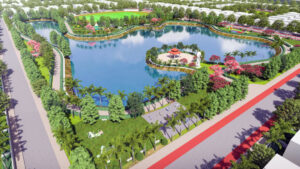
The high-profile project to create the self-sustaining Atal Puram township in Agra India, is impressive in scope and concept. In addition to ambitious environmental and sustainability goals, and as a project, the application of collaborative and construction management tools will yield efficiencies that are key to meeting these goals.
Infrastructure consultancy firm Voyants went full-in on digital twinning, facilitating collaborative modeling and analysis of multiple design options and simulating construction. From their entry summary: “Working in an integrated digital design and construction management platform enabled seamless coordination among the project teams, improving productivity to save 56% in resource hours and INR 7.72 million in costs.”
Construction
The construction sector continues to struggle with efficiency, but not from a lack of earnest effort. There are many internal and external factors. While the sector cannot mitigate some of the external challenges, when it comes to improving efficiency through further automation and digitization, that is something the sector could be much more proactive about. All of the finalist projects in the construction category are splendid examples of what is achievable.
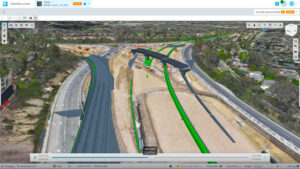
A tough choice, but our nod would go to ACCIONA for the M80 Ring Road project near Melbourne, Australia. There have been quite a few Melbourne area projects featured in these annual awards. Due in part to the sheer number of projects in the region, modernizing aspects of infrastructure that have long been neglected. Plus, there is widespread adoption of advanced AEC tools and approaches, especially digital twin and project management software.
Energy Production
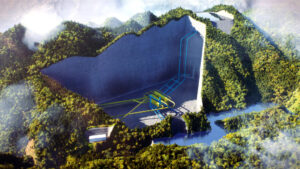
Embarking on a project for a relatively new type of infrastructure means working out new approaches. To achieve tight workflows and engineering efficiencies for the Caiziba pumped storage (a growing solution for energy storage) power station in Fengjie, Chongqing, China, Shanghai Investigation, Design & Research Institute Co., Ltd. employed a slate of digital approaches and solutions. 3D modeling, digital twin, construction simulation technology, a collaborative digital platform, and component libraries.
In their entry summary, the firm shared estimates of as many as “1,850 conflicts avoided, representing rework costs of approximately CNY 4.5 million ($630K USD). The integrated digital twin solution shortened the construction period by 42 days and optimized steel and concrete usage, reducing carbon emissions by 11,110 tons.”
Geospatial and Reality Modeling
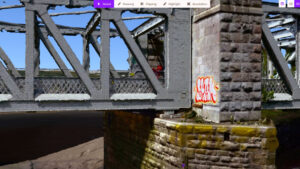
Digital twins, developed from rich reality capture datasets, are a boon to asset mapping, management, condition assessment, monitoring, and operations. Mott MacDonald captured key elements of Bristol Harbor in the UK employed Cesium to bring present assets into a common, web-based platform, accessible to the client and stakeholders to view asset defects.
Project Delivery
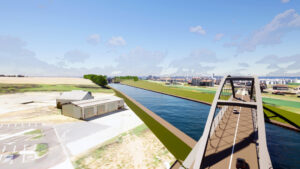
This is where efficiencies could be realized rapidly by the AEC sector. Egis brought the power of BIM to nearly 400 project collaborators for the Canal Seine Nord Europe project.
From Egis’s entry summary: “Working in a connected digital platform reduced model generation time by more than 60% and increased overall productivity by more than 40%. The model provides an as-built record of the canal for long-term asset management.”
Rail and Transit
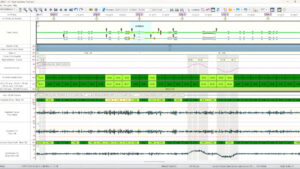
PT Kereta Api Indonesia (Persero) is the owner and operator of 7,000 kilometers of rail in Indonesia. The firm went the digital twin route to modernization. This to facilitate predictive network maintenance and enable smarter asset management.
Roads and Highways
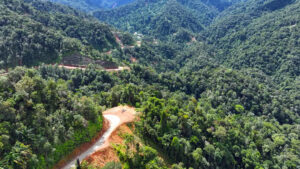
Jabatan Kerja Raya Sarawak (JKRS) went fully digital across the design and construction phases of Sarawak Sabah Link Road Phase 2, which serves a remote region of Malaysia.
Check out the other categories—all of the finalist projects are outstanding.
Note: the YII 2022 Going Digital Awards nominees, finalists, and winning projects all feature the use of one or more Bentley Systems software packages (the host of the awards program).



Be the first to comment