
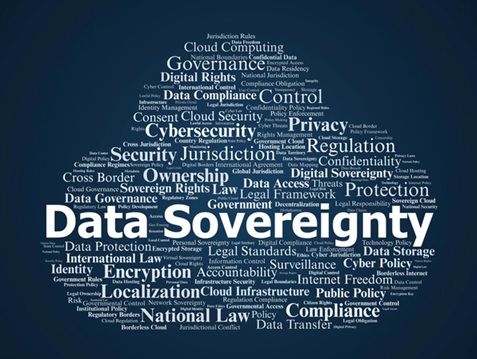
“Data is the new oil.”
Just as petroleum and electricity powered and transformed the 20th century, data is now driving the digital paradigm and shaping the global economy of the 21st century. It fuels innovation, competitiveness, governance, and national security.
Raw crude oil has little value until it is refined. Similarly, raw data must be processed, stored, and analyzed to unlock its true potential. AI, advanced computing, and data centers are the refineries of the digital age—transforming raw data into intelligence and economic power
From healthcare records to energy grid analytics, our most sensitive data increasingly resides beyond our borders. When Canadian data is stored on foreign soil, it falls under foreign laws and regulatory frameworks. This raises legitimate concerns about sovereignty, privacy, and national security.
Our natural resources are proudly wrapped in the Canadian flag. It is time to treat our data with the same strategic importance. To secure our digital future, we must invest in sovereign data infrastructure—Canadian-owned data centers, cloud platforms, and AI capabilities.
It is time to wrap our data in the Canadian flag.
Why Now in 2026?
Data sovereignty is not theoretical nor a legal policy that can be achieved in distant future. It is a new reality. It is crucial for national security.
Canada has remained heavily dependent on the United States for data storage, cloud services, and AI infrastructure. A significant portion of Canadian data resides on servers owned and operated by ‘Big three’ Microsoft, Amazon, and Google. This reliance creates a strategic vulnerability.
As geopolitical dynamics grow more volatile and longstanding alliances evolve, Canada must take a clear-eyed and strategic view of the global landscape. In an era of shifting power structures and uncertainty, resilience is no longer optional—it is essential.
Reducing external dependencies and investing in sovereign compute infrastructure is a prudent and forward-looking course of action. By strengthening our domestic digital foundations, we enhance national security, protect economic interests, and ensure that Canada remains agile and self-reliant in an increasingly unpredictable world.
Canadian Advantage :Cold and Clean
Canada’s geographic breadth and political diversity do not confine it to a single path toward sovereign data infrastructure. On the contrary, these strengths create a unique combination of advantages that position the country to succeed. I have listed a few here:
Energy Efficiency
Hydroelectricity generates approximately 59.3% of Canada’s electricity supply, making the country the world’s third-largest producer of hydropower. While many nations struggle to meet the immense energy demands of data centres, Canada has a distinct advantage: a low-carbon electricity that can power energy-intensive AI infrastructure at comparatively lower cost.
Cold-Climate Advantage
Canada’s naturally cooler climate provides a built-in efficiency benefit for data centres. Since thermal management represents a significant operational expense, access to ambient cold air reduces cooling requirements, lowers energy consumption, and improves…………
Competitive Edge in Sovereign AI
By developing its own AI infrastructure, Canada can accelerate the growth of “made-in-Canada” AI solutions, designed in alignment with Canadian values, regulatory standards, and ethical frameworks. A strong sovereign AI ecosystem will be an attractive destination for global investment seeking stable, responsible, and sustainable AI development.
Economic Benefit
The Canadian Institute for Health Information estimates that improved domestic access to health data alone could generate more than $10 billion annually in economic value. The same principle extends across the broader economy—including clean energy, education, finance, AI research, and advanced manufacturing.
The Concerns (The “Catch-22”)
Building sovereign data centers in Canada is an ambitious vision—one that comes with significant challenges. Behind the scenes, vast halls of servers, stacked in endless rows and illuminated by flickering lights, operate around the clock, processing complex algorithms and transforming data into actionable insight.
Such infrastructure demands substantial investment, long-term commitment, and careful navigation of economic, technological, and policy trade-offs.

- For example, telecommunications company Bell Canada has announced plans to develop a data centre campus on approximately 65 hectares of land. The facility is being positioned as critical digital infrastructure that would support research, provincial AI initiatives, and federally regulated and protected industries.
- However, the proposal has prompted concerns among local landowners in the Rural Municipality of Sherwood. A primary issue is water usage. Community members are questioning how the data centre’s substantial water requirements will affect local resources, particularly whether the project will rely on groundwater extraction or draw from the municipal water supply.
- Additional concerns raised with the municipality include potential noise pollution, impacts on local drainage systems, and increased pressure on road infrastructure resulting from construction and ongoing operations.
- As discussions continue, residents are seeking clarity on environmental safeguards, infrastructure planning, and long-term community impacts associated with the development.
The Geospatial Backbone of Sovereign AI
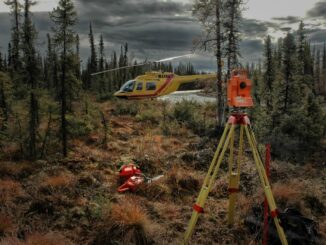
“Everything happens somewhere.” Every event has coordinates, context, behaviour patterns, and demographic realities. Location intelligence transforms these elements into insight—guiding site selection, informing environmental planning, and strengthening community involvement.
Building a sovereign data center larger than 100MW is an immense logistical puzzle. Geomatics is used to map the “perfect intersection” of:
- Site Selection as the Foundation: The success of a data center begins with selecting the right location. A rigorous evaluation of the landscape and surrounding environment—measured against technical, environmental, and operational criteria—requires significant time, expertise, and strategic investment.
- Seismic Stability: Geographic Information Systems (GIS) enable precise identification of low seismic-risk zones and avoidance of major fault lines, strengthening infrastructure resilience and supporting 99.999% uptime standards.
- Hydrological Assets: Spatial analysis allows for accurate mapping of sustainable water resources to support advanced cooling technologies, including liquid cooling systems and potential hydroelectric integration.
- Climate Modeling: By integrating historical weather data with predictive climate analytics, long-term free-cooling potential can be assessed across a 20-year horizon, improving efficiency and cost forecasting.
Across these complex, interdependent variables, GIS tools demonstrate their full value—transforming layered geographic data into actionable intelligence for high-stakes infrastructure decisions.
The infrastructure that will define our Future
Sovereign data infrastructure carries economic weight and national security consequences. Countries that control their own data systems will set the terms of the digital economy.
Canada has the capacity to be one of them. Doing so will require deliberate investment, coordinated action, and long-term thinking.



Be the first to comment