
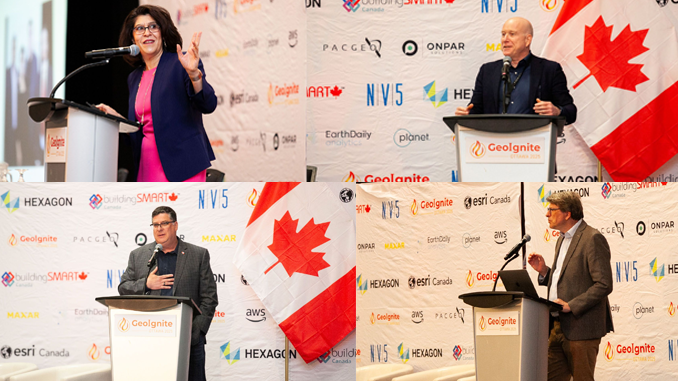
This year at GeoIgnite 2025, the keynote stage wasn’t just about showcasing the latest tech. It became a space for asking tough questions:
- What’s holding back real-world impact in geospatial research?
- Can AI be trusted with critical decisions?
- How do we balance national security and open collaboration?
- And what does it really mean to lead during a climate crisis?
Four standout speakers — Nadine Alameh, Peter Rabley, Alexander Verbeek, and Keith Masback — each brought a unique perspective. But together, their messages traced a bigger story: that Canada’s geospatial sector is standing at a crossroads, and the next move matters.
Nadine Alameh: Rewriting the Geospatial Narrative
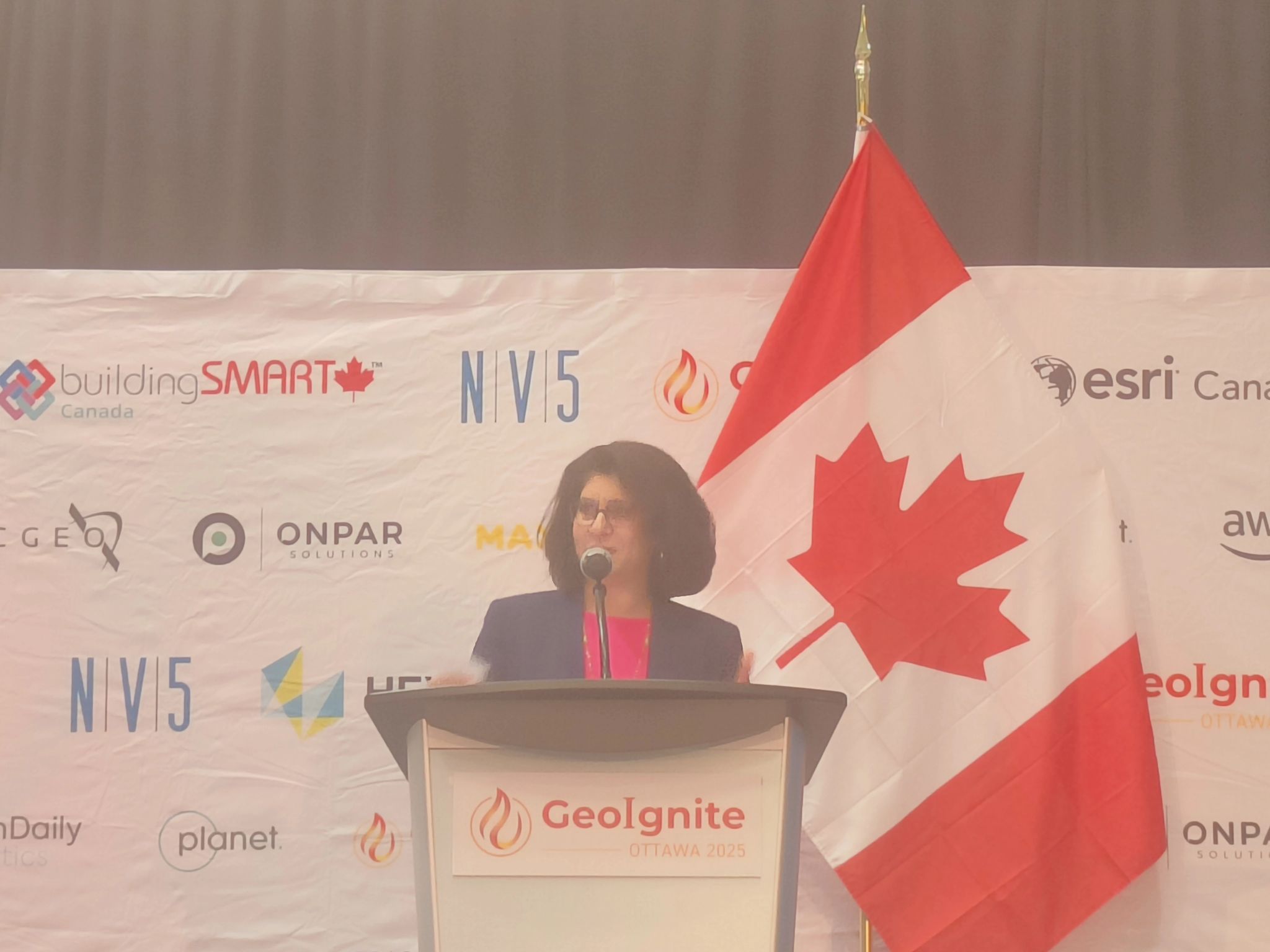
Nadine Alameh, global leader in geospatial innovation and Executive Director of the Taylor Geospatial Institute, opened her address with a challenge — stop celebrating fragmentation and start designing for impact. Her keynote called out the persistent gap between innovation and implementation in geospatial science.
She focused on how today’s biggest problems — climate change, food insecurity, disaster response — demand collaborative, interdisciplinary work that transcends institutional boundaries. Nadine emphasized that research, policy, and commercialization must be connected with intent.
“We don’t need more innovation for innovation’s sake,” she said. “We need to ask: are we building what people actually need?”
She also praised the nonprofits in the geospatial sector working behind the scenes to keep data open, standards aligned, and partnerships alive. Her call to action was simple but powerful — focus less on what’s possible and more on what’s useful.
Peter Rabley: Will AI Eat Geospatial?
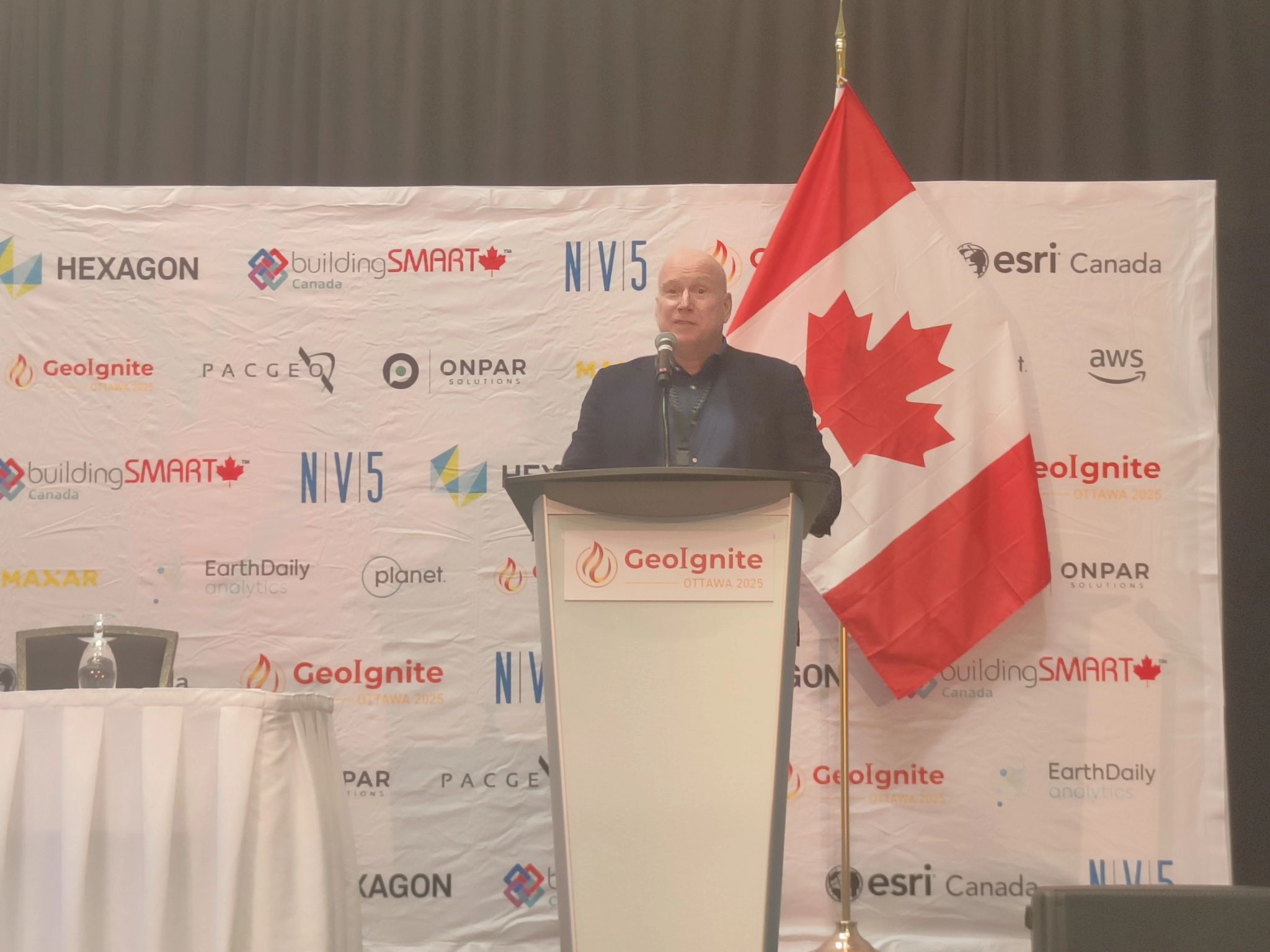
Peter Rabley, CEO of the Open Geospatial Consortium (OGC), posed the question no one could ignore: Will AI eat geospatial? He walked the audience through the promise and pitfalls of AI — from generative models and reasoning engines to the very real risk of fabricated results and broken trust.
“We have to know where the data came from. We have to know why the model made a decision,” Rabley said. “Otherwise, we’re building on sand.”
He didn’t dismiss AI — far from it. But his point was clear: speed must not come at the cost of transparency, accountability, or interoperability. The solution? Open standards, strong data governance, and industry-wide collaboration.
He also highlighted the urgency of dealing with fragmented metadata, untrusted pipelines, and black-box systems that can’t explain their outputs.
Alexander Verbeek: Our House is on Fire

Alexander Verbeek, Founder, Institute for Planetary Security, and Policy Director, Environment & Development Resource Centre, delivered one of the most emotionally resonant talks of the conference. His keynote, Mapping Our Planetary Future, explored the role of geospatial intelligence in navigating climate disruption and environmental risk.
He pointed out that while global instability is rising — trade wars, geopolitical conflicts, supply chain crises, food insecurity — climate change remains the greatest threat of all, and it isn’t waiting.
“We’re fighting about everything else, while our house is burning,” Verbeek said.
Drawing on Dutch-Canadian examples, he shared how Earth Observation tools and spatial analysis are helping cities adapt to sea level rise, manage water resources, and protect biodiversity.
Verbeek ended his talk with a reference to Carl Sagan’s Pale Blue Dot — a moving reminder of why the stakes are so high.
Keith Masback: GEOINT and the Strategic Edge

In his keynote, Keith Masback, global expert in geospatial intelligence, took the audience on a compelling journey through the deep history of how humans have always sought to understand their environment.
He opened with an example from a cave near Paris, where early humans carved what appears to be a 3D representation of terrain and water flow — a striking reminder that the instinct to map and analyze our surroundings is ancient. From Mesopotamian stone maps to the strategic value of high ground, Masback traced a continuous thread of geospatial thinking that has evolved alongside technology.
That search for vantage point moved from hilltops to horseback, then to aircraft and eventually to satellites — each shift expanding how we gather and use spatial intelligence.
Masback also shared how modern GEOINT took shape through the merger of imagery and mapping operations in the U.S. defense and intelligence communities, and the creation of the National Imagery and Mapping Agency (NIMA), now known as NGA, a move that set the stage for today’s integrated geospatial intelligence capabilities.
His message underscored the fact that GEOINT is rooted in history, but must constantly evolve — not just to meet strategic needs, but to anticipate them. From caves to satellites, it’s the same drive: to see more, understand faster, and act smarter.
The Common Thread: Lead With Purpose
Across all four keynotes, one message stood out: the geospatial sector has matured, but leadership is what’s needed next.
That means:
- Turning research into real-world action (Alameh)
- Building trust and governance into AI systems (Rabley)
- Prioritizing environmental security (Verbeek)
- And strengthening Canada’s global role in GEOINT (Masback)
As the industry evolves, these speakers reminded us that leadership isn’t just about having the best tech. It’s about asking the right questions, bringing the right people to the table, and never losing sight of what the data is ultimately for: the people and the planet we serve.


Be the first to comment