
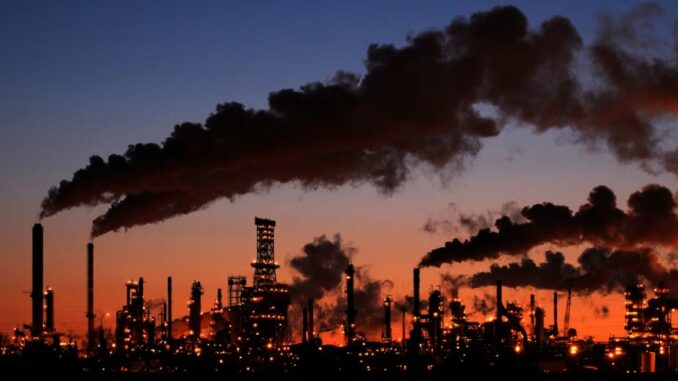
Reaching net-zero emissions means that Canada’s economy either produces no greenhouse gases or offsets any emissions through actions such as planting trees or using carbon capture technologies. Achieving net-zero is essential to ensure a safe and sustainable future for generations to come.
What is Canada’s plan to reach its net-zero target?
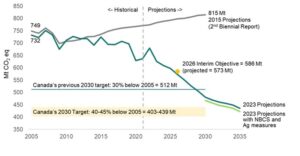 Courtesy: Government of Canada
Canada has committed to reducing its greenhouse gas emissions by 40 to 45 percent below 2005 levels by 2030 in line with its Paris Agreement pledge. This commitment is enshrined in the Canadian Net-Zero Emissions Accountability Act, enacted in June 2021, which legally binds Canada to reach net-zero emissions by 2050. The Act also emphasizes transparency and accountability, requiring public engagement and guidance from independent experts to help shape federal climate strategies.
Are we going to be “climate competitive” and still focused on hitting net-zero emission by 2050? Climate Change Institute, Canada has the answers.
Are we on track to be “climate competitive” by 2050?
According to the Climate Change Institute, Canada, progress has recently stalled. The Early Estimate of National Emission, shows that Canada’s emissions in 2024 remained at 694 megatonnes of CO₂, the same as in 2023 — indicating no measurable progress toward the national reduction targets.
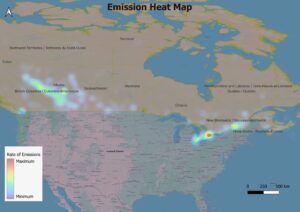
Data Courtesy: 440Megatonnes
Although certain sectors, such as electricity and buildings, sustained reductions in emissions in 2024, the overall progress remained limited and was outweighed by increased emissions from the oil and gas industry, notably from oil sands production. In total, emissions from oil and gas increased by 1.9 percent, representing 31 percent of the national emissions total in 2024..
In its report, the institute says Canada’s progress toward lowering its emissions is “fragile.”
Federal and provincial policy taking a back seat towards combating climate change effect have put Canada’s progress toward net-zero emissions in jeopardy. Not just one, but several factors which includes repealing consumer carbon tax, delays in federal and provincial electric vehicles policies and weakened industrial carbon pricing in several provinces.
Additionally, the anticipated expansion of natural gas production could freeze in emission intensive growth for many upcoming years. Clearly, even the 2035 interim target now appears uncertain at this point.
- Oil and gas: 9% rise in emission compared to the previous year, primarily attributable to a 3.4% rise in emissions from oil sands operations.
- Transportation: 7% reduction in emissions, maintaining a gradual downward trajectory observed since 2023.
- Buildings: Emissions from buildings decreased by 1.2%; however, this decline occurred at a slower rate than in the prior year, influenced by a colder winter season.
- Heavy industry: Emissions here declined by 1.2%, indicating progress toward decarbonization, although outcomes varied across different sub-sectors.
- Electricity: The electricity sector saw a 1.9% reduction in emissions, reaching levels 59 percent below those recorded in 2005, underscoring the critical role of coordinated federal and provincial policies alongside technological advancements.
Mapping the way forward
Canada’s emissions may have plateaued in 2024, but this national stagnation masks a deeper, more complex story.
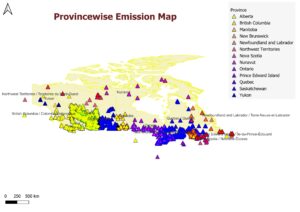 Data Courtesy: 440Megatonnes.ca
As this geospatial analysis using emissioin data from until 2023 shows, emissions trends across the country, some provinces and sectors have made meaningful strides, particularly in electricity generation and buildings, rising emissions from oil and gas operations, especially in Alberta and Saskatchewan, continue to offset national gains.
The outcome is a patchy picture of climate advancement: some provinces are leading in cutting emissions, others are opposing federal policies, and many are dealing with distinct economic and infrastructure issues. This uneven distribution highlights an important fact: Canada’s climate targets cannot be achieved by federal efforts alone; they need customized, region-specific strategies that account for local conditions.
For Canada to progress beyond its current stagnant emissions pathway, it is imperative to adopt a coordinated yet spatially differentiated strategy — one that identifies the most significant challenges and capitalizes on the areas with the greatest potential for advancement.
The Road Ahead: A Collective Effort
Climate change is no longer an abstract problem — it’s a visible, measurable reality shaping Canada’s environment, economy, and way of life. Canada’s path to net-zero by 2030 is still within reach — but only if everyone moves in step. The public sector must lead with clear policies, investments, and accountability, while the private sector accelerates clean innovation and scales up climate-friendly technologies.
Communities and individuals also have a role to play, from rethinking how we consume energy to supporting sustainable choices in everyday life. Together, these actions can turn stalled progress into momentum.
Reaching net-zero isn’t just a government mandate, it’s a shared mission. If public ambition, private innovation, and citizen engagement align, Canada can still hit its targets and define what true climate leadership looks like on the global stage.


Be the first to comment