
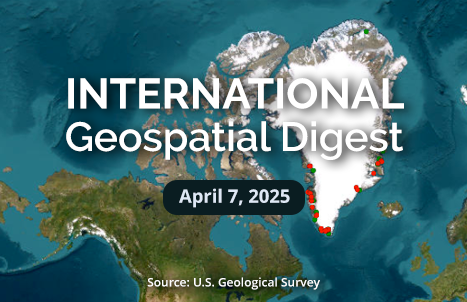
- Greenland Map Showing ‘Strategic Resources’ Eyed by USA, China
- Mapping the Destruction from the Myanmar Earthquake
- Apple Maps Adds More Than 250 Indigenous Placenames in Australia
- Stormy Rains in the Sahara Offer Clues to Past and Future Climate Change
- EU Space Act and its Potential Influence on the Future of Space Traffic Management
- Smartphone Data May Help Improve GPS
Greenland Map Showing ‘Strategic Resources’ Eyed by USA, China
The US administration’s renewed interest in acquiring Greenland stems largely from its vast mineral wealth, particularly rare earth elements crucial to national security and green technologies. A Newsweek report highlights the region’s strategic value amid growing competition with China and Russia over Arctic shipping lanes and critical mineral access. This article features an interactive map that allows users to navigate between all the currently known mineral deposits found throughout Greenland, highlighting rare and common earth metal deposits. While U.S. companies like Critical Metals move to secure mining rights, resistance from Greenland and Denmark—as well as infrastructure and environmental challenges—complicate American ambitions. For geomatics professionals, Greenland’s untapped resources and geopolitical significance underscore the critical role of spatial analysis in resource management and Arctic policy planning.

Interactive map of Greenlands mineral deposits. Source: ESRI/Newsweek
Mapping the Destruction From the Myanmar Earthquake
The 7.7-magnitude earthquake that hit Myanmar on March 28 is the most powerful earthquake to hit the country in over a century. The confirmed death toll has now exceeded 3000 people as international rescue efforts are still underway. Satellite imagery reported by both CNN and the BBC has allowed for a dramatic visualization of the destruction caused by this earthquake. The epicenter of this earthquake was near the city of Mandalay, Myanmar, however shaking was felt as far away as Bangkok, Thailand, roughly 1000 kilometers away.

Shakemap showing the intensity of surface shaking after the 7.7-magnitude earthquake in Myanmar. Source: Reuters
An article by Reuters, viewed in full here, shows footage of a building collapsing as well as a shakemap of the event, depicting the surface-level shaking intensity across the region. It is estimated that the economic impact of this earthquake could be as high as 70% of Myanmar’s GDP with fatalities ranging between 10,000 and 100,000 people.
Apple Maps Adds More than 250 Indigenous Placenames in Australia
Apple Maps has launched a major update in Australia, incorporating more than 250 dual placenames and displaying the traditional custodians of the land, marking a significant step toward Indigenous recognition in digital mapping. Developed in collaboration with Indigenous groups, local language holders, Aboriginal lands trusts, and ranger groups, this initiative also highlights protected areas and offers cultural context through “place cards” curated by local communities. The project follows similar updates in Canada and the U.S. and aims to support truth-telling, language revitalization, and cultural education. As traditional mapping intersects with Indigenous knowledge, this move underscores the evolving role of geomatics in promoting reconciliation and representation. To view the full story, click here.

A child uses a tablet to view Apple Maps. Source: Apple
Stormy Rains in the Sahara Offer Clues to Past and Future Climate Change
A new study in Hydrology and Earth System Sciences reveals how rare Atlantic-driven storms are responsible for filling the normally dry Sebkha El-Melah Lake in Algeria. Analyzing data from 2000 to 2021, researchers found only six substantial lake-filling events—despite hundreds of storms—were linked to persistent extratropical cyclones along the North African coast. These findings, reported here, challenge the long-held belief that the Sahara’s ancient lakes were mainly filled by southern monsoons, instead emphasizing a “recycling-domino effect” of moisture from the Atlantic. The research offers key insights into past and future hydrological shifts in arid regions, especially as climate change may increase extreme storm events and reshape desert water availability.

Lake Sebkha el Melah of northwestern Sahara. Source: Landsat 9/phys.org
EU Space Act and its Potential Influence on the Future of Space Traffic Management
The EU’s 2025 Space Act will shift global space governance from voluntary to mandated regulations, impacting US companies. Aiming for strategic autonomy and a unified market, it will harmonize 12 member states’ space laws. Key provisions include mandatory collision avoidance, active tracking, and standardized licensing. Information-sharing, cybersecurity, and minimum deorbiting standards are also expected, alongside environmental protections.

A photo of the European Commission. Source: European Commission
With a $3 billion annual space investment, which is set to double, the EU seeks global space traffic management leadership. Binding regulations will apply to all operators within its market. This Act redefines international space law, challenging the US preference for voluntary practices and establishing a new model for space safety and sustainability. For more information and to view the entire article, click here.
Smartphone Data May Help Improve GPS
Smartphones are now mapping the Earth’s ionosphere, a turbulent atmospheric layer crucial for GPS accuracy. The ionosphere’s charged particles, influenced by sunlight, weather, and solar activity, can disrupt radio signals, causing GPS errors.

Map of global Ionization levels made using cellphone data. Source: snexplores.org
Traditional ground-based monitors, while vital, are costly and leave coverage gaps, especially in Africa and South America. Researchers utilized GPS signals from millions of Android phones, effectively doubling global ionosphere mapping coverage.
Published in Nature, this crowdsourced data revealed ionospheric anomalies, including charged gas bubbles over India and solar storm-induced particle density over North America. This enhanced mapping promises improved GPS precision for various applications and facilitates new ionospheric research. This method offers a cost-effective way to gather data and fill gaps in current research. Click here to view the full article.

Be the first to comment