
Setting the Stage: Objectives and Framework
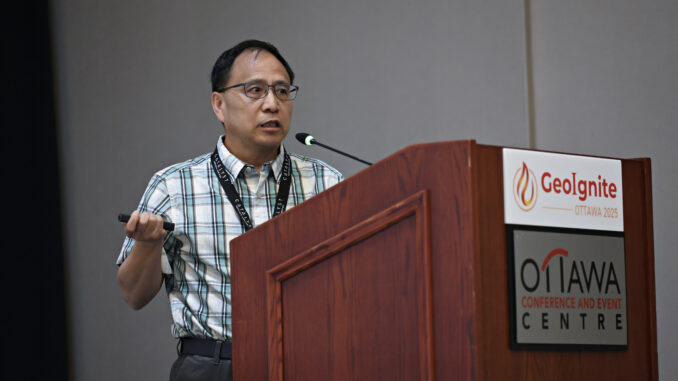
Dr. Wang began by outlining the dual objectives guiding his research team. First, they aim to advance scientific and technological applications of Earth observation in water-related studies. Second, they seek to produce long-term, national-scale baseline datasets essential for understanding Canada’s freshwater systems. These datasets support a wide array of end users, including researchers, resource managers, policymakers, and socio-economic analysts.
The scope of the team’s research spans the full terrestrial water cycle, covering variables such as surface water, soil moisture, groundwater, and snowmelt. They adopt a hybrid methodological approach that combines direct satellite observations with physically based land surface modeling. This integration allows for both the retrieval of observable data and the estimation of otherwise unobservable parameters like groundwater changes and evaporation rates.
Leveraging Satellite Data for Water Research
Dr. Wang introduced key satellite missions used in his team’s research. Foremost among these is the GRACE (Gravity Recovery and Climate Experiment) mission, which uses paired satellites to detect changes in Earth’s gravity field, thereby estimating variations in total water storage. Canada’s water loss, as detected by GRACE data from the past 22 years, reveals concerning trends:
- Glacial and Permafrost Regions: Significant water loss was recorded in western and central Canada due to glacial melt and permafrost degradation.
- Water Storage Trends: While some areas like Eastern Canada have seen net water gains, the overall national trend indicates a steady decline, averaging a loss of 11 millimeters of water per year. In total, Canada has lost the equivalent of 1.6 times the volume of Lake Ontario in freshwater, contributing to approximately 8.5% of global sea-level rise during that period.
- Developing a National Water Dataset with Landsat
Canada previously lacked a high-quality, monthly-resolution water dataset at the national scale. Dr. Wang’s team addressed this gap by leveraging the long observational history of the Landsat program (dating back to the early 1970s). Their goal was to develop a reliable, gap-free dataset for analyzing seasonal and interannual changes in surface water coverage.
Unlike global products that suffer from errors (e.g., misclassification of frozen lakes as land), their custom system integrates terrain and climatic considerations to deliver more accurate classifications. The resulting data enables the calculation of water occurrence frequency at pixel level, providing insight into how often a given area was covered by water over the past 40+ years.
Some findings included:
- Prairies: Despite common assumptions of increasing dryness due to climate change, the prairies have shown a net increase in water over 40 years, with short-term drying trends seen only in the last decade.
- Regional Analysis: The team has been able to break down water dynamics across provinces and watersheds, revealing nuanced, location-specific insights.
Dr. Wang also presented case studies differentiating the effects of climate change and human activity. For example:
- Glacier-fed Watersheds: Continuous water area loss since 1991, driven by glacial melt.
- Hydropower Development: A dramatic decrease in lake area in affected regions due to damming and reservoir management.
These examples underscore the need for datasets that can support integrated watershed-scale hydrological assessments.
Soil Moisture, Water Level, and Land Deformation
The session moved into discussions on other hydrological variables:
- Soil Moisture: Derived from passive microwave satellites like AMSR and SMAP, the data was downscaled to field-level resolutions (~1 km) using a proprietary tool.
- Water Levels: Laser altimetry from ICESat-2 and LIDAR data were combined with radar interferometry (InSAR) to account for seasonal effects such as ice cover, enabling year-round water level estimation.
- Surface Deformation: In contrast to common cases where water extraction leads to surface subsidence, parts of Ontario show surface deformation caused by water loading, demonstrating the vertical sensitivity of satellite remote sensing.
Perhaps the most ambitious part of Dr. Wang’s work lies in using models to estimate unobservable hydrological processes:
- Evaporation and Sublimation: Estimates of land-atmosphere water fluxes are key to understanding Canada’s hydroclimate.
- Groundwater Recharge: Data from permafrost zones showed increased recharge due to thawing, while arid zones remained largely stagnant.
- Dischargeable Water Storage: A novel metric introduced by the team, it indicates the amount of water available in an aquifer before river flow ceases.
By combining satellite-derived parameters with model-based simulations, Dr. Wang’s team can calculate water budgets at watershed and national levels over monthly and decadal timescales. These budgets act as diagnostic tools to assess the completeness and accuracy of the available hydrological knowledge.
Implications and Future Directions
In summarizing, Dr. Wang emphasized that Earth observation combined with robust modeling has transformed Canada’s ability to monitor and understand its water systems. Their datasets, extending over 30 to 40 years and updated at monthly intervals, support not only science and environmental management but also governance and infrastructure planning.
He concluded with a call to recognize the importance of innovation in satellite applications and to support sustained collaboration between government, academia, and technology providers. As Canada faces mounting water challenges, both from climate change and anthropogenic pressures, the tools and insights developed by Dr. Wang’s team will be central to crafting resilient water policies.

Be the first to comment