
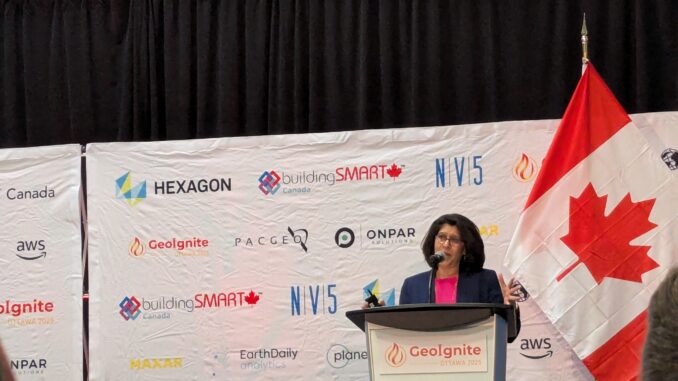
In this keynote address for GeoIgnite 2025 in Ottawa, Dr. Nadine Alameh reflected on the dramatic transformation in technology and the geospatial profession over the past five years, using a personal lens — starting with a story about her children — to highlight the generational shifts that are reshaping how we interact with the world.
She said that this generation exemplifies a new paradigm: digital-first, highly connected, and driven by on-demand learning and creation.
Today we are ‘Lucky’ to be in this era of Geospatial
Alameh emphasized that today’s professionals are “lucky” to have access to powerful cloud-native tools, open-source software, vast datasets, and game-changing AI models. Tools like QGIS plugins, Google Earth Engine, and platforms such as Cesium and Unreal Engine enable not only data analysis but also immersive spatial simulations.

The central message of her talk was that we are living in a uniquely privileged moment in the evolution of geospatial capabilities.
Also, AI and foundation models—originally developed for other industries—are now being creatively applied to geospatial challenges, enabling new workflows in mapping, disaster response, and spatial reasoning.
AI is coming for Geospatial
Another central concern that was conveyed by Nadine was the growing convergence between the AI and geospatial worlds. At global AI conferences, geospatial problems are being tackled—often without the presence or terminology of the geospatial community. She called it a wake-up call: geospatial professionals must be at the table in shaping AI policy, applications, and ethical guidelines.
Ethics and Digital Divide
Alameh sent a message highlighting the role of nonprofits and community-based organizations as key to ensuring inclusive development because, despite the technological capabilities growing rapidly, most of the world’s population — particularly in the Global South — lacks access to these tools.
Bridging gaps
Later, Alameh’s talk also points to a persistent gap between academic research and industry needs. Often, researchers and developers are not aligned, leading to inefficiencies and lost potential. The speaker calls for stronger bridges between academia and commercialization, especially at a time when both sectors are encountering AI from similar starting points.
In essence, the keynote emphasizes the importance of collective leadership, encouraging the community to break down barriers, reconsider conventional roles, and work together intentionally. This involves rethinking education, investing in workforce development, engaging in global policy dialogues, and adopting ethical guidelines such as the Locus Charter.
Alameh ended the talk with a rallying cry: “Let’s Geoignite. Let’s spark innovation, leadership, and inclusive progress together, to build a smarter, more ethical, and globally connected geospatial future.”

Be the first to comment