
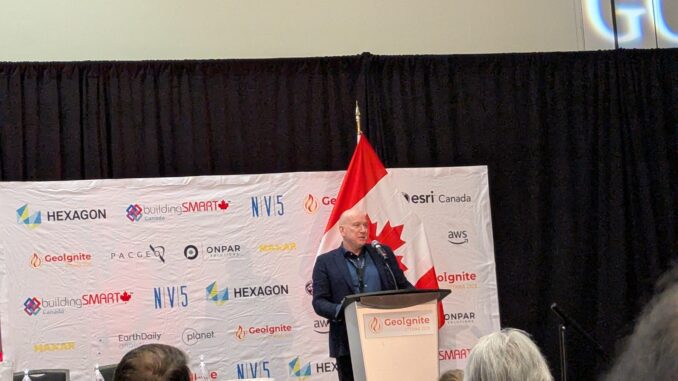
At GeoIgnite 2025, Peter Rabley, CEO of the Open Geospatial Consortium (OGC), took us through a lively, thought-provoking talk exploring the collision between artificial intelligence (AI) and the geospatial industry and oscillating between dystopian warnings and hopeful opportunities.
Peter navigated between optimism and concern, offering a whirlwind of insights, stats, and anecdotes about “Will AI Eat Geospatial?” as a central theme.
The Overstated Claims of AI Compared to Actual Challenges in Practice
Rabley made a striking claim:” 80% of AI initiatives do not succeed”. He later talked about how news articles often highlight progress, but the truth is more complex. He mentioned that a large part of the current AI boom might be built on shaky technical and ethical grounds. In the meantime, major technology companies like Meta, Microsoft, and Amazon are intensifying their efforts by pouring hundreds of billions of dollars.
Rabley raised a powerful question: What happens when AI makes a decision you can’t appeal? As automation expands, concerns over privacy, accuracy, and accountability grow louder.
“Will we be told, ‘That’s just what the machine says,’ and have no recourse?” A thought-provoking question by Rabley.
When AI Meets Geospatial
What is the significance of GIS in this transformation? It is at the forefront of this evolution. Rabley shared an intriguing case study from Spain where artificial intelligence outperformed traditional stereo-plotting in detecting structures from aerial images, achieving this in just a quarter of the time and cost, while also yielding superior results.
Will AI replace our jobs?

Not quite! According to Peter, AI is expected to take over tedious and repetitive tasks, enabling smaller teams to concentrate on more valuable work. However, this transition comes with challenges. Companies will have to retrain employees, reevaluate their workflows, and redefine the concept of value in a landscape where machines do the bulk of the work.
Ethics, Environment, and Equity
Rabley addressed the broader implications of AI. He highlighted the significant environmental impact of AI, noting that data centers require enormous amounts of energy and materials like steel, as well as issues related to copyright infringement and the concentration of power among tech-savvy elites.
He concluded with a compelling idea: it is essential for governments to safeguard the public interest. We might even need to consider if “universal basic computing” should be recognized as a right in the era of AI.
Concluding Reflections: Optimism Amidst Turmoil
Despite the significant challenges ahead, Peter holds a measured sense of hope. The transition may be chaotic, and mistakes are inevitable. However, if we move forward with careful consideration—implementing ethical guidelines, robust governance, and a focus on human-centered design—GeoAI has the potential to transform our understanding and engagement with the world.
“AI is similar to a Roomba. It’s useful, but it still requires a human to clean up the crumbs.”
Ultimately, AI may not replace geospatial technology; instead, it could enhance its capabilities. Are you ready to embrace this change?


Be the first to comment